
SOPHIA RARE BOOKS
Koebenhavn V, DNK
 More images
(1) MEITNER & FRISCH, 'Disintegration of Uranium by Neutrons: a New Type of Nuclear Reaction,' pp. 239-240, in Vol. 143, No. 3615, 11 February 1939 [PMM 422b]; (2) FRISCH, 'Physical Evidence for the Division of Heavy Nuclei under Neutron Bombardment,' p. 276, in No. 3616, 18 February [PMM 422c]; (3) BOHR, 'Disintegration of Heavy Nuclei,' p. 330, in No. 3617, 25 February; (4) HALBAN, JOLIOT & KOWARSKI, 'Liberation of Neutrons in the Nuclear Explosion of Uranium,' pp. 470-471 [PMM 422d], with MEITNER & FRISCH, 'Products of the Fission of the Uranium Nucleus,' pp. 471-472, both in No. 3620, 18 March;(5) HALBAN, JOLIOT & KOWARSKI, 'Number of Neutrons Liberated in the Nuclear Fission of Uranium,' p. 680, in No. 3625, 22 April; (6) ADLER & HALBAN, 'Nuclear Physics: Control of the Chain Reaction Involved in Fission of the Uranium Nucleus,' pp. 793-794, in No. 3628, 13 May; (7) FEATHER, 'Fission of Heavy Nuclei: a New Type of Nuclear Disintegration,' pp. 877-879, in No. 3630, 27 May; (8) HALB
MEITNER, Lise; FRISCH, Otto; BOHR, Niels; HALBAN, Hans von; JOLIOT, Frédéric; KOWARSKI, Lew; ADLER, Frédéric; & FEATHER, Norman
Published by Macmillan, London, 1939
- Softcover
- Signed
Seller: SOPHIA RARE BOOKS, Koebenhavn V, DenmarkSOPHIA RARE BOOKS
Contact seller5-star sellerCondition: Used
US$ 7,500.00
Free ShippingShips from Denmark to Hong KongQuantity: 1 available
Add to basketThe Discovery of Nuclear Fission and of the Chain Reaction. First edition, rare, journal issues in the original printed wrappers, of the complete sequence of papers in Nature by which nuclear fission was reported, theoretically interpreted, experimentally verified, and shown to liberate enough secondary neutrons to sustain a cha…in reaction-the sequence that, between 11 February and 3 June 1939, took physics from a chemical anomaly observed in Berlin to the certainty of a feasible nuclear bomb. Three of the eight issues offered here contain Printing and the Mind of Man entries (422b, the discovery and naming of fission; 422c, its experimental confirmation; 422d, the demonstration of neutron multiplication); the remaining five are the immediately surrounding papers without which the PMM trio cannot be properly read. Together they constitute the entire foundational literature of nuclear fission, in the form in which it first reached the working physicist on his subscriber's table, and in the four-month window between the Christmas-week calculation of Meitner and Frisch in a Swedish wood and the outbreak of the Second World War in Poland fewer than thirteen weeks after the appearance of the last paper here offered. The story begins in Berlin in December 1938. Otto Hahn and Fritz Strassmann had been bombarding uranium with neutrons since 1934, hoping to produce transuranic elements. Their chemical analyses kept yielding results that made no nuclear-physical sense: among the products, in repeated and unmistakable fashion, was an isotope of barium (Z = 56), an element less than two-thirds the atomic number of uranium (Z = 92). The reigning view of nuclear processes-that a slow neutron could only nudge a heavy nucleus by a unit or two of charge through the emission of ? or ? particles-made any such large change inconceivable. Hahn, an outstanding radiochemist with no theoretical training, wrote to his former collaborator of thirty years, the physicist Lise Meitner, who had fled Berlin five months earlier as the post-Anschluss racial laws closed in on Jewish scientists, and who was now working in straitened circumstances at Manne Siegbahn's institute in Stockholm. Meitner read Hahn's letter on 21 December 1938 and could not at first make sense of the chemistry either, except in the conviction-based on thirty years of joint work-that the chemistry was right. She read the letter again over the Christmas holiday at Kungälv on the west coast of Sweden, where she was the guest of her old friend Eva von Bahr-Bergius and where she was joined by her thirty-four-year-old nephew Otto Robert Frisch, then a junior researcher at Bohr's institute in Copenhagen. The two of them went out for a walk in the snow on the morning of Christmas Day-Frisch on skis, Meitner walking briskly alongside-to talk through what could possibly be wrong with Hahn's analysis, which they were certain was not. They sat down on a tree-trunk in the woods and did the calculation together. Treating the uranium nucleus as a deformable liquid drop, in the model that George Gamow had proposed in 1928 and that Niels Bohr and Carl Friedrich von Weizsäcker had developed through the middle 1930s, they reasoned that the surface tension that ordinarily held the drop spherical would be largely cancelled by the mutual electrostatic repulsion of the 92 protons in a nucleus as heavy as uranium. The drop should be on the verge of instability with respect to even small deformations. A captured neutron might set it oscillating; the oscillation could elongate it into a dumbbell; the electrostatic repulsion could then drive the two halves apart, with the release of about 200 MeV per nucleus. Where, Frisch asked, would the energy come from? Meitner, working from memory of the empirical mass formula, calculated that the daughter nuclei would together be about one-fifth of a proton-mass lighter than the parent, and that this mass deficit, multiplied by c , gave precisely 200 MeV. The mechanism, the magnitude of the energy, and the chemistry all fitted at once. Frisch returned to Copenhagen by ferry on 3 January 1939 and went straight to Bohr, who, on hearing the explanation, slapped his forehead and said something to the effect that they had all been idiots not to have seen it. Bohr immediately recognised that the new picture refined rather than refuted his own compound-nucleus theory, and promised not to publish or speak of the result until Meitner and Frisch had submitted their paper. Frisch, in the days that followed, consulted the American biologist William A. Arnold, then visiting Copenhagen, on the term used in microbiology for the division of a single cell into two. The answer was 'binary fission.' Frisch shortened it to 'fission,' used the noun and the verb throughout his papers and Meitner's, and within a year the term-coined by analogy with the multiplication of an amoeba-had displaced every alternative in every language of physics. Bohr boarded the Drottningholm for New York on 7 January 1939 to attend the fifth Washington Conference on Theoretical Physics. He was accompanied by his collaborator Léon Rosenfeld; he had given Frisch and Meitner his word, but appears not to have impressed on Rosenfeld that the news was confidential. Met at the New York pier on 16 January by Enrico Fermi and John Wheeler, the party went down to Princeton, where the regular Monday-evening Physics Journal Club was meeting. Wheeler asked Rosenfeld for any news from Europe; Rosenfeld delivered a complete account of the Meitner-Frisch interpretation. Within days the result was known across the United States, and a mortified Bohr-who had been counting on a discreet interval until the Meitner-Frisch paper appeared-wrote a hurried note to Nature defending the European priority, which is the third paper here offered ('Disintegration of Heavy Nuclei,' p. 330 in the 25 February issue). Hahn, when he saw the note, was nettled that Bohr had cited only Meitner and Frisch and only m. Signed.
Also in these catalogs: Atomic Physics, Quantum Theory, Printing and the Mind of Man
Seller Inventory # 6687
 More images
Histoire naturelle, générale et particulière, avec la description du Cabinet du Roy
BUFFON, Georges-Louis Leclerc, Comte de, with Louis-Jean-Marie DAUBENTON, Philibert GUÉNEAU DE MONTBEILLARD, Abbé Gabriel-Léopold BEXON & Bernard Germain de LACÉPÈDE
Published by De l'Imprimerie Royale [later Imprimerie des Bâtimens du Roi; Hôtel de Thou; Plassan], Paris, 1804
- First Edition
Seller: SOPHIA RARE BOOKS, Koebenhavn V, DenmarkSOPHIA RARE BOOKS
Contact seller5-star sellerCondition: Used
US$ 75,000.00
Free ShippingShips from Denmark to Hong KongQuantity: 1 available
Add to basketFirst edition. The Founding Treatise of Secular Science. First edition of the first work to present natural history as a continuous secular narrative-from planetary formation through geology and mineralogy to the quadrupeds, birds, fishes, and cetaceans, and at last to the human races-and the work in which, across fifty-five yea…rs and four political regimes, the biblical chronology that had organised European natural science since antiquity ceased to be the only frame within which educated readers could discuss the age of the earth. Buffon was appointed Intendant du Jardin du Roi in 1739 at thirty-two, and spent nearly half a century converting the royal cabinet of natural-history specimens into a compendium that, at its close under Lacépède's hand in 1804, comprised forty-four quarto volumes, more than twelve hundred engraved plates, and a style so supple that Buffon's elegies on individual species remained set texts in French lycées into the twentieth century. Uniformly bound in contemporary French mottled calf and preserving all forty-four text volumes together with the separately-issued and frequently-absent atlas to the Minéraux, the present copy is of a completeness and coherence uncommon in a publication whose fifty-five-year issue spanned four successive Parisian imprints. His prose made deep time habitable. Within thirty years of the final volume Lyell was writing the Principles of Geology; within sixty, Darwin the Origin. Ernst Mayr called Buffon "the father of all thought in natural history" at his time; the DSB records that he "established the intellectual framework within which most naturalists up to Darwin worked." The publishing history is itself a monument. The first three volumes appeared together in the autumn of 1749 from the Imprimerie Royale, sold out in six weeks, were reprinted three times within the same interval, and provoked the Sorbonne's faculty of theology into delivering Buffon a list of propositions judged heretical-to which Buffon submitted a carefully calibrated retraction while continuing to print the offending volumes unchanged. The initial prospectus of 1748 had promised fifteen volumes in three divisions; by the time Buffon died in 1788 thirty-five were in print, a thirty-sixth was on the press, and the plan of covering the vegetable kingdom had quietly been abandoned. The seventh and final Supplément appeared posthumously in 1789 through Lacépède's editorship; the fifth volume of the Minéraux, containing the Traité de l'aimant, had issued a year earlier from the Imprimerie des Bâtimens du Roi and was accompanied by a separately-issued atlas of folding maps and tables. Lacépède then continued the animal-kingdom programme with the Quadrupèdes ovipares et Serpens (1788-89), the Poissons (1798-An XII) and the Cétacées (1804). The combined output of four imprints across three generations of Parisian printers-the Imprimerie Royale, the Imprimerie des Bâtimens du Roi, the Hôtel de Thou under Panckoucke and Plassan, and Plassan imprimeur-libraire-makes the uniformly-bound contemporary set one of the more elusive bibliographical objects of the French Enlightenment. Volume I opens the series with the Premier Discours: De la manière d'étudier et de traiter l'histoire naturelle, a forty-page frontal assault on Linnaean classification that argues, from a position of mathematical and empirical rigour rare in the literature of the period, that species as Linnaeus conceived them were artificial abstractions imposed on the continuous variability of individuals, and that a taxonomy built on stamen-counts and pistil-counts had no purchase on nature. The attack was political as well as philosophical. Linnaeus's Systema Naturae (Leiden, 1735) had already been adopted as the common grammar of European zoology; Buffon's Discours, delivered from within the most prestigious press in France, asserted that the Swede's method was a convenience of memory mistaken for a description of the world. The volume continues with the Second Discours: Histoire et théorie de la Terre, dated by Buffon himself "à Montbard le 3 octobre 1744," which proposes a cosmogony in which the planets were struck from the sun by the oblique impact of a comet and have been cooling ever since, and with the Preuves de la théorie de la Terre, in which Buffon develops his theory across seventeen articles and provides two engraved terrestrial maps drawn under his supervision by Robert de Vaugondy fils. These arguments, delivered within a volume bearing the royal arms of France on its title-page vignette, constituted the most public challenge to Mosaic cosmogony yet mounted in eighteenth-century France. The geological argument reached its mature form a generation later in the fifth Supplément, the Époques de la Nature (1778), published when Buffon was seventy-one. Here he proposed seven epochs of the earth's history, estimated their combined duration at roughly 75,000 years, and in unpublished manuscript notes pushed his private estimate to three million-an order of magnitude consistent with the timescales that Lyell would later extract from stratigraphy and that Darwin would require for natural selection to operate. The significance of the Époques is not only the number. It is the rhetorical form of the argument: Buffon marshals fossil molluscs at Alpine altitudes, the decay of volcanic emissions, the rate at which heated iron spheres cool in Buffon's own forge at Montbard, and the distribution of living species across climate zones, and weaves these into a cumulative inductive case in which each line of evidence corroborates the others. The technique is no longer antiquarian but probabilistic-Buffon had, after all, published a French translation of Newton's Method of Fluxions in 1740, and would publish original work on the probability that a needle tossed on a ruled floor should cross a line, the problem that bears his name in modern geometric probability. When the Époques reached Edinburgh and Cambridge in the 1780s, it ann.
Also in these catalogs: Chemistry, Medicine, Biology, Natural History, Geology, Printing and the Mind of Man
Seller Inventory # 6665
 More images
Published by Remondini, Venice, 1761
- First Edition
Seller: SOPHIA RARE BOOKS, Koebenhavn V, DenmarkSOPHIA RARE BOOKS
Contact seller5-star sellerCondition: Used
US$ 28,500.00
Free ShippingShips from Denmark to Hong KongQuantity: 1 available
Add to basketDust Jacket Condition: Hardcover. First edition. Foundation of Pathological Anatomy. First edition, first issue, an exceptional copy, completely untouched in the original printer's interim-boards, of "one of the most important [works] in the history of medicine" (Garrison & Morton). "After Antonio Benivieni (1443-1502), Giovanni… Battista Morgagni is considered the founder of pathological anatomy. His 'De sedibus', regarded as one of the most important books in the history of medicine, established a new era in medical research" (Norman). "Morgagni's contribution to the understanding of disease may well rank with the contributions of Vesalius in anatomy and Harvey in physiology" (Heirs of Hippocrates). "On the basis of direct examination and records of some 700 post mortem dissections, he advanced the procedure of basing diagnosis, prognosis and treatment on a detailed and comprehensive knowledge of the anatomical conditions of common diseases. In the above volumes, some of the cases are given with a precision and details hardly surpassed in medical history. His proposal was a shift of emphasis from the traditional 'nature' of a disease to its anatomical 'seat'. It combined the approach of anatomist and pathologist, making their special knowledge available to the diagnostician" (Dibner). Due to this work, "Morgagni may thus be considered to be the founder of pathological anatomy" (DSB). "Rudolf Virchow epitomized Giovanni Battista Morgagni's influence on the development of modern medicine when he wrote, 'The full consequences of what he worked out were harvested in London and Paris, in Vienna and in Berlin. And thus we can say that, beginning with Morgagni and resulting from his work, the dogmatism of the old schools was completely shattered, and that with him the new medicine begins.' This 'new medicine' began with the publication of Morgagni's masterpiece known as De Sedibus et Causis Morborum per Anatomen Indagatis Libri Quinque or 'The Seats and Causes of Disease Investiguted by Anatomy in Five Books' . In addition to Vesalius' Fabrica and Harvey's De Motu Cordis, De Sedibus was the final vinculum by which the old medicine was to be buried perpetually" (Ventura, p. 792). "Morgagni's most important work . is his 'De sedibus et causis morborum per anatomen indagatis' of 1761. This book grew out of a concept of Malpighi, which Morgagni then developed into a major work. The concept may be stated simply as the notion that the organism can be considered as a mechanical complex. Life therefore represents the sum of the harmonious operation of organic machines, of which many of the most delicate and minute are discernible, hidden within the recesses of the organs, only through microscopic examination. "Like inorganic machines, organic machines are subject to deterioration and breakdowns that impair their operation. Such failures occur at the most minute levels, but, given the limits of technique and instrumentation, it is possible to investigate them only at the macroscopic level, by examining organic lesions on the dissecting table. These breakdowns give rise to functional impairments that produce disharmony in the economy of the organism; their clinical manifestations are proportional to their location and nature. "This thesis is implicit in the very title 'De sedibus et causis morborum per anatomen indagatis'. In this book Morgagni reasons that a breakdown at some point of the mechanical complex of the organism must be both the seat and cause of a disease or, rather, of its clinical manifestations, which may be conceived of as functional impairments and investigated anatomically. Morgagni's conception of etiology also takes into account what he called 'external' causes, including environmental and psychological factors, among them the occupational ones suggested to Morgagni by Ramazzini. "The parallels that exist between anatomical lesion and clinical symptom served Morgagni as the basis for his 'historiae anatomico-medicae', the case studies from which he constructed the 'De sedibus' . the special merit of Morgagni's work lies in its synthesis of case materials with the insights provided by his own anatomical investigations. In his book Morgagni made careful evaluations of anatomic medical histories drawn exhaustively from the existing literature. In addition, he describes a great number of previously unpublished cases, including both those that he had himself observed in sixty years of anatomical investigation and those collected by his immediate predecessors, especially Valsalva, whose posthumous papers Morgagni meticulously edited and commented upon. The case histories collected in the 'De sedibus' therefore represent the work of an entire school of anatomists, beginning with Malpighi, then extending through his pupils Valsalva and Albertini to Morgagni himself" (DSB). "The number of pathologic observations described by Morgagni, many of them for the first time, is enormous. His observations are included in the De Sedibus et Causis Morborum per Anatomen Indagatis Libri Quinque or The Seats and Causes of Disease Investigated by Anatomy in Five Books, which was published in 1761, when Morgagni was 79 years old. Prior to the publication of De Sedibus, the first attempt to correlate premortem symptoms with postmortem findings was described in a book named the Sepulchretum Sive Anatomica Practica. Theophilus Bonetus published this treatise first in 1679, and an enlarged second edition appeared in 1700. It included almost 3,000 cases in which clinical histories were correlated with autopsy reports and commentary. There were several deficiencies in the Sepulchretum, which made the work virtually useless to scholars. These included misquotations, misinterpretations, inaccurate observations, and the lack of a proper index. The idea for De Sedibus was generated in 1740, while Morgagni was involved in a discussion of the deficiencies of Theophilus Bonetus' encyclopedic compilation. At the time, Morgagni had agreed to write a series of letters to.
Also in these catalogs: Chemistry, Medicine, Biology, Printing and the Mind of Man
Seller Inventory # 6603
 More images
Published by J. Dickson for the Royal Society of Edinburgh, [Edinburgh, 1787
- Softcover
- First Edition
Seller: SOPHIA RARE BOOKS, Koebenhavn V, DenmarkSOPHIA RARE BOOKS
Contact seller5-star sellerCondition: Used
US$ 95,000.00
Free ShippingShips from Denmark to Hong KongQuantity: 1 available
Add to basketFirst edition. The Foundation of Modern Geology. First edition, extremely rare offprint from the family of the great Scottish mathematician James Stirling (1692-1770), of the epoch-making Theory of the Earth, or an Investigation of the Laws observable in the Composition, Dissolution, and Restoration of Land upon the Globe, read…at two meetings of the Royal Society of Edinburgh on 7 March and 4 April 1785 and published in Part II of Volume I of the Transactions (Edinburgh: J. Dickson, 1788), pp. 209-304, with two engraved plates. In this paper Hutton lays the foundations of uniformitarianism, the doctrine that the earth's surface is the continuous product of natural forces still operating today - the idea whose acceptance, through Lyell and Darwin, would transform the natural sciences of the nineteenth century. This copy of the offprint is bound after John Whitehurst's An Inquiry into the Original State and Formation of the Earth (London: for the author, 1778). RBH lists only the Norman-Freilich copy (Christie's New York, 15 June 1998, lot 540, $36,800; resold Sotheby's New York, 10 January 2001, lot 259, $28,350). A further copy, in a sammelband from James Watt's library, was sold by Sotheby's in 2003. Library Hub locates copies at the British Library, the Bodleian, Cambridge, Edinburgh, and the National Library of Scotland. Hutton's fundamental conception, now accepted as a matter of course but then entirely new, was that the formation of the surface of the earth is one continuous process which can be studied entirely from terrestrial materials, without cosmological or supernatural intervention. His discussion of the erosion of land surfaces by the atmospheric, chemical, and mechanical action of water, together with his central principle that small changes acting over immense periods of time produce gigantic transformations, had far-reaching consequences in their influence on Charles Lyell and, through Lyell, on Darwin. The Dictionary of Scientific Biography calls his cyclical view of geological processes "a principle now accepted as axiomatic." The revolutionary nature of Hutton's system lay equally in its rejection of the catastrophic view of geological evolution, in its cyclical view of earth history, and in its insistence that the materials of the earth itself - not revelation, not cosmogony - constitute the adequate testimony to a continuous and uniform process of change. His methodology was of nearly equal importance to the development of geology: the examination of rocks in their structural relations, attention to their mineralogical and chemical composition, and close study of the physical processes now operating on the earth's surface as the key to the past and an indication of the future course of events. Hutton was the first field geologist in the modern sense. James Hutton (1726-1797) was born in Edinburgh on 3 June 1726. At fourteen he entered Edinburgh University to study humanities and medicine; he studied chemistry and anatomy in Paris, and took his medical degree at Leyden in 1749 with a thesis on the circulation of the blood. In 1750 he inherited and worked two farms in the Scottish Borders, travelling to Norfolk and Flanders to learn new methods of husbandry and applying them on his own land. It was on his farms, through direct observation of erosion and sediment deposition, that his geological interests took shape. After a decade of successful farming he returned to Edinburgh in 1767, where with Joseph Black he established a successful sal ammoniac manufactory that provided him a steady income and the leisure to pursue his geological work. In 1777 he published a small pamphlet, Considerations on the Nature, Quality, and Distinctions of Coal and Culm, a commercial rather than geological piece arguing that the low-grade stony coal exported from Edinburgh for lime-burning should qualify for a lower rate of duty - a document that, together with his involvement in the Forth and Clyde Canal, indicates the practical recognition his geological knowledge had already attained. In Edinburgh, Hutton entered the remarkable intellectual circle that made the city, in Tobias Smollett's phrase, "a hotbed of genius." He enjoyed the company of Sir James Hall of Dunglass, James Watt, Adam Smith, Joseph Black, and the mathematician John Playfair; his special companion on geological travels was John Clerk of Eldin. Through the elder Watt, Hutton was introduced during a tour of England to members of what would later be called the Lunar Society, and thereafter he corresponded with Erasmus Darwin and Matthew Boulton. When the Royal Society of Edinburgh was founded in 1783, Hutton became one of its most active supporters. Between 1785 and 1788 he visited various parts of Scotland assembling the field evidence that the 1795 expansion of the Theory would incorporate. After 1788, so far as is known, he made no more field excursions; from 1791 he was subject to recurrent illness and devoted his remaining years to lesser-known works on chemistry, physics, and philosophy. He died on 26 March 1797 and is buried in Greyfriars Kirkyard, Edinburgh. Hutton's theory - which he invariably called a "system," the title "Theory of the Earth" having been applied to the work by the editors of the Edinburgh Transactions - postulated a cyclical history of the earth in four stages: erosion of existing land, deposition of the eroded material as strata at the bottom of the ocean, compression and consolidation of those strata under the heat that lies beneath the earth's crust, and the fracturing and re-emersion of the fused sediments to form new continents. The opening Part, Prospect of the Subject to be Treated of, presents the earth as a unique creation - in Hutton's deistic framing, specifically designed by an infinitely wise Creator to serve as a habitable world for life in all its forms. The world consists of four spherical parts - core, water, crust, and air - each of which contributes to the maintenance of life. A solid bod.
Also in these catalogs: Natural History, Geology, Printing and the Mind of Man
Seller Inventory # 6605
 More images
Published by I. N. Kushnereff & Ko, St. Petersburg, 1897
- First Edition
Seller: SOPHIA RARE BOOKS, Koebenhavn V, DenmarkSOPHIA RARE BOOKS
Contact seller5-star sellerCondition: Used
US$ 18,500.00
Free ShippingShips from Denmark to Hong KongQuantity: 1 available
Add to basketDust Jacket Condition: Hardcover. First edition. The Physiology of Digestion. First edition of Pavlov's landmark lectures on the work of the principal digestive glands, the classic statement of the experimental physiology of digestion for which he received the Nobel Prize in Physiology or Medicine in 1904. In these lectures Pavl…ov presents the results of more than a decade of pioneering research using his revolutionary "chronic" experimental method, which allowed precise, long-term observation and quantitative collection of salivary, gastric, and pancreatic secretions in conscious, healthy dogs living under near-normal conditions. His detailed account of "psychic secretion"-the anticipatory flow of digestive juices triggered by the sight, smell, or even the mere expectation of food-forms the crucial bridge from classical gastrointestinal physiology to his later formulation of the conditioned reflex and the modern experimental study of learning and behaviour. Provenance: Early ownership inscription on the front free endpaper: "???? ?????????? 1902" (Vlad. Svyatnikova, 1902), acquired only five years after publication; the contemporary Russian half morocco binding was almost certainly executed for the owner at the time of acquisition. By the early 1890s Ivan Petrovich Pavlov (1849-1936) had already established himself as one of Russia's foremost physiologists. Frustrated by the artificial results obtained from traditional acute vivisection experiments performed on anaesthetised animals, he developed an entirely new approach: the surgical creation of permanent fistulas that brought the opening of a salivary gland, the stomach (the famous "Pavlov pouch"), or the pancreatic duct to the surface while leaving the animal otherwise intact and healthy. This "chronic" preparation was revolutionary because it permitted the study of normal digestive processes in conscious, behaving animals over periods of months or even years, with unprecedented accuracy in measuring the quantity, quality, timing, and nervous regulation of secretion. The present volume collects the lectures Pavlov delivered at the Military-Medical Academy and the Institute of Experimental Medicine in St. Petersburg between 1894 and 1897. With extraordinary clarity and supported by hundreds of meticulously tabulated experiments, he systematically examines the innervation and regulation of each major digestive gland. He demonstrates the three phases of gastric secretion (cephalic, gastric, and intestinal), the role of the vagus nerve, and the exquisite sensitivity of the glands to different foods and stimuli. The lectures are richly illustrated with anatomical diagrams and graphic curves plotting secretion over time in response to meat, bread, milk, and other foods. Perhaps the most revolutionary observation in the book is Pavlov's documentation of "psychic" or cephalic secretion: dogs would begin to salivate or secrete gastric juice not only when food was placed in the mouth, but at the mere sight or smell of food, or even at the sound of the laboratory assistant's footsteps at feeding time. Pavlov initially termed this phenomenon "psychic secretion," recognising it as a higher nervous response linking the external environment with internal physiological processes. These observations would later evolve into the famous conditioned reflex experiments that defined the second half of his career. The book's publication in Russian in 1897 was followed by a German edition in 1900 and the influential English translation (The Work of the Digestive Glands) in 1902. Its impact was immediate and profound. It transformed the understanding of gastrointestinal physiology and established Pavlov as the leading figure in experimental medicine. In 1904 he was awarded the Nobel Prize - the first Russian and the first physiologist to receive it - "in recognition of his work on the physiology of digestion, by which knowledge on vital aspects of the subject has been transformed and enlarged." The chronic fistula method became a cornerstone of experimental physiology for decades, and the concept of the conditioned reflex, born directly from the "psychic secretion" described here, revolutionised psychology and neuroscience in the twentieth century. Garrison-Morton 1022 ("Pavlov made perhaps the greatest contribution to our knowledge of the physiology of digestion"); Grolier Medicine 82; Heirs of Hippocrates 1930; the English translation of 1902 is Haskell F. Norman 1665; Dibner Heralds of Science 135 (German edition). An outstanding and attractive copy of one of the most influential scientific books of the modern era - the work that established Ivan Pavlov as one of the giants of twentieth-century science. 8vo (184 × 130 mm). [4], 223, [1] pp. With numerous tables and woodcut illustrations and diagrams in the text (including secretion curves and anatomical figures). Contemporary Russian half morocco over marbled boards, spine gilt-lettered and ruled with raised bands, marbled edges (spine extremities lightly rubbed with small chip at head, corners slightly worn, but binding firm and attractive; text clean with only occasional light foxing). A genuine, well-preserved copy in a pleasing contemporary binding. / Hardcover. First edition of Pavlov?s landmark lectures on the principal digestive glands, the classic statement of the experimental physiology of digestion for which he received the Nobel Prize (1904). Pavlov describes the ?chronic? techniques that made it possible to observe and quantify salivary, gastric, and pancreatic secretion over long periods in conscious dogs, establishing the nervous regulation of digestive function. His account of ?psychic secretion??responses triggered by the sight, smell, or expectation of food?forms the crucial bridge from gastrointestinal physiology to his later formulation of the conditioned reflex and, ultimately, to the modern experimental study of learning.
Also in these catalogs: Chemistry, Medicine, Biology, Printing and the Mind of Man
Seller Inventory # 6618
 More images
Published by Instituti Scientiarum, Bologna, 1791
- Softcover
- First Edition
Seller: SOPHIA RARE BOOKS, Koebenhavn V, DenmarkSOPHIA RARE BOOKS
Contact seller5-star sellerCondition: Used
US$ 195,000.00
Free ShippingShips from Denmark to Hong KongQuantity: 1 available
Add to basketFirst edition. Discovery of Animal Electricity. First edition, incredibly rare offprint - preceding the journal publication and therefore the true first edition - of the work that inaugurated the modern epoch in electricity. Luigi Galvani's De viribus electricitatis in motu musculari commentarius was published as one of the Opus…cula of the De Bononiensi scientiarum et artium instituto atque academia (vol. 7, pp. 363-418), but the journal volume, though dated 1791, did not appear until the beginning of 1792. Galvani had a small number of offprints pulled in advance and distributed them to colleagues, notably to Alessandro Volta, whose copy (now at the Huntington Library) bears the inscription "Ex dono auctoris." It was therefore this offprint, not the journal issue, that first communicated Galvani's discoveries to the scientific world and set in train the controversy with Volta from which the electric battery, the continuous current, and the entire science of electrodynamics emerged. The four engraved plates by Galvani's friend Jacopo Zambelli, graphically illustrating the dissections and electrical apparatus, are among the most famous of all illustrations in the history of biology - comparable, in their domain, to Harvey's plate of the veins of the forearm. RBH records only the Honeyman copy (Sotheby's, 1979, £15,400 - for comparison, Honeyman's two copies of the first-edition Principia made £7,700 and £8,800). The bibliographical complexity of the offprint is itself significant. There were two separate printings, both with separate pagination and register, and both with an ornamental border above the opening of the text. The first was printed from the standing type of the journal and has a half-title but no title page; since it bore no printer's name and no approbatione, it could not legally be distributed, and only two copies are known (Yale and Columbia). Galvani then corrected a number of errors, had the first gathering reset, and added a title page with the notice "cum approbatione." It was this second version - the version offered here - that was distributed publicly, and it is therefore this version that has priority as the edition through which Galvani's work first reached the wider world. OCLC records verified copies at the Bodleian, the University of British Columbia, Harvard, the Huntington, the University of Oklahoma, and the Muséum national d'Histoire naturelle in Paris, with further copies at the University of Bologna and the Hagströmer Library in Stockholm. A book edition with notes by Galvani's nephew Giovanni Aldini and a report by Bassano Carminati of Volta's repetition of the experiments was published at Modena several months later (dated 1792), with the plates re-engraved and printed on three sheets instead of four. The question of exactly when the offprint appeared has now been settled by Walter Bernardi, who examined the manuscript correspondence of Sebastiano Canterzani (1734-1818), secretary of the Bologna Academy of Sciences, in the University Library of Bologna. The seventh volume of the Commentarii, though its imprimatur was dated 27 March 1791, was not published until the beginning of 1792, perhaps on 2 or 3 January. The delay in printing was a characteristic feature of the Commentarii, whose small circulation made it an ineffective vehicle for scientific communication - which is precisely why Galvani had the offprints pulled separately. No definitely dated reaction to the paper is earlier than 3 April 1792, when Carminati, the professor of medicine at Pavia, acknowledged receipt of a copy that the Abbé Felice Fontana had brought him. Carminati's letter of acknowledgement, as Fulton and Cushing noted, first drew the attention of the learned world to Galvani's studies and inaugurated the controversy with Volta that immediately followed. Luigi Galvani (1737-1798), professor of anatomy at the University of Bologna, had been investigating the effect of electrical discharges on prepared frog specimens since the late 1770s, building on the earlier work of Beccaria, Leopoldo Caldani, Felice Fontana, and Tommaso Laghi on the electrical stimulation of nerves and muscles. The initial observation, described in the De viribus electricitatis, occurred when a dissected frog lay on a table on which there was an electrical machine. An assistant touched the inner crural nerve of the frog with the point of a scalpel, and violent contractions of the leg muscles occurred simultaneously with the discharge of a spark from the machine. The contractions occurred only when the scalpel blade was grounded through the experimenter's hand touching the iron rivets that held the blade to the handle; if the blade was insulated, nothing happened. Galvani did not know that the insulated frog was being charged by induction from the machine and discharged through the grounded scalpel - a mechanism no different in principle from the electrical stimulation experiments of the preceding thirty years. But the observation puzzled him, and like any good experimentalist he varied the parameters. He moved outdoors, suspending prepared frog legs from copper hooks on an iron railing. He found that the legs contracted not only during thunderstorms but in calm weather as well. Impatient at the long wait between contractions in fair weather, he began to press the copper hook against the iron railing and discovered that contractions were produced reliably, apparently independent of atmospheric conditions. He brought the experiment indoors: a frog placed on an iron plate contracted whenever the brass hook attached to its backbone was pressed against the plate. He varied the metals and found that the intensity of the contractions depended on the combination used; when he substituted non-conductors - glass, gum, resin, stone, dry wood - no contractions occurred. From these results Galvani concluded that an electric fluid must reside in the animal itself, and he likened the process of its flowing from the nerves into the muscles.
Also in these catalogs: Chemistry, Medicine, Biology, Classical Physics, Mechanics, Optics, Printing and the Mind of Man
Seller Inventory # 6576
 More images
Published by Dieterichschen Buchhandlung, Göttingen, 1867
- First Edition
Seller: SOPHIA RARE BOOKS, Koebenhavn V, DenmarkSOPHIA RARE BOOKS
Contact seller5-star sellerCondition: Used
US$ 150,000.00
Free ShippingShips from Denmark to Hong KongQuantity: 1 available
Add to basketFirst edition. Made Possible the General Theory of Relativity. First edition, very rare separately-paginated offprint, and a fine copy without institutional stamps, of the lecture that remade geometry. Riemann's Über die Hypothesen welche der Geometrie zu Grunde liegen, delivered before the philosophical faculty at Göttingen on…10 June 1854, generalised Gauss's differential geometry of curved surfaces to spaces of arbitrary dimension, introduced the concepts of the Riemannian manifold and the Riemannian metric, and demonstrated that the geometry of physical space is not a truth of reason but a question to be settled by measurement. The lecture was not published in Riemann's lifetime; his colleague and friend Richard Dedekind brought it to print in the Abhandlungen der Königlichen Gesellschaft der Wissenschaften zu Göttingen in 1867, the year after Riemann's death at the age of thirty-nine. Sixty years later, the mathematical apparatus Riemann had outlined in twenty pages supplied the framework within which Einstein formulated the general theory of relativity. ABPC/RBH lists only two other copies at auction: a defective copy with erased inscriptions (Reiss, 2007, ?23,200) and a copy with institutional stamps (Christie's, 2022, £75,600). OCLC records six copies in the United States. The occasion was itself remarkable. To qualify as a lecturer (Privatdozent) in a German university, a candidate was required to submit a dissertation and then to deliver a public lecture on one of three topics proposed by the candidate and chosen by the faculty. Riemann submitted three titles: the first on the representability of functions by trigonometric series (the subject of his Habilitationsschrift, already substantially complete), the second on the solution of pairs of quadratic equations (a technical algebraic problem), and the third on the hypotheses underlying geometry. Convention dictated that the faculty would choose the first topic; Gauss, who as the senior mathematician controlled the choice, selected the third. Dedekind, who witnessed the event, later wrote that the choice was unexpected and that Gauss was curious to hear how so young a man would handle so difficult a subject. The curiosity was well placed. Riemann was twenty-seven; Gauss was seventy-six and would not live past the following spring. Jeremy Gray has described the resulting lecture as the most consequential work on geometry and physical space since Euclid's Elements. Riemann opened with an observation that would have been striking in any mathematical lecture and was revolutionary in this one: that a darkness lay at the foundations of geometry which the usual axiomatic treatment did nothing to illuminate. The problem was not with the theorems but with the assumptions. Euclidean geometry assumed a particular structure for space - three dimensions, infinite extent, a specific relationship between distances - without examining whether those assumptions were necessary or even true. Riemann proposed to replace the unexamined assumptions with a general framework within which many different geometries could be formulated, and to let observation determine which of them described the physical world. The framework begins with what Riemann called a Mannigfaltigkeit - a manifold, or multiply-extended magnitude - of n dimensions: a space in which the position of each point is specified by n coordinates. A curve is a one-dimensional manifold; a surface is a two-dimensional manifold; ordinary space is three-dimensional; but there is no reason in principle to stop at three. The concept is general enough to include the space of all possible colours (which Riemann mentions as an example) or any other continuously variable quantity that requires several independent measurements to specify. Once the manifold is given, Riemann asks what it means to measure distances within it. His answer is an infinitesimal metric - a formula, expressed in terms of the coordinates and their differentials, that gives the distance between two infinitesimally close points. If the manifold is a surface embedded in ordinary space, the metric is the formula Gauss had derived in his Disquisitiones generales circa superficies curvas of 1827; Riemann's innovation was to define the metric without reference to any surrounding space, treating it as an intrinsic property of the manifold itself. A geometry, in Riemann's conception, is a manifold equipped with a metric - a space of points together with an infinitesimal ruler. From this apparatus Riemann derives a curvature that generalises Gauss's curvature of surfaces to n dimensions. In two dimensions the curvature at a point is a single number; in higher dimensions it is a more complex object - the Riemann curvature tensor, as later mathematics would call it - that encodes the degree to which the geometry of the manifold deviates from flatness at each point and in each direction. A manifold of zero curvature is flat: its geometry is Euclidean. A manifold of constant positive curvature is the n-dimensional analogue of a sphere; one of constant negative curvature is the n-dimensional analogue of the pseudosphere that Beltrami would identify in 1868 as the natural model for the non-Euclidean geometry of Lobachevsky and Bolyai. A manifold of variable curvature - positive in some regions, negative in others, changing from point to point - admits no simple global description; it is exactly such a manifold that describes the spacetime of general relativity, in which the curvature at each point is determined by the distribution of matter and energy. The intellectual antecedents of the lecture were narrower than its consequences would suggest. Gauss's 1827 Disquisitiones generales, with its theorema egregium establishing that the curvature of a surface is intrinsic to it and independent of any embedding, was the indispensable mathematical precursor; Gauss had also, in private speculations he never published, considered the possibility of geometries in whic.
Also in these catalogs: Geometry, Number Theory, Printing and the Mind of Man
Seller Inventory # 6438
 More images
Published by M.-M. Bousquet, Lausanne, 1748
- Hardcover
- First Edition
Seller: SOPHIA RARE BOOKS, Koebenhavn V, DenmarkSOPHIA RARE BOOKS
Contact seller5-star sellerCondition: Used
US$ 15,000.00
Free ShippingShips from Denmark to Hong KongQuantity: 1 available
Add to basketFirst edition. The Foremost Textbook of Modern Times. First edition, a fine and entirely unrestored copy, with an eighteenth-century ownership inscription from the milieu of the old university of Louvain, of the book in which mathematical analysis first stood on its own - the only one of Euler's works admitted to Printing and th…e Mind of Man, and the text that fixed the language in which mathematics has been written ever since. Before the Introductio, the calculus of Newton and Leibniz was a collection of powerful techniques attached to curves; after it, analysis was an autonomous science whose central object was the function, expounded from first principles in a notation - sin, cos, e, ? - that any modern reader opens without translation. The two quarto volumes that carry this programme are also among the handsomest books Euler ever published: two-colour titles, an allegorical frontispiece, a folding portrait of the dedicatee, and forty folding plates, produced not by an academy press but by the Swiss publisher Marc-Michel Bousquet, who gave the book a generosity of apparatus the St Petersburg and Berlin printing-houses never attempted. Survival tells its own story: copies of the Introductio circulate, but the condition record is chequered. The Honeyman copy was waterstained throughout; copies traced in the trade in recent decades recur with browning, dampstaining, or rubbed and restored bindings, and the folding portrait is a recognised point of variance, found remargined or supplied from other copies. The present set, in contemporary mottled calf with richly gilt spines, its portrait in fine original state and its plates clean and fresh, with only a few gatherings lightly browned, stands well above the condition norm for this book, and carries besides an eighteenth-century ownership inscription that ties it to the world of the old university of Louvain. That inscription, in brown ink disposed around the engraved vignette of the first title, reads 'Ex Libris d. D. Martin.', with a toponymic epithet most plausibly read as 'Barbentanensis' - of Barbentane in Provence - and, beneath it, a deliberately cancelled word beginning 'Lovan-', for Louvain; two further words are struck through and illegible. The owner has not been identified, and the reading of the epithet must remain provisional; but the pattern - a Latin ex-libris of the mid-eighteenth century, its Louvain element later inked out - is consistent with the fate of books from the colleges and religious houses of Louvain, whose libraries were dispersed after the old university's suppression in 1797. A working mathematician's university town was a natural first home for this book. Printing and the Mind of Man judged that in the Introductio Euler 'did for modern analysis what Euclid had done for ancient geometry', and the comparison has been made with complete seriousness by professional historians. Addressing the International Congress of Mathematicians at Cambridge, Massachusetts, in 1950, Carl Boyer proposed a canon of one supreme textbook per age: Euclid's Elements for antiquity, al-Khwarizmi's algebra for the medieval period - and, for the modern age, not Descartes, not Newton, but the Introductio, precisely because its clarity, breadth, and notational authority did more to shape how mathematics is actually written and taught than any work since Euclid. The editors of Euler's Opera Omnia remark that the book still deserves to be not merely read but 'studied with devotion'; Gauss is credited with the judgement that the study of Euler's works remains 'the best school for the different fields of mathematics'. No other eighteenth-century mathematical textbook attracts this register of praise, and none has held its place in the working canon so long. Boyer's choice was deliberately provocative - against the Géométrie of Descartes, which buried its method in deliberate obscurity, and against the Principia, which taught no one to calculate, he argued that Euler's textbook had actually formed the mathematicians who came after it - and the provocation has aged well: the judgement is quoted, and endorsed, in nearly every modern history of the calculus. Euler (1707-83) was born at Basel and formed by Johann Bernoulli, the most celebrated mathematician of the day, who declined to give the pastor's son formal lessons but set him a reading course in the higher mathematics and received him for consultation each week - an apprenticeship Euler later remembered as the decisive gift of his education. The sons of his teacher drew him abroad: on their urging he was called to the new Academy of Sciences at St Petersburg in 1727, arriving as a twenty-year-old to a physiological post and rising to succeed Daniel Bernoulli in the chair of mathematics in 1733. In 1741 he accepted Frederick the Great's invitation to Berlin, where he directed the mathematical class of the Prussian Academy for a quarter of a century while continuing to draw a St Petersburg pension and to fill the Petersburg journals - the double affiliation under which the Introductio was written. Recalled to Russia in 1766, he lost his sight almost entirely in the same period, first the right eye in the late 1730s, then the left to cataract; a failed operation in 1771 ended any hope of recovery. Blindness barely slowed him: roughly half of his output was thereafter dictated to his sons and assistants, computed in his head to many decimal places. That output has never been matched: thirty-two books and, in the standard catalogue of his writings compiled by Eneström, 866 numbered works, with the collected Opera Omnia still in progress after more than a century. Within this enormous production analysis holds first place - seventeen volumes of the Opera Omnia - and from it several whole disciplines descend: the calculus of variations, the theory of differential equations, the elementary theory of functions of a complex variable, the theory of special functions. The Introductio was written in Berlin, around 17.
Also in these catalogs: Mathematics, Analysis, Algebra, Printing and the Mind of Man
Seller Inventory # 6401
 More images
Published by Gerh. Fleischer, Leipzig, 1801
- First Edition
Seller: SOPHIA RARE BOOKS, Koebenhavn V, DenmarkSOPHIA RARE BOOKS
Contact seller5-star sellerCondition: Used
US$ 65,000.00
Free ShippingShips from Denmark to Hong KongQuantity: 1 available
Add to basketFirst edition. The Founding Treatise of Modern Number Theory. First edition of the work that created modern number theory and established its twenty-four-year-old author as the foremost mathematician in Europe. Before the Disquisitiones Arithmeticae the theory of numbers consisted of a collection of isolated results - brilliant…particular theorems due to Fermat, Euler, Lagrange, and Legendre, without a unifying framework or a systematic method of attack. Gauss brought the entire subject into order, filled the gaps, corrected the unsound proofs, solved the outstanding problems that had defeated his predecessors, and introduced concepts and notation of such power that they determined the direction of number-theoretic research for the next century and remain in daily use today. Leopold Kronecker, in his Berlin lecture course on the concept of number, called it the "Book of all Books," and the epithet has stuck. The present copy carries a provenance of unusual interest, passing through a French private collection of 1881 and thence into the library of St. Laurence's Abbey at Ampleforth - the senior house of the English Benedictine Congregation, in historic descent from Westminster Abbey through the last Marian monk - where it was received as a memorial gift for a member of the Witham family of recusant Yorkshire and Durham. Carl Friedrich Gauss (1777-1855), the son of a bricklayer and gardener in Brunswick, had shown extraordinary mathematical precocity from early childhood. The Duke of Brunswick, recognising the gift, funded his education at the Collegium Carolinum and then at the University of Göttingen, which Gauss entered in October 1795. On 30 March 1796, one month before his nineteenth birthday, he proved that the regular heptadecagon - the polygon of seventeen sides - could be constructed with ruler and compass alone. This was the first advance in the constructibility of regular polygons since antiquity: Euclid had shown how to construct the regular triangle, square, pentagon, hexagon, and fifteen-gon, and no one in two thousand years had added to the list. The discovery confirmed Gauss in his vocation as a mathematician. On the same day he began his mathematical diary, and within weeks he had proved the law of quadratic reciprocity, the theorem that Euler and Legendre had both attempted without success. An early version of the Disquisitiones was drafted the following year. In November 1797 Gauss began rewriting it into the mature text he would deliver to the printer piecemeal; composition of the book and the search for a permanent position occupied him simultaneously through 1798-1801. He was still only twenty when he submitted his doctoral dissertation at Helmstedt, containing the first rigorous proof of the fundamental theorem of algebra; when the Disquisitiones appeared two years later, it announced to Europe that the foremost living mathematician was a man of twenty-four. Printing began in April 1798 at the Leipzig press of Gerhard Fleischer, but proceeded with excruciating slowness. The typesetters could not understand the mathematics they were setting, and the resulting errors were so numerous and so elaborate that Gauss could not correct them in proof. After the book was printed he insisted on a four-page errata sheet and, in addition, that the worst mistakes be corrected by cancel leaves inserted into copies before sale - five cancels in total (B7, G4, K3, Ff7, Tt6), an unusually drastic measure reflecting a level of typographic corruption that must have been agonising for an author of Gauss's precision. The edition was small. The 668 pages of dense Latin, laden with new notation and addressed to a readership that scarcely existed yet, ensured that copies sold slowly; first editions are rare in commerce, and copies preserving all five cancels alongside the original uncancelled leaves are rarer still. Every cancel called for in Horblit and in Norman is present in this copy. The book comprises seven sections of markedly unequal length and ambition. Section 1, the shortest, introduces the concept and notation that would prove the most consequential single innovation in nineteenth-century mathematics: congruence of integers with respect to a modulus. Two integers b and c are congruent modulo a if a divides their difference; Gauss writes this as b ? c (mod a). The notation is at once a simplification - it compresses an entire class of divisibility statements into a single symbolic relation - and a conceptual revolution: it identifies a new algebraic structure, the ring of integers modulo a, that is the first significant example of what modern algebra calls an equivalence relation. Its compatibility with the four arithmetic operations, established in the opening pages, makes it a tool of extraordinary power, and the three-bar sign ? that Gauss introduces here is still taught to every student of number theory on earth. Sections 2 and 3 develop the arithmetic of congruences. Section 2 proves the unique prime factorisation of integers - the theorem we now call the fundamental theorem of arithmetic, first stated with Gauss's rigour here - and treats linear congruences and the Chinese remainder theorem. Section 3, on the residues of powers, proves Fermat's little theorem, establishes the existence of primitive roots modulo a prime, and presents Gauss's own solution to the problem of the index and his table of indices to the modulus 97. Much of this material was partly known to Euler and Lagrange, but it had never before been assembled into a coherent logical sequence with rigorous proofs from a common foundation, nor furnished with a notation adequate to its expression. In Section 3 Gauss also gives his first proof of Wilson's theorem - a theorem which Lagrange had proved by a different route but which Gauss establishes as a corollary of his theory of primitive roots, demonstrating already the systematic economy that would make the Disquisitiones a model for mathematical exposition. Section 4 is the p.
Also in these catalogs: Geometry, Number Theory, Mathematics, Analysis, Algebra, Printing and the Mind of Man
Seller Inventory # 6460
 More images
Published by Printed for W. and J. Innys & T. Woodward, London, 1727
- First Edition
- Signed
Seller: SOPHIA RARE BOOKS, Koebenhavn V, DenmarkSOPHIA RARE BOOKS
Contact seller5-star sellerCondition: Used
US$ 7,500.00
Free ShippingShips from Denmark to Hong KongQuantity: 1 available
Add to basketFirst edition. PLANT NUTRITION AND PNEUMATIC CHEMISTRY (PMM 189) . First edition, and a particularly handsome copy, of this important work on plant nutrition, experimental physiology, and pneumatic chemistry. "He studied the movement of sap in plants and discovered what is known now as root pressure. He measured the amount of wa…ter lost by plants through evaporation and related this to the amount of water present in a given area of soil in which the plants were growing. He estimated rain and dewfall in this connection, measured the rate of growth of shoots and leaves, and investigated the effect of light on plants. He experimented on gases and found that they were obtainable from plants by dry distillation. He was the first to realize that carbon dioxide was supplied to plants by the air and formed a vital part of the plant's food supply" (PMM).Hales initiated a new stage in physiological experimentation with his 'statical' methods, which were characterized by precise quantitative measurements, repetition and the use of controls, and were based on the assumption that that the known laws of matter operated in the bodies of plants and animals as well as in non-living materials. He prefigured the cohesion theory of water movement in plants, although his ideas were not understood at the time, so he did not influence the debate on water transport in plants in the 19th century. He also speculated that plants might use light as a source of energy for growth (i.e., photosynthesis), based on Isaac Newton's suggestion that 'gross bodies and light' might be interconvertible. "In his experiments on plants Hales frequently noticed bubbles of air emerging from the cut stems of vines or rising through the sap, often in such quantity as to produce a froth. This, he remarked, 'shews the great quantity of air which is drawn in thro' the roots and stem.' The air, he thought for a time, was 'perspired off' through the leaves; but an inconclusive experiment led him to suspect that 'the leaves of plants do imbibe elastick air.' By 1725 he had performed a few experiments to prove that a considerable quantity of air is 'inspired' by plants. The problem interested him so much that he deferred publication until he could make 'a more particular enquiry into the nature of a Fluid,' the air, 'which is so absolutely necessary for the support of the life and growth of Animals and Vegetables.' These investigations, carried out between 1725 and 1727, were embodied in the long chapter, nearly half the final work, called 'Analysis of Air.' This chapter was to have momentous consequences for the later development of chemistry" (DSB). "While Hales' work on the chemistry of air appears primitive by modern standards, its importance was acknowledged by Antoine Lavoisier, the discoverer of oxygen. Hales' invention of the pneumatic trough to collect gases over water is also considered a major technical advance. Modified forms of the pneumatic trough were later used by William Brownrigg, Henry Cavendish and Joseph Priestley in their research" (Wikipedia). "Hales's true mentor was Newton, whose last query of the Opticks (1718) was in fact a monograph on the role of attractive and repulsive forces in chemical processes, and whose short 'Thoughts About the Nature of Acids' Hales had also read. He was familiar too with the Chymical Lectures in which John Freind attempted to explain chemical reactions in Newtonian terms" (DSB). Rare in such fine condition. "Stephen Hales (1677-1761) was a dissenting minister, physiologist and chymist who was awarded the Copley medal by the Royal Society in 1739 . In his seminal work, Vegetable Staticks (1727), Hales applied Newtonian experimental method to plant physiology, further developing the chymical queries in the Opticks. The Staticks primarily included analyses to show 'how great a proportion air is wrought into the composition of animal, vegetable and mineral substances.' As Francis Darwin realized, the foundation of Hales' views on the nutrition and presence of 'airs' in plants was based upon a premise of Newton's in which he postulated if fermentation progressed to its ultimate end, the compound putrefied, and the dense bodies rarified into several sorts of Air; this Air by fermentation, and sometimes without it, was then formed into new mixtures or compounds. As Hales wrote of Query 30 of the Opticks, Newton 'observes of air that dense bodies by fermentation rarity into several sorts of air, and this air, by fermentation, and sometimes without, returns into dense bodies.' On this basis Hales formed his theory of vegetable nutrition, concluding 'that particles of air in a fixt state' adhere to and 'are wrought into the substance' of plants. Hales thought of fixed air as a unifying and binding principle 'greatly contributing in fixed state to the union and firm connection of the several constituent parts' of living and non-living matter. Non-fixed air, or free air however was inherently elastic. "Although in modern terms, Hales did prepare a wide variety of gases in his experimentation, he did not think that the differences in the properties of the free or fixed 'airs' he collected were due to chemical identities. As Ecklund has noted, Hales 'viewed the differences he found in the air obtained from different substances as being due to the presence of impurities, which he referred to as 'fumes' or 'vapours' . Hales was led by his faith in Newtonian atomism to explain the differences of properties in terms of an intermixing of particles of the impurities with those of the one true elastic substance - air.' "As air was capable of union with other substances, Hales believed that upon such union, the fixed air lost that elastic property associated with its free state. "To accomplish his analyses of airs and their fixation into plants and animals, as well as their impurities, Hales used an apparatus to collect gases over water in vessels separate from those in which they were generated. The substance that Hales. Signed.
Also in these catalogs: Chemistry, Medicine, Biology, Printing and the Mind of Man
Seller Inventory # 6427
 More images
'Molecular Structure of Nucleic Acids: A Structure for Deoxyribose Nucleic Acid'; 'Molecular Structure of Deoxypentose Nucleic Acids'; 'Molecular Configuration in Sodium Thymonucleate'. Three papers in a single offprint from Nature, Vol. 171, No. 4356, April 25, 1953
WATSON, J. D. & CRICK, F. H. C.; WILKINS, M. H. F., STOKES, A. R. & WILSON, H. R.; FRANKLIN, R. E. & GOSLING, R. G.
Published by Fisher, Knight & Co, St. Albans, 1953
- First Edition
Seller: SOPHIA RARE BOOKS, Koebenhavn V, DenmarkSOPHIA RARE BOOKS
Contact seller5-star sellerCondition: Used
US$ 25,000.00
Free ShippingShips from Denmark to Hong KongQuantity: 2 available
Add to basketFirst edition. DISCOVERY OF THE STRUCTURE OF DNA. First edition, in the rare offprint form, of one of the most important scientific papers of the twentieth century, which "records the discovery of the molecular structure of deoxyribonucleic acid (DNA), the main component of chromosomes and the material that transfers genetic cha…racteristics in all life forms. Publication of this paper initiated the science of molecular biology. Forty years after Watson and Crick's discovery, so much of the basic understanding of medicine and disease has advanced to the molecular level that their paper may be considered the most significant single contribution to biology and medicine in the twentieth century" (One Hundred Books Famous in Medicine, p. 362). "The discovery in 1953 of the double helix, the twisted-ladder structure of deoxyribonucleic acid (DNA), by James Watson and Francis Crick marked a milestone in the history of science and gave rise to modern molecular biology, which is largely concerned with understanding how genes control the chemical processes within cells. In short order, their discovery yielded ground-breaking insights into the genetic code and protein synthesis. During the 1970s and 1980s, it helped to produce new and powerful scientific techniques, specifically recombinant DNA research, genetic engineering, rapid gene sequencing, and monoclonal antibodies, techniques on which today's multi-billion dollar biotechnology industry is founded. Major current advances in science, namely genetic fingerprinting and modern forensics, the mapping of the human genome, and the promise, yet unfulfilled, of gene therapy, all have their origins in Watson and Crick's inspired work. The double helix has not only reshaped biology, it has become a cultural icon, represented in sculpture, visual art, jewelry, and toys" (Francis Crick Papers, National Library of Medicine, profiles./SC/Views/Exhibit/narrative/). In 1962, Watson, Crick, and Wilkins shared the Nobel Prize in Physiology or Medicine "for their discoveries concerning the molecular structure of nucleic acids and its significance for information transfer in living material." In 1869, the Swiss physiological chemist Friedrich Miescher (1844-95) first identified what he called 'nuclein' inside the nuclei of human white blood cells. (The term 'nuclein' was later changed to 'nucleic acid' and eventually to 'deoxyribonucleic acid,' or 'DNA.') Miescher's plan was to isolate and characterize not the nuclein (which nobody at that time realized existed) but instead the protein components of leukocytes (white blood cells). Miescher thus made arrangements for a local surgical clinic to send him used, pus-coated patient bandages; once he received the bandages, he planned to wash them, filter out the leukocytes, and extract and identify the various proteins within the white blood cells. But when he came across a substance from the cell nuclei that had chemical properties unlike any protein, including a much higher phosphorous content and resistance to proteolysis (protein digestion), Miescher realized that he had discovered a new substance. Sensing the importance of his findings, Miescher wrote, "It seems probable to me that a whole family of such slightly varying phosphorous-containing substances will appear, as a group of nucleins, equivalent to proteins". But Miescher's discovery of nucleic acids was not appreciated by the scientific community, and his name had fallen into obscurity by the 20th century. "Researchers working on DNA in the early 1950s used the term 'gene' to mean the smallest unit of genetic information, but they did not know what a gene actually looked like structurally and chemically, or how it was copied, with very few errors, generation after generation. In 1944, Oswald Avery had shown that DNA was the 'transforming principle,' the carrier of hereditary information, in pneumococcal bacteria. Nevertheless, many scientists continued to believe that DNA had a structure too uniform and simple to store genetic information for making complex living organisms. The genetic material, they reasoned, must consist of proteins, much more diverse and intricate molecules known to perform a multitude of biological functions in the cell. "Crick and Watson recognized, at an early stage in their careers, that gaining a detailed knowledge of the three-dimensional configuration of the gene was the central problem in molecular biology. Without such knowledge, heredity and reproduction could not be understood. They seized on this problem during their very first encounter, in the summer of 1951, and pursued it with single-minded focus over the course of the next eighteen months. This meant taking on the arduous intellectual task of immersing themselves in all the fields of science involved: genetics, biochemistry, chemistry, physical chemistry, and X-ray crystallography. Drawing on the experimental results of others (they conducted no DNA experiments of their own), taking advantage of their complementary scientific backgrounds in physics and X-ray crystallography (Crick) and viral and bacterial genetics (Watson), and relying on their brilliant intuition, persistence, and luck, the two showed that DNA had a structure sufficiently complex and yet elegantly simple enough to be the master molecule of life. "Other researchers had made important but seemingly unconnected findings about the composition of DNA; it fell to Watson and Crick to unify these disparate findings into a coherent theory of genetic transfer. The organic chemist Alexander Todd had determined that the backbone of the DNA molecule contained repeating phosphate and deoxyribose sugar groups. The biochemist Erwin Chargaff had found that while the amount of DNA and of its four types of bases - the purine bases adenine (A) and guanine (G), and the pyrimidine bases cytosine (C) and thymine (T) - varied widely from species to species, A and T always appeared in ratios of one-to-one, as did G and C. Maurice Wilkins an.
Also in these catalogs: Chemistry, Medicine, Biology, Printing and the Mind of Man
Seller Inventory # 6370
 More images
Published by Camp d?Auvours (Champagné, Sarthe), 1908
- First Edition
- Signed
Seller: SOPHIA RARE BOOKS, Koebenhavn V, DenmarkSOPHIA RARE BOOKS
Contact seller5-star sellerCondition: Used
US$ 25,000.00
Free ShippingShips from Denmark to Hong KongQuantity: 1 available
Add to basketFirst edition. EXCEPTIONAL ARCHIVE DOCUMENTING WILBUR WRIGHT'S RECORD-BREAKING FLIGHTS AT CAMP D'AUVOURS . A remarkable archive of photographs, drawings, and other ephemera documenting Wilbur Wright's demonstration flights of his and his brother Orville's Model A Flyer at the Camp d'Auvours near Le Mans beginning in 1908. Althou…gh the brothers Orville and Wilbur Wright had, as early as 1905, invented the first aeroplane capable of making controlled turns, their flights were carried out for three years only in the greatest secrecy. Fearing imitators, waiting for a patent, the Wright brothers refused to organize any demonstration without a purchase contract.The public - in France, especially, where aviation was on the rise - was quick to show its skepticism. In May 1908, collaborating with the United States Army, the Wrights accepted several passengers on board their aeroplane for test flights.However, it was in France, where a contract had been signed with the Compagnie Générale de Navigation Aérien, that the first public demonstrations took place: while Orville continued the tests in the United States, Wilbur had a Flyer Model A transported to Le Mans. The plane took off on June 18 from the Hunaudières racecourse. The demonstrations continued throughout the summer at the Auvours military camp.In the fall, two French student pilots began their training with the engineer.They founded the Wright School in Pau, the world's first flying school. On December 31 of the same year, Wright made his last flight at the Auvours camp, covering a record distance of 124.7 km.in 2 hours, 20 minutes and 23 seconds.This feat earned him the very first Michelin Cup.He made some 120 flights in Le Mans, setting 9 world records. "There was slight public interest but in 1908 they won the Michelin trophy in Paris and in the following year contracted to supply an airplane for the U. S. Army. The flight by Bleriot across the English Channel in 1909 brought the world's attention to the possibilities of flight, and in a few years man rose to the use of the air as an additional medium of transportation" (Dibner). Wilbur Wright maintained throughout his life that he and his brother had 'invented the airplane'.The question is still subject to debate today.While the Wrights did indeed design the first dirigible aeroplane and are therefore considered by most historians to be the fathers of the invention, others argue that their models, which depended on a system of rails (and sometimes a catapult) to take off, cannot claim this title.In any case, the Wright brothers, after the triumph of 1908, were quickly overtaken: in 1911, the Flyer Model A, already obsolete, was acquired by the Pittsfield Museum. Provenance: René Jean Gresser (1908-1983), antique dealer in Le Mans and aviation aficionado (envelope with his name containing the archive). "The death, on 10 August 1896, of German aviation pioneer Otto Lilienthal, from injuries suffered in a gliding accident, led the Wrights to the serious study of flight. By 1899 they had carried their theory of lateral balance (aileron control) to the point of a practical demonstration made by Wilbur, in August, using a five-foot-span biplane kite. Equilibrium was maintained and maneuver made possible by varying the air pressures at the wing tips through adjustment of the angles of attack on the two sides. With this action and an adjustable horizontal surface (elevator), later (1902) combined with the compensating action of a movable vertical rudder, they achieved control about the three axes of the airplane. The system was patented in 1906 and has been used on all airplanes ever ever since. "Discovering-from field experiments and tentative gliding trials at kitty Hawk, North Carolina, in the summers of 1900 and 1901-that almost all existing aerodynamic data were erroneous, the Wrights designed a small wind tunnel in which, in the fall of 1901, they tested several hundred model airfoils and obtained reliable lift and drag measurements as well as many other essential aerodynamic data. "With this knowledge, in October 1902 they began the construction of a powered of a powered airplane. The all-up weight, including pilot, was 750 pounds. The engine and propellers were of their own design and manufacture, and the propellers were based entirely on theories they originated. With this machine four successful fights were made from the level sand near the Kill Devil Hills, North Carolina, on 17 December 1903. The final, longest flight lasted for fifty-nine seconds and covered a distance of 852 feet; this represented about half a mile through the air. "The Wrights devoted the next five years to improving both their invention and their skill as pilots. In 1905, with the airplane nearing the state of practical utility, they offered their patent and their scientific data to the United States War Department, which rejected the overture. Convinced that the first use of the airplane would be in war, the Wrights sought markets abroad. In 1908, after many rebuffs, they received purchase offers from a French syndicate and from the United States government. Demonstration trials in the two countries took place concurrently, with Orville flying in the United States and Wilbur in France" (DSB). "The Wright Model A, produced from 1907 to 1909, was the world's first series production airplane. It was slightly larger and heavier than the Wright Flyer III which had preceded it. It was a two-place, single-engine canard biplane built of a wooden framework braced with wires and covered with muslin fabric. A new system of flight controls allowed the pilot to sit upright rather than lying prone on the lower wing. The dual horizontal elevators were placed forward and the dual vertical rudders aft. The biplane was 31 feet (9.449 meters) long with a wingspan of 41 feet (12.497 meters). The wings had a chord of 6.6 feet, and vertical separation of 6 feet. The airplane had an empty weight of approximately 800 pounds (363 kilograms). The Mo. Signed.
Also in these catalogs: Classical Physics, Mechanics, Optics, Printing and the Mind of Man
Seller Inventory # 6291
 More images
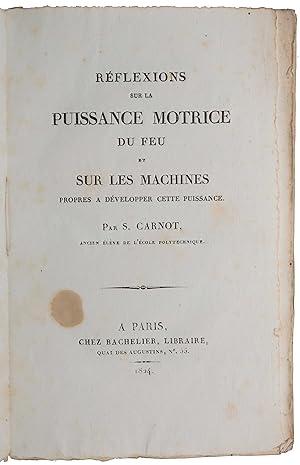
Published by Giraudet for Bachelier, Paris, 1824
- First Edition
Seller: SOPHIA RARE BOOKS, Koebenhavn V, DenmarkSOPHIA RARE BOOKS
Contact seller5-star sellerCondition: Used
US$ 60,000.00
Free ShippingShips from Denmark to Hong KongQuantity: 1 available
Add to basketFirst edition. PAVED THE WAY FOR THE LAWS OF THERMODYNAMICS (PMM 285) . First edition, very rare, and a fine copy in original state, of Carnot's only published work, which led directly to the first and second laws of thermodynamics. "Carnot, one of the most original thinkers among physical scientists, applied himself to the anal…ysis of the cyclical operation of [heat] engines" (Dibner). "Carnot's treatise on the motive power of heat, which contains the first (albeit imperfect) statement of the second law of thermodynamics, was written to address a practical engineering problem that had occupied French physicists since 1815 - namely, how heat could be used most economically in the production of motive power . Carnot's originality lay in his recognition that the motive power of a heat engine was independent of the nature of the substance generating it - that it was a function, instead, of the transfer of heat from a warmer to a colder body. He also introduced the fundamental thermodynamic concept of completeness of cycle, in which the engine and working substance return to their original conditions. Carnot's achievement was largely ignored by his contemporaries, and the Réflexions remained forgotten until rediscovered by William Thomson (Lord Kelvin) in the 1840s; Kelvin, one of the founders of modern thermodynamics, said of Carnot's work that 'nothing in the whole range of natural philosophy is more remarkable than the establishment of general laws by such a process of reasoning' (quoted in Fox, p. 1). The first edition of Réflexions was published in an edition of six hundred copies (see Fox, p. 23, illustrating the printer's bill)" (Norman). The Réflexions is now regarded as one of the great rarities of 19th-century science, and copies such as ours in completely original state are extremely difficult to find. "After a concise review of the industrial, political, and economic importance of the steam engine, Carnot [in the Réflexions] raised two problems that he felt prevented further development of both the utility and the theory of steam engines. Does there exist an assignable limit to the motive power of heat, and hence to the improvement of steam engines? Are there agents preferable to steam in producing this motive power? As Carnot conceived it, the Réflexions was nothing more, nor less, than a 'deliberate examination' of these questions. Both were timely problems and, although French engineers had investigated them for a decade, no generally accepted solutions had been reached. In the absence of a clear concept of efficiency, proposed steam-engine designs were judged largely on practicality, safety, and fuel economy . The usual approach to these problems was either an empirical study of the fuel input and the work output of individual engines or the application of the mathematical theory of gases to the abstract operations of a specific type of engine. In his choice of problems Carnot was firmly in this engineering tradition; his method of attacking them, however, was radically new and is the essence of his contribution to the science of heat. "Previous work on steam engines, as Carnot saw it, had failed for want of a sufficiently general theory, applicable to all imaginable heat engines and based on established principles. As the foundations for his study Carnot carefully set out three premises. The first was the impossibility of perpetual motion, a principle that had long been assumed in mechanics and had recently played an important role in the work of Lazare Carnot [Sadi's father]. As his second premise Carnot used the caloric theory of heat, which, in spite of some opposition, was the most accepted and most developed theory of heat available. In the Réflexions, heat (calorique) was always treated as a weightless fluid that could neither be created nor be destroyed in any process. As an element in Carnot's demonstrations this assumption asserted that the quantity of heat absorbed or released by a body in any process depends only on the initial and final states of the body. The final premise was that motive power can be produced whenever there exists a temperature difference. The production of motive power was due 'not to an actual consumption of caloric, but to its transportation from a warm body to a cold body.' Making the analogy with a waterwheel, Carnot observed that this motive power must depend on both the amount of caloric employed and the size of the temperature interval through which it falls. In his concept of reversibility Carnot also implicitly assumed the converse of this premise, that the expenditure of motive power will return caloric from the cold body to the warm body. "The analysis of heat engines began . with an abstract, three-stage steam-engine cycle. The incompleteness of this cycle proved troublesome, and Carnot pushed the abstraction one step further, producing the ideal heat engine and the cycle that now bear his name. The 'Carnot engine' consisted simply of a cylinder and piston, a working substance that he assumed to be a perfect gas, and two heat reservoirs maintained at different temperatures. The new cycle incorporated the isothermal and adiabatic expansions and the isothermal compression of the steam engine, but Carnot added a final adiabatic compression in which motive power was consumed to heat the gas to its original, boiler temperature. In describing the engine's properties, Carnot introduced two fundamental thermodynamic concepts, completeness and reversibility. At the end of each cycle the engine and the working substance returned to their original conditions. This complete cycle not only provided an unambiguous definition of the input and output of the engine, but also rendered superfluous the detailed examination of each stage of the cycle. With each cycle the engine transferred a certain quantity of caloric from the high-temperature reservoir to the low-temperature reservoir and thereby produced a certain amount of motive power. Since each stage of the cy.
Also in these catalogs: Classical Physics, Mechanics, Optics, Printing and the Mind of Man
Seller Inventory # 6270
 More images
Published by Jan Maire, Leiden, 1637
- Hardcover
- First Edition
- Signed
Seller: SOPHIA RARE BOOKS, Koebenhavn V, DenmarkSOPHIA RARE BOOKS
Contact seller5-star sellerCondition: Used
US$ 300,000.00
Free ShippingShips from Denmark to Hong KongQuantity: 1 available
Add to basketFirst edition. Cogito, Ergo Sum in the Court Ballet-Master's Library. First edition of the founding text of modern philosophy, in a strictly contemporary Parisian armorial binding bearing the gilt quartered arms of Louis Hesselin (1602-1662) - maître ordinaire de la Chambre aux deniers, conseiller du Roi, and surintendant des pl…aisirs du Roi, choreographer of the court ballets in which the young Louis XIV learned to dance, builder (with Le Vau) of the most admired cabinet de curiosités on the Île Saint-Louis, host at Chantemesle to John Evelyn and to Queen Christina of Sweden. The juxtaposition is not trivial. Descartes in 1637 had withdrawn from court life to the Netherlands, published his method anonymously, and suppressed its cosmological foundations after the condemnation of Galileo. Hesselin in the same decade was choreographing the court ballets in which the young Louis XIV would learn to dance. Two volumes of seventeenth-century French culture - the austere philosophical method, and the courtly spectacle - are bound here into a single object. Contemporary armorial copies of the Discours with named aristocratic descent are the rarest form in which the book survives; a copy traceable by inscription through six named hands across two and a half centuries is effectively without parallel in the modern trade. The Discours is a book that exists only because a larger one could not be. Descartes had been writing Le Monde since October 1629 - a comprehensive natural philosophy founded on the heliocentric hypothesis and designed as his magnum opus, treating everything he believed he knew about material nature: light, the Sun and fixed stars, the heavens, the planets and comets, the Earth, terrestrial bodies, and finally man observing them. The condemnation of Galileo in June 1633 arrested it. Galileo's fate was a legal warning Descartes took seriously: in letters to Mersenne through the autumn of 1633 and spring of 1634 he described the Roman decision as theologically unfounded and politically menacing, and hoped it would be reversed so that Le Monde could be published without fear of censure. It would not be, in his lifetime. He salvaged from the unpublishable work the portions that were theologically survivable - the geometrical optics, the meteorology, and the analytic geometry - and released them four years later as three Essais with a hastily composed methodological preface, anonymously, in Leiden. Posterity has inverted the book's original proportions. What Descartes wrote and conceived as a preface to his science is now read as one of the canonical texts of Western philosophy, while the three Essais it was meant to introduce have lapsed, in the modern handbooks, into what are routinely called its appendices. Yet the Géométrie contains the birth of analytic or coordinate geometry, which Florian Cajori called 'of epoch-making importance' (History of Mathematics, p. 174) and which John Stuart Mill named 'the greatest single step ever made in the progress of the exact sciences' (An Examination of Sir William Hamilton's Philosophy, 1865). It, in A. R. Hall's phrase, 'rendered possible the later achievements of seventeenth-century mathematical physics' (Nature and Nature's Laws, 1970, p. 91). The Dioptrique states the sine law of refraction independently of the Leiden mathematician Willebrord Snellius; the Météores gives the first geometrically correct explanation of the rainbow. The foundations of seventeenth-century mathematical physics are here, released only because the cosmological framework that would have carried them had been made politically unpublishable by the Galileo affair. The Dioptrique, the first of the three Essais, opens with a mathematical analysis of reflection and refraction. Descartes demonstrates that the angle of incidence equals the angle of reflection and derives the sine law of refraction - the same conclusion reached independently around 1621 by Snellius, whose unpublished work Descartes may or may not have known, and whose priority has generated a four-century controversy of which Descartes' published statement is the first public trace. The third discourse contains a cross-sectional description of the human eye, written without recourse to the technical vocabulary of iris, pupil, or optical lens, but with enough detail to support the analysis of vision that follows, and evidently drawing on Descartes' own anatomical dissections during his Amsterdam years. The fourth, fifth, and sixth discourses develop a philosophical account of perception that anticipates the Meditations: it is the mind that senses, not the body, or rather the mind in the brain, exercising what Descartes calls the sens commun; nerves transmit information through the motion of their inner filaments; there need be no pictorial resemblance between the retinal image and the idea the soul forms of the object. The text closes with a long discussion of lens-grinding, in which Descartes argues that hyperbolic and elliptical sections are to be preferred to any others for optical instruments - an ingenious if impractical recommendation that Huygens was to pursue over the decade that followed. The Météores treats the phenomena of the atmosphere - winds, clouds, rain, hail, snow, lunar and solar haloes, parhelia - with the stated polemical aim of displacing the language of omens and prodigies from meteorology. Much of what is explained derives from specific experiences Descartes dates from his own observation: the shapes of snowflakes seen at Amsterdam in the winter of 1635, the avalanches he watched when crossing the Alps in May 1625, the coronas around a lighted candle seen while crossing the Zuiderzee, and the parhelia observed at Rome in March 1629. The centrepiece, however, is Descartes' explanation of the rainbow, which depends on the sine law established in the Dioptrique. A ray of light striking a raindrop, he proposes, undergoes two refractions (on entering and leaving the drop) and one internal reflection; for. Signed.
Also in these catalogs: Classical Physics, Mechanics, Optics, Mathematics, Analysis, Algebra, Printing and the Mind of Man
Seller Inventory # 5910
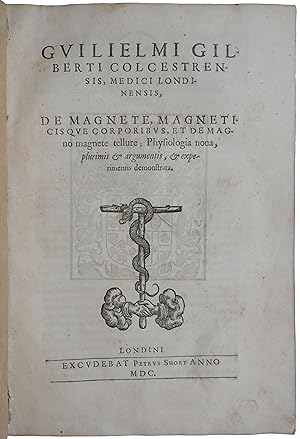 More images
Published by Peter Short, London, 1600
- First Edition
Seller: SOPHIA RARE BOOKS, Koebenhavn V, DenmarkSOPHIA RARE BOOKS
Contact seller5-star sellerCondition: Used
US$ 50,000.00
Free ShippingShips from Denmark to Hong KongQuantity: 1 available
Add to basketDust Jacket Condition: Hardcover. First edition. FIRST SCIENTIFIC TREATISE ON ELECTRICITY AND MAGNETISM (PMM 107) . First edition, an exceptionally fine copy, the nicest we have seen, of the first work of experimental physics published in England. Gilbert was chiefly concerned with magnetism; but as a digression he discusses in…his second book the attractive effect of amber (electrum), and thus may be regarded as the founder of electrical science. He coined the terms 'electricity,' 'electric force' and 'electric attraction.' His 'versorium', a short needle balanced on a sharp point to enable it to move freely, is the first instrument designed for the study of electrical phenomena, serving both as an electroscope and electrometer. He contended that the earth was one great magnet; he distinguished magnetic mass from weight; and he worked on the application of terrestrial magnetism to navigation. Gilbert's book influenced Kepler, Bacon, Boyle, Newton and, in particular, Galileo, who used his theories [in the Dialogo] to support his own proof of the correctness of the findings of Copernicus in cosmology" (PMM). "Gilbert provided the only fully developed theory . and the first comprehensive discussion of magnetism since the thirteenth century Letter on the Magnet of Peter Peregrinus" (DSB). Although this book does appear with some regularity on the market, copies such as ours in fine condition and in untouched contemporary bindings are rare. Provenance: presentation inscription on front free endleaf dated 1622 to the Bibliotheca Academiae Juliae Carolinae, Helmstedt: 'In bibliotheca illustris et inclutae academiae Juliae, quae Helmosteti est, nutrici meritissimae et aeternum venerandae, donarium hoc exiguum dedicavit Bartholdus Nihusius anno MDCXXII'; the donor, the German Catholic Bishop Barthold Nihus (1590-1657) was a correspondent of Athanasius Kircher; old stamp 'Ex bibliotheca Academiae Iuliae Carolinae Helmstadt' on verso of title, with deaccession stamp across it; Herbert McLean Evans (1882-1971) with his bookplate (all of the Evans books I have seen have been outstanding copies). 'Herbert McLean Evans . made a monumental contribution to the field of endocrinology through his studies of the physiology of reproduction. . Four of his lines of research and discovery were often mentioned as deserving of the Nobel Prize: (1) development of the vascular system, (2) elucidation of the estrous cycle in the rat, and the role of pituitary gonadotropin in reproduction, (3) discovery of growth hormone, and (4) discovery of and isolation of vitamin E. The first of these was entirely Evans' own work. The other three were collaborative efforts, but Evans' contribution to each was crucial.' (A History of UCSF; People). Evans was also a historian of science and medicine, pioneering collector, and author of the outstanding Epochal Achievements in the History of Science (Berkeley, University of California Press, 1934), the first such compilation of its kind, and precursor of Dibner and Horblit. "During the fifteenth century the widespread interest in navigation had focused much attention on the compass. Since at that time the orientation of the magnetic needle was explained by an alignment of the magnetic poles with the poles of the celestial sphere, the diverse areas of geography, astronomy, and phenomena concerning the lodestone overlapped and were often intermingled. Navigators had noted the variation from the meridian and the dip of the magnetic needle and had suggested ways of accounting for and using these as aids in navigation. The connection between magnetic studies and astronomy was less definite; but so long as the orientation of the compass was associated with the celestial poles, the two studies were interdependent . "Gilbert divided his De magnete into six books. The first deals with the history of magnetism from the earliest legends about the lodestone to the facts and theories known to Gilbert's contemporaries . In the last chapter of book I, Gilbert introduced his new basic idea which was to explain all terrestrial magnetic phenomena: his postulate that the earth is a giant lodestone and thus has magnetic properties . The remaining five books of the De magnete are concerned with the five magnetic movements: coition, direction, variation, declination and revolution. Before he began his discussion of coition, however, Gilbert carefully distinguished the attraction due to the amber effect from that caused by the lodestone. This section, chapter 2 of book II, established the study of the amber effect as a discipline separate from that of magnetic phenomena, introduced the vocabulary of electrics, and is the basis for Gilbert's place in the history of electricity . "Having distinguished the magnetic and amber effects, Gilbert presented a list of many substances other than amber which, when rubbed, exhibit the same effect. These he called electrics. All other solids were nonelectrics. To determine whether a substance was an electric, Gilbert devised a testing instrument, the versorium. This was a small, metallic needle so balanced that it easily turned about a vertical axis. The rubbed substance was brought near the versorium. If the needle turned, the substance was an electric; if the needle did not turn, the substance was a nonelectric. "After disposing of the amber effect, Gilbert returned to his study of the magnetic phenomena. In discussing these, Gilbert relied for his explanations on several assumptions: (1) the earth is a giant lodestone and has the magnetic property; (2) the magnetic property is due to the form of the substance; (3) every magnet is surrounded by an invisible orb of virtue which extends in all directions from it; (4) pieces of iron or other magnetic materials within this orb of virtue will be affected by and will affect the magnet within the orb of virtue; and (5) a small, spherical magnet resembles the earth and what can be demonstrated with it is applicable to the earth. This small spherical magnet he called a terr.
Also in these catalogs: Classical Physics, Mechanics, Optics, Printing and the Mind of Man
Seller Inventory # 6244
 More images
Published by Printed by William Fry for Thomas Dobson, Philadelphia, 1814
- First Edition
Seller: SOPHIA RARE BOOKS, Koebenhavn V, DenmarkSOPHIA RARE BOOKS
Contact seller5-star sellerCondition: Used
US$ 18,000.00
Free ShippingShips from Denmark to Hong KongQuantity: 1 available
Add to basketFirst edition. The Hebrew Bible Comes to America. First edition of the first Hebrew Bible printed in America - the editio prima Americana of the sacred tongue, of major importance in the field of American Judaica - this copy preserving the publisher's inserted notice of February 1814 recounting the genesis of the edition, a leaf… so rarely retained that Goldman's standard bibliography of American Hebrew printing records it in the Jewish Theological Seminary copy alone and omits it from the collation of the edition. Until these two octavo volumes left William Fry's Philadelphia press, no complete biblical text in Hebrew had ever issued from an American press: congregations and colleges alike read from Bibles carried or ordered across the Atlantic. Their publication was the most ambitious Hebrew typesetting yet attempted in the United States, and a measure of the standing Hebrew learning held in the early republic - a symbolic weight out of all proportion to the number of its readers. Abraham Karp, surveying the Judaic treasures of the Library of Congress, singled out the inserted notice as the key document of the edition's history, found 'in some of the first copies of the first volume off the press'; the present set is one of the very few in which that first-state leaf escaped the binder's discard. Only one other copy described with the notice has been traced in auction records (Philadelphia, 2024). The notice itself, dated February 1814 and printed on a single inserted leaf, compresses the whole story of the enterprise into four paragraphs. In 1812 Jonathan Horwitz had proposed an edition of the Hebrew Bible, 'the first proposal of the kind ever offered in the United States'; clergymen of standing endorsed the undertaking, and subscriptions were gathered. Early in 1813 Horwitz transferred his rights and his subscriber list to Thomas Dobson, who now reported the first volume published and the second well advanced. The publisher then turned his readers into proof-correctors: gentlemen of learning into whose hands the volume might come were entreated to note typographical errors and transmit their lists to Dobson in Philadelphia, so that an accurate table of errata might be printed at the close of the work - a table which, the collations of recorded copies suggest, was never executed. A final line explains both the leaf's function and its disappearance: the title pages and preface would be furnished with the second volume. The earliest purchasers therefore received volume one as a bare text block, this notice standing in for the missing preliminaries; when the second volume appeared with the title leaves and Van der Hooght's preface, binders bound the proper preliminaries in and discarded the now-superfluous notice. The variable placement of those preliminaries among recorded copies - the four preface leaves stand at the front of the second volume in another documented set, at the front of the first in the present one - is itself a fossil of this two-stage issue. The notice's survival here, bound after the first title with the prefatory selections following, marks the present set as one assembled from the first copies issued and fixes a terminus for its earliest American owner. Behind the notice lies a publishing race conducted in the newspapers of two cities. Jonathan Horwitz (d. 1852), a Jewish émigré recently arrived from Amsterdam, brought with him a font of Hebrew type and the conviction that the United States was ready for its own Hebrew Bible. He was nearly right and nearly first: the New York theological booksellers Whiting & Watson announced a rival Hebrew Bible under the patronage of the Theological Seminary at Andover; the missionary leaders John M. Mason and James McFarlane stood ready to enter the field; and in London, Joseph Samuel C. F. Frey - the converted president of the London Society for Promoting Christianity Amongst the Jews - had in 1812 already published the first volume of a vocalized Hebrew Bible for the English-speaking world, with rumours that he would cross the Atlantic to distribute it. Horwitz counter-attacked in the New York Evening Post of 16 January 1813, declaring that Harvard College and the Andover Theological Institution patronised his edition and had subscribed for forty copies each. Within weeks, however, he chose security over glory: he sold his Hebrew type to the printer William Fry, made over his publication rights and subscriber list to Dobson, and enrolled in the medical department of the University of Pennsylvania, taking his M.D. in 1815. He practised medicine for the rest of his life, marrying into the family of Haym Salomon, the Jewish financier of the Revolution; his son Phineas rose to head the United States Navy's Bureau of Medicine. The Whiting & Watson Bible never appeared. The men who carried the project to completion were two of the most substantial figures in the Philadelphia book trade. Thomas Dobson (1751-1823), Scottish-born and Philadelphia-established from 1785, had already accomplished the most audacious publishing feat of the young republic: Dobson's Encyclopaedia (1789-1798), the first encyclopaedia published in the United States, eighteen quarto volumes re-edited from the third Encyclopaedia Britannica, with George Washington among the subscribers. His shop at 41 South Second Street was known simply as the Stone House, and the Bible's title page Latinises the address into the imprint: edita ex aedibus lapideis. William Fry, a printer praised for the accuracy of his presswork - his former partnership of Fry & Kammerer had printed the elegant 1809 specimen of Binny & Ronaldson, the first permanent type foundry in the United States - executed the Hebrew text with the font acquired from Horwitz. Horwitz's prospectus had promised a new pica Hebrew to be cast for the purpose at the Binny & Ronaldson foundry, but the type Fry actually employed appears to have been the Amsterdam font Horwitz had carried across the Atlantic: the foundry's surviving.
Also in these catalogs: Printing and the Mind of Man
Seller Inventory # 6255
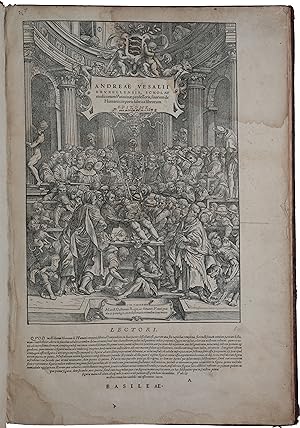 More images
Published by Johannes Oporinus, Basel, 1543
- First Edition
- Signed
Seller: SOPHIA RARE BOOKS, Koebenhavn V, DenmarkSOPHIA RARE BOOKS
Contact seller5-star sellerCondition: Used
US$ 250,000.00
Free ShippingShips from Denmark to Hong KongQuantity: 1 available
Add to basketFirst edition. The Epitome of Vesalius - an Icon of Anatomical Illustration. First edition, extremely rare, of the illustrated summary of the De humani corporis fabrica that Vesalius designed as its companion and that proved, over the following century, to be the more widely disseminated of the two. The Epitome was published sim…ultaneously with the Fabrica by Johannes Oporinus at Basel in June 1543; both bear the same colophon date. Where the Fabrica is a seven-book folio of more than seven hundred pages addressed to established physicians, the Epitome is a fourteen-leaf atlas of large anatomical plates with concise descriptive text, designed to be used as wall charts in the dissecting room and affordable enough for students. Vesalius described it in his dedication to Prince Philip of Spain as a footpath beside the highway of the larger work. The footpath reached further than the highway. Unauthorised translations and adaptations appeared in German (Torinus, Basel, August 1543, only two months after the Latin original), English (Geminus, London, 1545 and 1553), French (1560), and Dutch (1569), carrying Vesalian anatomy into vernacular medical education across Europe; no comparable sequence of translations followed the Fabrica itself. The present copy preserves all fourteen leaves including the two unsigned sheets [N] and [O], printed on one side only with individual anatomical parts to be cut out and assembled as overlays - the sheets most frequently lacking in surviving copies, since they were designed to be destroyed in use. The Epitome's approach to the body differs from the Fabrica's. The larger work proceeds systematically from the skeleton outward - bones, muscles, vascular system, nerves, abdominal organs, thorax, brain - in the order an anatomist would encounter them in a progressive dissection. The Epitome reverses the sequence, beginning topographically with the surface of the body and working inward: first the two celebrated nude figures of a man and a woman (the 'Adam and Eve', placed at the centre of the book), then four muscular charts showing successive layers of musculature progressively stripped from the standing figure, then the skeleton in two views, and finally the vascular, visceral, and neurological systems. The plates are similar to but not identical with those in the Fabrica: they are approximately sixty millimetres taller, the figures are in slightly different attitudes, and the landscape backgrounds that give the Fabrica's muscle-men their Venetian scenery are reduced or eliminated. The effect is closer to a modern anatomical atlas - the body presented for study rather than for contemplation. The nine principal anatomical plates were cut from the same Venetian workshops that produced the Fabrica's woodblocks, and the question of their designer remains one of the great unsolved problems of Renaissance art history. Vesalius's 1539 letter names Jan Steven van Calcar, pupil of Titian, as the intended artist; the skeletal figures in the Tabulae Sex of 1538, Vesalius's first illustrated anatomy, are documented as Calcar's work, and there are continuities of shading technique between those early plates and the Fabrica/Epitome figures of 1543. But the qualitative leap from the Tabulae Sex to the mature anatomical illustrations is so large that a single artist working over five years seems insufficient to explain it. The prevailing scholarly view is that several artists from or trained in the school of Titian were involved, with Vesalius himself possibly contributing to the more schematic diagrams; but no documentary evidence settles the matter. The woodblocks themselves survived at Basel, then at Munich, until the night of 30 March 1944, when an Allied bombing raid destroyed the library of the Universität München in which they had been deposited. Casts and prints taken from the blocks before their destruction confirm the extraordinary quality of the cutting, which translates the modelling of muscle and shadow with a precision that has no precedent in the history of woodcut illustration. The Epitome's two final sheets - the unsigned leaves [N] and [O] present in this copy - are an exercise in instructional design without parallel in sixteenth-century printing. Each sheet carries printed images of individual organs, vessels, and skeletal parts, intended to be cut out with scissors and pasted in layers onto one of the standing figures to produce a three-dimensional paper anatomy. The technique owes something to the flap-plate tradition that had begun with Vogtherr's Strasbourg broadsides in the 1530s; Vesalius's innovation was to extend it into a full dissection exercise in which the student assembled the body from parts, reversing on paper the operation performed on the cadaver. The sheets were consumed in use, which is why they are absent from most surviving copies; their presence here, in the male sheet intact and the female partially completed as intended, is a principal distinction of the copy. The technical achievement of producing such large and finely cut woodblocks at Basel was as remarkable as the achievement of the dissection on which they rest. Vesalius shipped the woodblocks themselves overland from Venice to Basel in the summer of 1542, sending a porter of high reliability with the precious cargo and writing to Oporinus from Padua with detailed instructions on the printing. The two volumes were to be set with the highest care, the woodblocks aligned exactly with their accompanying text, and proof sheets sent to Vesalius for correction. Oporinus, the celebrated humanist printer who had published Andreas Cratander's editions of the Greek classics and would soon publish the first Latin Qur'an, treated the assignment as the central project of his career; the result is universally regarded as among the most beautifully printed books of the sixteenth century. The Epitome's broadsheet folio format, larger than the Fabrica's, was technically the more demanding of the two, and the s. Signed.
Also in these catalogs: Chemistry, Medicine, Biology, Printing and the Mind of Man
Seller Inventory # 6204
 More images
Published by Giorgio Marescotti, Florence, 1583
- First Edition
Seller: SOPHIA RARE BOOKS, Koebenhavn V, DenmarkSOPHIA RARE BOOKS
Contact seller5-star sellerCondition: Used
US$ 48,000.00
Free ShippingShips from Denmark to Hong KongQuantity: 1 available
Add to basketFirst edition. THE FIRST TEXTBOOK OF BOTANY (PMM 97) . First edition, and an exceptionally fine copy, of "the first true textbook of botany' (DSB): the introduction of Cesalpino's classification system, which anticipated Linnaeus' system of binomial nomenclature. "Whereas other sixteenth-century botanists were content simply to…compile vast haphazard catalogues of plants, Cesalpino was the first to devise a rational classification system based upon plant morphology, the principles of which he set forth in the first book of De plantis" (Norman). "With Andreas Caesalpinus a new era begins . His book 'On Plants' was the first attempt to classify plants in a systematic manner based on a comparative study of forms . The traditional division into trees, shrubs, half-shrubs and herbs is retained, but they are now subdivided into different categories according to their seed, fruit and flower. The first section contains the general system, while the other fifteen sections describe 1,520 plants in fifteen classes. Caesalpinus's philosophy is Aristotelian: plants have a vegetable soul which is responsible for nutrition and for the reproduction of organisms. Nutrition was believed to come from the roots in the soil and to be carried up the stems to produce the fruit. Hence, the roots, stems and fruit are the main characteristics selected by Caesalpinus as the basis for his classification. His descriptive terminology was finally based on the fruits of plants. Lower plants such as lichens and mushrooms, having no reproductive organs, were believed to arise by spontaneous generation from decaying matter. They were placed at the lower end of the hierarchy of plants, providing the link between plants and inorganic nature. Sex in plants had not yet been discovered; and leaves were considered simply as a protection for the seed. Imperfect as it was, Cesalpinus's was the first rational system of plant classification by which their ever-growing number (six thousand were known in 1600, but nearly twenty thousand by the beginning of the eighteenth century) could be described. The discovery of sex on plants by Camerarius further supported Caesalpinus's method, as reproductive organs could now be used as classifying elements in greater detail. His influence on his contemporaries was not at first very great; they continued to use empirical descriptions. His chief follower was J. Jung (1587-1657). Within one hundred years, however, the need for a system based on comparative morphology was clearly recognized, culminating in the work of Linné who was greatly indebted to this book as well as to Bauhinus. A modern basis for classification of plants was eventually provided by the theory of organic evolution" (PMM). Greene, however, believes that Cesalpino's classification system quickly gained adherents, noting that "only three years later, in 1586, the Arabic physician Q?sim ibn-Muhammad al-Waz?r al Ghass?n? wrote his ?ad?quat al-azh?r f?, sar? m?h?yat al-'ushb wa al-'aq q?r [Garden of flowers, or explanation of the characters of herbs and drugs], which contained the first Arabic classification of plants" (p. 808). Provenance: from the library of the Königliches Joachimsthalsches Gymnasium (their stamp used before 1911 on the verso of titlepage), a Brandenburg princely school (founded in 1607, dissolved in 1953), one of the largest School libraries owned in German-speaking countries. Front board of the binding with initials and date 1585 in blindstamp. "Cesalpino's principal contribution to science lies in botany. Whereas such contemporary botanists as Brunfels, Bock, Leonhart Fuchs, Mattioli, and Tabernaemontanus merely described and illustrated a great number of plants in their Krättterbücher. Cesalpino wrote the first true textbook of botany. The first book of this text is of outstanding historical importance. Here, in thirty pages of admirably clear Latin, Cesalpino presented the principles of botany, grouping a wealth of careful observations under broad categories, on the model of Aristotle and Theophrastus. "Cesalpino considered the portion of the plant between the roots and the shoots -which he called the 'heart' (cor) - to be the seat of its 'soul' (anima), although he added that the soul is present throughout the plant. The task of the roots is to draw nourishment from the ground, and that of the shoots is to bear seeds. The leaves protect the shoots and the fruit from sunlight; they fall off in autumn, when the fruit is ripe and the shoots are developed Cesalpino's description of the tendrils on the shoots and leaves, the climbing petioles of the Clematis, the anchoring roots of the Hedera, the secretion of the nectar from the blossoms, and many other phenomena testify to extraordinary skill in observation. "The parts of the plant, Cesalpino asserted, exist either 'for a purpose' (alicuius gratia) or 'out of (inner) necessity' (ex necessitate); with this distinction he anticipated the concepts of adaptive characteristics and organizational characteristics. Cesalpino considered the fruit to be the most important part of the plant and, accordingly, made it the basis of his system of the plant kingdom. In this system the perianth and the stamens serve only to protect the young fruit; for in his opinion plants do not possess sexuality. He called the outer covering of the fruit the pericarpium. Among fruits he distinguished 'racema' (Vitis), 'juba' (Milium), 'panicula' (Panicum), and 'umbella' (Ferula). "Like Aristotle, Cesalpino divided plants into four 'genera': Arbores (trees), Frutices (shrubs), Suffrutices (shrubby herbs), and Herbae (herbs). Trees possess a single stem, whereas shrubs have many thin stems. Shrubby herbs live for many years and often bear fruit, but herbs die after formation of the seeds. The distinction among species should be made, he held, only according to similarity and dissimilarity of forms; 'unessential features' (accidentia), such as medicinal use, practical application, and habitat, must not be c.
Also in these catalogs: Chemistry, Medicine, Biology, Natural History, Geology, Printing and the Mind of Man
Seller Inventory # 6089
 More images
Published by Joannem Billium, London, 1620
- First Edition
Seller: SOPHIA RARE BOOKS, Koebenhavn V, DenmarkSOPHIA RARE BOOKS
Contact seller5-star sellerCondition: Used
US$ 437,500.00
Free ShippingShips from Denmark to Hong KongQuantity: 1 available
Add to basketFirst edition. A Total Reconstruction of Sciences, Arts and all Human Knowledge. First edition, first issue, the Devonshire-Horblit-Garden copy, and one of approximately fifteen copies printed on large paper with the crown watermark. Published in October 1620 with Norton's name in the colophon, the first issue is of considerable… rarity in any paper; the large-paper state in the first issue is of an altogether different order of scarcity. ESTC locates ten copies of the first issue in the United Kingdom and twelve in the United States, without distinguishing paper stock; ABPC/RBH records since 1975 only two other copies of the first issue (a large-paper copy in a presentation vellum binding at auction in 1996, and the Honeyman copy, not stated to be large paper), together with two large-paper copies of the second issue. On the evidence presently available, this is one of only two first-issue large-paper copies to have appeared in commerce in living memory. The book is dedicated to King James I, to whom Bacon had presented a manuscript draft in October 1620 with a letter explaining that he had laboured at the work for almost thirty years and that the king's acceptance was the only reward he sought; James, on receiving the volume, is said to have remarked that it was 'like the peace of God, which passeth all understanding'. The presentation copy to the king has not survived; the present copy is thus among the very small number of large-paper copies that did, and the only one to have descended through Devonshire, Horblit, and Garden. Bacon's Instauratio magna - the Great Instauration, or renewal - was conceived as the total reconstruction of human knowledge on experimental and inductive foundations, in six parts, of which only the first two were ever brought to completion. Part I, a survey of existing knowledge and its gaps, appeared in 1623 as the De Augmentis Scientiarum, a greatly expanded Latin recasting of his English Advancement of Learning of 1605. Part II, the book offered here under the running title Novum Organum - the New Instrument, set deliberately against Aristotle's Organon - presented the new logical method by which true knowledge was to be acquired. Part III, intended to collect the natural and experimental histories that would supply the raw material for inductive inference, appears in the 1620 volume only as the prefatory Parasceve ad Historiam Naturalem et Experimentalem. Parts IV, V, and VI - worked examples, preliminary speculations, and the new philosophy itself - were never written. Bacon understood the Novum Organum as the working core of the entire programme: the part of the Instauratio in which the method of all the rest is laid down, and without which the other parts cannot be attempted. The frontispiece, engraved by Simon van de Passe, places a ship in full sail passing outward through the Pillars of Hercules - the classical boundary of the known world - into open ocean. The device is the book in miniature: the old philosophy is the inland sea, the new is the Atlantic. The Novum Organum proper is divided into two books of aphorisms. Book I opens with a diagnosis of the obstacles to true knowledge - the four classes of idola, or illusions, to which the unreformed intellect is natively prone. The idols of the Tribe arise from common features of human nature itself - the tendency to anthropomorphise, to impose pattern on disorder, to read purpose into process. The idols of the Cave arise from the peculiar history, education, and temperament of the individual. The idols of the Market-Place arise from the ambiguity and inadequacy of the words through which thought is transacted. The idols of the Theatre arise from received philosophical systems - Aristotelian, Platonic, Galenic - which impose a fictional dramaturgy on the world. Until the mind has been purged of the four, Bacon argues, it cannot receive truth from nature; the effort of the Instauratio is therefore at once logical, psychological, and religious, a tabula abrasa on which nature itself may write. The theological motif is sustained: the reformation of the intellect reverses the effects of the Fall, restoring the human capacity for dominion over creation that was forfeited in Eden. Book II of the Novum Organum presents Bacon's inductive method as applied, by way of worked example, to the investigation of heat. The aim of the method is to discover the form of a simple nature - by which Bacon means not an Aristotelian essence but what later philosophy would call an explanation or a reduction: the arrangement of primary qualities from which the secondary quality in question is generated. The form of heat, Bacon concludes, is a motion - expansive, restrained, and acting in its striving upon the smaller parts of bodies. The route to this conclusion runs through three tables. The Table of Presence collects instances in which heat is manifestly present - the rays of the sun, flame, boiling liquids - chosen to be as unlike one another as possible so that the nature they share may stand out against irrelevant commonalities. The Table of Absence collects matched instances in which heat is absent - the rays of the moon, phosphorescence, cool liquids - to eliminate candidate forms that fail the negative test. The Table of Comparison collects instances in which heat varies in degree, requiring that the true form vary with it. Between them the three tables function as an analytic sieve: a putative form survives only if it is present when heat is present, absent when heat is absent, and co-variant with heat where heat is graded. The structure anticipates by two centuries John Stuart Mill's Joint Method of Agreement and Difference, and is radically more discriminating than the induction by simple enumeration with which Bacon's method has sometimes been mistakenly identified. Construction of the tables demands not passive observation but the active interrogation of nature through designed experiment - nature, in Bacon's phrase, must be put.
Also in these catalogs: Classical Physics, Mechanics, Optics, Mathematics, Analysis, Algebra, Printing and the Mind of Man
Seller Inventory # 5962
 More images
Published by S. Russell for R. Bickerstaff; Russell & Allen for R. Bickerstaff; Executives of S. Russell for G. Wilson, Manchester, 1827
- First Edition
Seller: SOPHIA RARE BOOKS, Koebenhavn V, DenmarkSOPHIA RARE BOOKS
Contact seller5-star sellerCondition: Used
US$ 65,000.00
Free ShippingShips from Denmark to Hong KongQuantity: 1 available
Add to basketFirst edition, first issue. THE ATOMIC THEORY OF MATTER (PMM 261). First edition, untouched in uniform original publisher's bindings with original printed spine labels, of Dalton's classic work on the atomic theory of matter. "Dalton reconstructed Newton's speculations on the structure of matter, and, applying them in a new form… to chemistry, gave Lavoisier's reformation of that science a deeper significance" (PMM). "Dalton's chemical atomic theory was the first to give significance to the relative weights of the ultimate particles of all known compounds, and to provide a quantitative explanation of the phenomena of chemical reaction. Dalton believed that all matter was composed of indestructible and indivisible atoms of various weights, each weight corresponding to one of the chemical elements, and that these atoms remained unchanged during chemical processes. Dalton's work with relative atomic weights prompted him to construct the first periodic table of the elements (in Vol. I, pt. 1), to formulate laws concerning their combination and to provide schematic representations of various possible combinations of atoms. His equation of the concepts "atom" and "chemical element" was of fundamental importance, as it provided the chemist with a new and enormously fruitful model of reality" (Norman). "He developed a system of chemical symbols and a table [plate 4 in part 1] showing the relative weights of the atoms of a list of elements. From his principles he deduced the law of definite proportions and the law of multiple proportions" (Dibner). This, and pp. 546-548 along with the 4 plates in part 2, in effect describe the first periodic table, which Mendeleev was to refine later. "In 1808 John Dalton published A New System of Chemical Philosophy, which described principles such as the uniqueness of atoms of the same element, relative atomic masses, and the rules of chemical combination, which taken together comprise the tablets of modern chemistry. The adoption of molecular formulas based on the laws of definite and multiple proportions, and the assignment of relative atomic masses, placed the science on a new quantitative footing" (Grossman, p. 339). This set is complete with the two parts of Vol. I and Vol. II, Part I (no further parts were published). Only one complete copy in uniform publisher's bindings has appeared since Norman, but that copy was made up with varying provenances, one part being ex-library. The Norman copy itself was in non-uniform bindings without the printed paper spine labels. Dalton (1766-1844) was born of a Quaker family at Eaglesfield, a small village in the English Lake District. As a young boy, he worked in the fields with his older brother, and helped his father in the shop where they wove cloth. In 1776, when only ten years old, he entered the service of Elihu Robinson, a wealthy Quaker, who taught him mathematics. In 1781, after a brief period of teaching in the village school, he joined his brother who was a master at a school in Kendal. In 1793 he moved to Manchester and, in the same year, published Meteorological Observations in which he suggested that the processes of evaporation and condensation were not chemical changes of state but rather changes in the physical form of water. These ideas laid the foundations for his theory that all matter is composed of discrete 'atoms'. At first after he moved to Manchester he taught mathematics and natural philosophy at New College, and began observing the behavior of gases, but after six years he resigned. Thereafter he devoted his life to research, which he financed by giving private tuition. By 1800, Dalton had become the secretary of the Manchester Literary and Philosophical Society (LPS), and in 1805 he presented a series of papers to the society outlining key points about the behaviour of gases in his series of essays, "Experimental Essays on the Constitution of Mixed Gases". He proposed that particles of an elastic fluid or gas were in fact elastic only with particles of their own kind. This extended Boyle's law to mixtures of gases. Dalton's further essay "On the Expansion of Gases by Heat" proposed the law that all elastic fluids expand the same quantity at the same heat. Jacques Charles (1746-1823) and Joseph Louis de Guy-Lussac (1778-1850) arrived at the same notion almost simultaneously. It is in this work that we see interest in the particles of matter themselves, rather than their behaviour, begin to emerge in Dalton's thinking. Atomism itself was not a particularly new idea in the early 19th century. The ancient Greek philosopher, Democritus (460-370 B.C.E.), proposed as part of a materialist philosophy that matter was made of tiny, indivisible pieces. Democritus suggested that there were certain basic elements that could be neither created nor destroyed, but that could be arranged into myriad forms. These atoms possess simple properties only, specifically size, shape, and mass. Anything else that we perceive, such as colour, is merely the result of interaction between the particles. In the 17th century, Isaac Newton hypothesized that matter was made up of atoms-small, hard homogeneous spheres adhering to one another through the gravitational force they exerted. The notion that matter was composed of atoms, and that there existed pure substances made of only one kind of atom (elements), was fairly common during the later Enlightenment period and into the 19th century. As a member of the Manchester LPS, Dalton was certainly familiar with these ideas. Dalton came to the notion of atomic structure only gradually, at first as a physical concept forced on him by his study of the atmosphere, heat, and gases. Dalton's notebooks and papers were destroyed during the bombing of Manchester during World War II, so historians of science perforce rely on earlier generations for their reporting of Dalton's day-to-day investigations. In his 1802-1804 notebooks, Dalton records on September 6, 1803, a table of the relative weights of the atoms of.
Also in these catalogs: Chemistry, Medicine, Biology, Printing and the Mind of Man
Seller Inventory # 5935
 More images
Published by Christoph Peter Detleffsen for the widow of Eberhard Klett, Augsburg, 1760
- Softcover
- First Edition
Seller: SOPHIA RARE BOOKS, Koebenhavn V, DenmarkSOPHIA RARE BOOKS
Contact seller5-star sellerCondition: Used
US$ 80,000.00
Free ShippingShips from Denmark to Hong KongQuantity: 1 available
Add to basketFirst edition. THE FOUNDATION WORK OF PHOTOMETRY (PMM 205) . First edition, very rare, and the finest copy we have seen, of the foundation work of photometry, the measurement of the intensity of light, both objectively and as perceived by the eye; this is one of the rarest of modern science books of this stature. Lambert's disco…veries "are of fundamental importance in astronomy, photography and visual research generally . Both Kepler and Huygens had investigated the intensity of light, and the first photometer had been constructed by Pierre Bouguer (1698-1758); but the foundation of the science of photometry - the exact scientific measurement of light - was laid by Lambert's 'Photometry' . In the Photometria he described his photometer and propounded the law of the absorption of light named after him. He investigated the principles and properties of light, of light passing through transparent media, light reflected from opaque surfaces, physiological optics, the scattering of light passing through transparent media, the comparative luminosity of the heavenly bodies and the relative intensities of coloured lights and shadows" (PMM). "It is difficult to overstate how original most of Photometria was and how great was the advance Lambert made with it. He was the first to accurately identify most fundamental photometric concepts, to assemble them into a coherent system of photometric quantities, to define these quantities with a precision sufficient for mathematical statement, and to build from them a system of photometric principles . The behavior of point light sources had been understood since Kepler's time. Lambert was the first to correctly solve the problem posed by extended light sources. He was the first to state the cosine emanation law, which describes how a surface of perfect diffusion emits light, and to see the far-reaching consequences of this idea. Lambert spent one tenth of Photometria developing equations for the calculation of illumination at points and surfaces from luminous areas of various forms - equations that are now used in modern computer graphics, and thermal and lighting engineering . With his emanation law, Lambert calculated the average brightness of the moon and planets, anticipating part of modern astrophysics by a century . Lambert made extensive measurements of the photometric properties of materials by ingenious application of the process of equating two brightnesses. He determined the reflectance and transmittance of glass for a range of angles, the brightness of images produced by lenses, the diffuse reflectance of matte surfaces, and the absorption of light in glass and in the atmosphere. He measured the color composition of white and colored surfaces and was the first to mix colored light and record that the result was different from mixing colored pigments . Lambert was the first to attempt to establish a relationship between the subjective assessment of a luminous stimulus - the brightness - made by the visual system, and the strength - the luminance and size - of that stimulus" (Dilaura, pp. i-ii). ABPC/RBH record the sale of three copies since Norman. OCLC lists copies in US at Brown, Harvard Medical School and Oklahoma. Provenance: Georg Hermann Quincke (1834-1924) (signature on front free endpaper). Quincke received his Ph. D. in 1858 at Berlin, having previously studied also at Königsberg and at Heidelberg. He became privatdozent at Berlin in 1859, professor at Berlin in 1865, professor at Würzburg in 1872, and in 1875 was called to be professor of physics at Heidelberg, where he remained until his retirement in 1907. Quincke did important work in the experimental study of the reflection of light, especially from metallic surfaces. "Lambert began with two simple axioms: light travels in a straight line in a uniform medium and rays that cross do not interact. Like Kepler before him, he recognized that 'laws' of photometry are simply consequences and follow directly from these two assumptions. In this way Photometria demonstrated (rather than assumed) that Illuminance varies inversely as the square of the distance from a point source of light. Illuminance on a surface varies as the cosine of the incidence angle measured from the surface perpendicular. Light decays exponentially in an absorbing medium. "In addition, Lambert postulated a surface that emits light (either as a source or by reflection) in a way such that the density of emitted light (luminous intensity) varies as the cosine of the angle measured from the surface perpendicular. In the case of a reflecting surface, this form of emission is assumed to be the case, regardless of the light's incident direction. Such surfaces are now referred to as 'Perfectly Diffuse' or 'Lambertian'. "Lambert demonstrated these principles in the only way available at the time: by contriving often ingenious optical arrangements that could make two immediately adjacent luminous fields appear equally bright (something that could only be determined by visual observation), when two physical quantities that produced the two fields were unequal by some specific amount (things that could be directly measured, such as angle or distance). In this way, Lambert quantified purely visual properties (such as luminous power, illumination, transparency, reflectivity) by relating them to physical parameters (such as distance, angle, radiant power, and color). Today, this is known as 'visual photometry.' Lambert was among the first to accompany experimental measurements with estimates of uncertainties based on a theory of errors and what he experimentally determined as the limits of visual assessment. "Although previous workers had pronounced photometric laws 1 and 3, Lambert established the second and added the concept of perfectly diffuse surfaces. But more importantly, as Anding pointed out in his German translation of Photometria [Leipzig, 1892], 'Lambert had incomparably clearer ideas about photometry' and with them established a comple.
Also in these catalogs: Classical Physics, Mechanics, Optics, Printing and the Mind of Man
Seller Inventory # 5873
 More images
Published by David l?ainé, Paris, 1743
- First Edition
Seller: SOPHIA RARE BOOKS, Koebenhavn V, DenmarkSOPHIA RARE BOOKS
Contact seller5-star sellerCondition: Used
US$ 4,500.00
Free ShippingShips from Denmark to Hong KongQuantity: 1 available
Add to basketFirst edition. "A LANDMARK IN THE HISTORY OF DYNAMICS" (PMM) . First edition of one of the classics in the history of science, d'Alembert's formalization of the new science of mechanics. "The 'Treatise on Dynamics' was d'Alembert's first major book and it is a landmark in the history of mechanics. It reduces the laws of the moti…on of bodies to a law of equilibrium. Its statement that 'the internal forces of inertia must be equal and opposite to the forces that produce the acceleration' is still known as 'd'Alembert's principle'. This principle is applied to many phenomena and, in particular, to the theory of the motion of fluids. It has become useful in the practical solution of many technical and mechanical problems, and is as important for the motion of bodies as is the principle of virtual velocities for their equilibrium - the latter formulated by Johann Bernoulli in 1717. It was left to Lagrange to combine both these principles and to construct mechanical equations applicable to the motions of any system of bodies" (Printing and the Mind of Man, 195). "In the first part of the treatise Alembert developed his own three laws of motion: inertia, the parallelogram of motion, and equilibrium; his third law assumed conservation of momentum and defined mass accordingly. The second part contains the first statement of what is now known as 'Alembert's principle' (Norman). "The Traité de dynamique, which has become the most famous of his scientific works, is significant in many ways. First, it is clear that d'Alembert recognized that a scientific revolution had occurred, and he thought that he was doing the job of formalizing the new science of mechanics . The Traité also contained the first statement of what is known as d'Alembert's principle. D'Alembert was, furthermore, in the tradition that attempted to develop mechanics without using the notion of force. Finally, it was long afterward said (rather simplistically) that in this work he resolved the famous vis viva controversy (whether, in modern terms, it is momentum or kinetic energy that measures the 'quantity of motion'), a statement with just enough truth in it to be plausible" (DSB). The second work, in which d'Alembert laid the foundations of scientific meteorology, is an application of the methods set out in the Traité de dynamique. He rejected the conception of Edmund Halley that the general circulation of the atmosphere is significantly controlled by the distribution of solar heating, and instead explained the origin of winds by means of the gravitational effects of the sun and moon. "The [Traité de dynamique] was published in 1743 by David, the great bookselling and printing house, . presented to the Académie des Sciences on 22 June and given a favourable review by the commissioners P. L. Maupertuis and F. Nicole. It includes a letter to Count de Maurepas, a 26-page preface summarizing and commenting on the main general ideas, and finally the body of the text with all its trimmings (table of contents, plates, corrections, extract from the records of the Académie des Sciences, royal favour). "Contrary to the author's current custom, the book is clearly structured. Following the definitions and preliminary notions (pp. 1-2), the first Part is entitled 'General laws of motion and equilibrium of bodies' (pp. 3-48). It consists of three chapters, each of which is subdivided into articles numbered continuously. These chapters represent the three great principles on which dynamics is based: I. 'On the force of inertia' (arts. 2- 20); II. 'On composite motion' (arts. 21-26); III. 'On motion destroyed or changed by obstacles' (arts. 27-49). This last chapter contains, in particular, the theory of equilibrium. "The second Part, which is much larger (pp. 49-186), is entitled 'A general principle for finding the motion of many bodies that act on each other in an arbitrary way, with many applications of this principle'. It consists of four chapters of disparate length and status: I. 'Exposition of the principle' (art. 50); II. 'Properties of the centre of gravity of many bodies combined, deduced from the preceding principle' (arts. 51-72); III. 'Problems illustrating the application of the preceding principle' (arts. 73-153); IV. 'On the principle of conservation of live forces' (arts. 154-175). What is today called 'D'Alembert's principle' constitutes the single article of Chapter I. The rest of the second Part consists of what the author calls 'applications' . "'D'Alembert's principle' (Chapter I of Part II) plays a pivotal role in the book: Part I paves the way for it and Chapters II-IV of Part II consist of applications. Moreover, it is this principle that posterity has universally accepted as one of D'Alembert's main contributions to science" (Crépel, pp. 161-3). "It was not so much a principle as it was a rule for using the previously stated laws of motion. It can be summarized as follows: In any situation where an object is constrained from following its normal inertial motion, the resulting motion can be analyzed into two components. One of these is the motion the object actually takes, and the other is the motion "destroyed" by the constraints. The lost motion is balanced against either a fictional force or a motion lost by the constraining object. The latter case is the case of impact, and the result is the conservation of momentum (in some cases, the conservation of vis viva as well). In the former case, an infinite force must be assumed. Such, for example, would be the case of an object on an inclined. The normal motion would be vertically downward; this motion can be resolved into two others. One would be a component down the plane (the motion actually taken) and the other would be normal to the surface of the plane (the motion destroyed by the infinite resisting force of the plane)" (DSB). "D'Alembert deduces from [his principle] that the determination of all motions reduces to applying the principle of equilibrium and that of composite motion.
Also in these catalogs: Classical Physics, Mechanics, Optics, Printing and the Mind of Man
Seller Inventory # 5878
 More images
Published by H. Hall for R. Davis & B. Took, Oxford, 1680
- Hardcover
Seller: SOPHIA RARE BOOKS, Koebenhavn V, DenmarkSOPHIA RARE BOOKS
Contact seller5-star sellerCondition: Used
US$ 35,000.00
Free ShippingShips from Denmark to Hong KongQuantity: 1 available
Add to basketA FOUNDING WORK OF MODERN CHEMISTRY. Second edition in English (first, 1661), complete with the very rare advertisement leaf which is lacking from most copies, of this landmark in the history of science, "his most important work [where he] set down his corpuscular theory of the constitution of matter, which finally freed chemist…ry from the restrictions of the Greek concept of the four elements, and was the forerunner of Dalton's atomic theory" (Sparrow). "Boyle's most celebrated book is his Sceptical Chymist . It contains the germs of many ideas elaborated by Boyle in his later publications" (Partington II, p. 496). The physicists, Boyle called them 'hermetick philosophers', upheld the Peripatetical or Aristotelian doctrine of the four elements - fire, air, earth, and water. The chemists, 'vulgar spagyrists', were disciples of Paracelsus who believed in the tria prima - salt, sulphur, and mercury. Boyle showed that both of these theories were totally inadequate to explain chemistry and was the first to give a satisfactory definition of an element. This second edition of the Sceptical Chymist contains the first printing of the second part, Experiments and Notes about theProducibleness of Chymical Principles. The first edition of the Sceptical Chymist hardly ever appears on the market and now commands a very high price - the last complete copy sold at auction realized £362,500 in 2015. Fulton located five copies of this second edition complete with the advertisement leaf; four are recorded on ABPC/RBH in the last 40 years (only one since the Norman sale, and that in a modern binding). "The 'Sceptical Chymist' is one of the great books in the history of scientific thought, for it not only marks the transition from alchemy to modern chemistry but is a plea, couched in most modern terms, for the adoption of the experimental method. Boyle inveighed against the inaccurate terminology of the 'vulgar spagyrists' and the 'hermetick philosophers,' as he termed the alchemists who refused to define their terms . He predicted that many more [elements] existed than had been described, but insisted that many substances, then thought to be elemental, were, in fact, chemical compounds. He set forth the modern distinction between a compound and a mixture, pointing out that a true chemical compound possessed properties entirely different from either of its constituents" (Fulton). "The importance of Boyle's book must be sought in his combination of chemistry with physics. His corpuscular theory, and Newton's modification of it, gradually led chemists towards an atomic view of matter . Boyle distinguished between mixtures and compounds and tried to understand the latter in terms of the simpler chemical entities from which they could be constructed. His argument was designed to lead chemists away from the pure empiricism of his predecessors and to stress the theoretical, experimental and mechanistic elements of chemical science. The Sceptical Chymist is concerned with the relations between chemical substances rather than with transmuting one metal into another or the manufacture of drugs. In this sense the book must be considered as one of the most significant milestones on the way to the chemical revolution of Lavoisier in the late eighteenth century" (PMM). "Boyle (1627-91) has ben called the founder of modern chemistry, for three reasons: (1) he realized that chemistry is worthy of study for its own sake and not merely as an aid to medicine or alchemy - although he believed in the possibility of the latter; (2) he introduced a rigorous experimental method into chemistry; (3) he gave a clear definition of an element and showed by experiment that the four elements of Aristotle and the three principles of the alchemists (mercury, sulphur and salt) did not deserve to be called elements or principles at all, since none of them could be extracted from bodies" (Partington II, p. 495). The Sceptical Chymist takes the form of a dialogue, clearly modeled on Galileo's Dialogo, involving four participants. The Aristotelian Themistius and the Paracelsian Philoponus state their positions briefly, but soon fall silent. A wide-ranging discussion ensues between the sceptical Carneades (Boyle himself) and Eleutherius, the open-minded enquirer. Carneades argues - citing many experimental examples - that the Aristotelian four-element system and the Paracelsian three-principle model give equally inadequate explanations of what happens when complex substances are attacked by fire, or by powerful solvents. He shows that these processes often generate new compounds, rather than the promised 'primitive and simple, or perfectly unmingled bodies', which remain stubbornly elusive. His second proposal is more speculative - and theologically more dangerous. Boyle believed, and hoped to prove in time, that the ultimate constituents of bodies were minute atoms, differing only in 'bulk, figure, texture and motion'. This idea was first suggested by the ancient Greek natural philosophers Leucippus and Democritus. Their successor, Epicurus, incorporated it into a godless materialistic world-view that was universally condemned by Christian theologians. Consequently, atomistic theories were suppressed for centuries. By the mid-17th century the works of the classical Greek atomists had been printed, translated and commented upon by scholars such as Pierre Gassendi, though there was still considerable hostility to them from clergy of all persuasions. But Boyle - a devout (though somewhat unorthodox) Christian who funded translations of the Gospels into many languages, including Gaelic and Turkish - saw no reason why a benign deity could not have chosen to create an atomic universe. "This work has often been acclaimed as a turning point in the evolution of modern chemistry, a crushing blow to traditional alchemy, but in fact Boyle's message is a more complex one. In his text he made a clear distinction between 'the true Adepti' and 'those Chymists.
Also in these catalogs: Chemistry, Medicine, Biology, Printing and the Mind of Man
Seller Inventory # 5684
 More images
Published by S. Russell for R. Bickerstaff, Strand, London; Russell & Allen for R. Bickerstaff, Strand, London; executors of S. Russell for George Wilson; John Harrison, Manchester, 1840
- First Edition
Seller: SOPHIA RARE BOOKS, Koebenhavn V, DenmarkSOPHIA RARE BOOKS
Contact seller5-star sellerCondition: Used
US$ 75,000.00
Free ShippingShips from Denmark to Hong KongQuantity: 1 available
Add to basketFirst edition. THE ATOMIC THEORY OF MATTER. First edition, complete with all three parts inscribed by Dalton, and in original publisher's bindings with original printed spine labels, of his classic work on the atomic theory of matter. "Dalton reconstructed Newton's speculations on the structure of matter, and, applying them in a… new form to chemistry, gave Lavoisier's reformation of that science a deeper significance" (PMM). "Dalton's chemical atomic theory was the first to give significance to the relative weights of the ultimate particles of all known compounds, and to provide a quantitative explanation of the phenomena of chemical reaction. Dalton believed that all matter was composed of indestructible and indivisible atoms of various weights, each weight corresponding to?one of the chemical elements, and that these atoms remained unchanged during chemical processes. Dalton's work with relative atomic weights prompted him to construct the first periodic table of the elements (in Vol. I, pt. 1), to formulate laws concerning their combination and to provide schematic representations of various possible combinations of atoms. His equation of the concepts "atom" and "chemical element" was of fundamental importance, as it provided the chemist with a new and enormously fruitful model of reality" (Norman). "He developed a system of chemical symbols and a table [plate 4 in part 1] showing the relative weights of the atoms of a list of elements. From his principles he deduced the law of definite proportions and the law of multiple proportions" (Dibner). This, and pp. 546-548 along with the 4 plates in part 2, in effect describe the first periodic table, which Mendeleev was to refine later. "In 1808 John Dalton published A New System of Chemical Philosophy, which described principles such as the uniqueness of atoms of the same element, relative atomic masses, and the rules of chemical combination, which taken together comprise the tablets of modern chemistry. The adoption of molecular formulas based on the laws of definite and multiple proportions, and the assignment of relative atomic masses, placed the science on a new quantitative footing" (Grossman, p. 339). This set is complete with the two parts of Vol. I and Vol. II, Part I (no further parts were published). ABPC/RBH list only two other presentation copies of the first edition: Sotheby's, 20 March 2003, lot 76, a copy of Vol. I, Part I only; and Bonham's, 8 March 2016, lot 442, comprising Vol. I, Part II and Vol. II, Part I only. We are not aware of any other presentation copy of all three parts having appeared in commerce. Provenance: Dr. Cleghorn (presentation inscriptions in Vol. I, Parts I & II, 'Dr. Cleghorn with respects from the Author'); New College, Edinburgh ('Bibliotheca Coll. Nov. Edinensis' stamp on title-page); The Manchester publishers Bradshaw & Blacklock (Vol. II inscribed 'To Bradshaw & Blacklock presented by John Dalton D.C.L., F.R.S. &' on front free endpaper). 'Dr. Cleghorn' is probably Robert Cleghorn (c. 1755-1821). He studied medicine at Edinburgh University, graduating MD in 1783, and was in general medical practice in Glasgow from 1785. He lectured at Glasgow University, from 1788 in medicine, and from 1791 in chemistry, and in 1818 he was awarded a professorship in chemistry and pharmacology at Glasgow, a role in which he continued until his death. He was elected a Fellow of the Royal Society of Edinburgh in 1790. He is the author of Dissertatio medica inauguralis, de somno (Edinburgh, 1783). By 1839, Bradshaw & Blacklock had moved premises to 27 Brown Street, from where they published their famous railway guides. Dalton and George Bradshaw attended the same Manchester Quaker's Meeting House. Dalton (1766-1844) was born of a Quaker family at Eaglesfield, a small village in the English Lake District. As a young boy, he worked in the fields with his older brother, and helped his father in the shop where they wove cloth. In 1776, when only ten years old, he entered the service of Elihu Robinson, a wealthy Quaker, who taught him mathematics. In 1781, after a brief period of teaching in the village school, he joined his brother who was a master at a school in Kendal. In 1793 he moved to Manchester and, in the same year, published Meteorological Observations in which he suggested that the processes of evaporation and condensation were not chemical changes of state but rather changes in the physical form of water. These ideas laid the foundations for his theory that all matter is composed of discrete 'atoms'. At first after he moved to Manchester he taught mathematics and natural philosophy at New College, and began observing the behavior of gases, but after six years he resigned. Thereafter he devoted his life to research, which he financed by giving private tuition. By 1800, Dalton had become the secretary of the Manchester Literary and Philosophical Society (LPS), and in 1805 he presented a series of papers to the society outlining key points about the behaviour of gases in his series of essays, "Experimental Essays on the Constitution of Mixed Gases". He proposed that particles of an elastic fluid or gas were in fact elastic only with particles of their own kind. This extended Boyle's law to mixtures of gases. Dalton's further essay "On the Expansion of Gases by Heat" proposed the law that all elastic fluids expand the same quantity at the same heat. Jacques Charles (1746-1823) and Joseph Louis de Guy-Lussac (1778-1850) arrived at the same notion almost simultaneously. It is in this work that we see interest in the particles of matter themselves, rather than their behaviour, begin to emerge in Dalton's thinking. Atomism itself was not a particularly new idea in the early 19th century. The ancient Greek philosopher, Democritus (460-370 B.C.E.), proposed as part of a materialist philosophy that matter was made of tiny, indivisible pieces. Democritus suggested that there were certain basic elements that could be neither created nor.
Also in these catalogs: Chemistry, Medicine, Biology, Printing and the Mind of Man
Seller Inventory # 5839
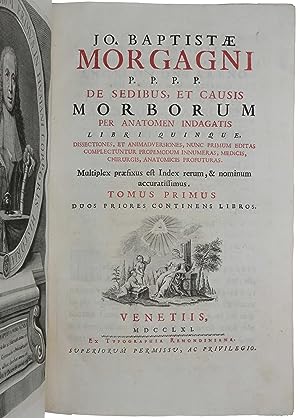 More images
Published by Remondini, Venice, 1761
- First Edition
Seller: SOPHIA RARE BOOKS, Koebenhavn V, DenmarkSOPHIA RARE BOOKS
Contact seller5-star sellerCondition: Used
US$ 28,500.00
Free ShippingShips from Denmark to Hong KongQuantity: 1 available
Add to basketDust Jacket Condition: Hardcover. First edition. EVANS 98 - VIRTUALLY THE CREATION OF PATHOLOGICAL ANATOMY. First edition, first issue, a very fine copy, of "one of the most important [works] in the history of medicine" (Garrison & Morton). "After Antonio Benivieni (1443-1502), Giovanni Battista Morgagni is considered the founde…r of pathological anatomy. His 'De sedibus', regarded as one of the most important books in the history of medicine, established a new era in medical research" (Norman). "Morgagni's contribution to the understanding of disease may well rank with the contributions of Vesalius in anatomy and Harvey in physiology" (Heirs of Hippocrates). "On the basis of direct examination and records of some 700 post mortem dissections, he advanced the procedure of basing diagnosis, prognosis and treatment on a detailed and comprehensive knowledge of the anatomical conditions of common diseases. In the above volumes, some of the cases are given with a precision and details hardly surpassed in medical history. His proposal was a shift of emphasis from the traditional 'nature' of a disease to its anatomical 'seat'. It combined the approach of anatomist and pathologist, making their special knowledge available to the diagnostician" (Dibner). Due to this work, "Morgagni may thus be considered to be the founder of pathological anatomy" (DSB). "Rudolf Virchow epitomized Giovanni Battista Morgagni's influence on the development of modern medicine when he wrote, 'The full consequences of what he worked out were harvested in London and Paris, in Vienna and in Berlin. And thus we can say that, beginning with Morgagni and resulting from his work, the dogmatism of the old schools was completely shattered, and that with him the new medicine begins.' This 'new medicine' began with the publication of Morgagni's masterpiece known as De Sedibus et Causis Morborum per Anatomen Indagatis Libri Quinque or 'The Seats and Causes of Disease Investiguted by Anatomy in Five Books' . In addition to Vesalius' Fabrica and Harvey's De Motu Cordis, De Sedibus was the final vinculum by which the old medicine was to be buried perpetually" (Ventura, p. 792). "Morgagni's most important work . is his 'De sedibus et causis morborum per anatomen indagatis' of 1761. This book grew out of a concept of Malpighi, which Morgagni then developed into a major work. The concept may be stated simply as the notion that the organism can be considered as a mechanical complex. Life therefore represents the sum of the harmonious operation of organic machines, of which many of the most delicate and minute are discernible, hidden within the recesses of the organs, only through microscopic examination. "Like inorganic machines, organic machines are subject to deterioration and breakdowns that impair their operation. Such failures occur at the most minute levels, but, given the limits of technique and instrumentation, it is possible to investigate them only at the macroscopic level, by examining organic lesions on the dissecting table. These breakdowns give rise to functional impairments that produce disharmony in the economy of the organism; their clinical manifestations are proportional to their location and nature. "This thesis is implicit in the very title 'De sedibus et causis morborum per anatomen indagatis'. In this book Morgagni reasons that a breakdown at some point of the mechanical complex of the organism must be both the seat and cause of a disease or, rather, of its clinical manifestations, which may be conceived of as functional impairments and investigated anatomically. Morgagni's conception of etiology also takes into account what he called 'external' causes, including environmental and psychological factors, among them the occupational ones suggested to Morgagni by Ramazzini. "The parallels that exist between anatomical lesion and clinical symptom served Morgagni as the basis for his 'historiae anatomico-medicae', the case studies from which he constructed the 'De sedibus' . the special merit of Morgagni's work lies in its synthesis of case materials with the insights provided by his own anatomical investigations. In his book Morgagni made careful evaluations of anatomic medical histories drawn exhaustively from the existing literature. In addition, he describes a great number of previously unpublished cases, including both those that he had himself observed in sixty years of anatomical investigation and those collected by his immediate predecessors, especially Valsalva, whose posthumous papers Morgagni meticulously edited and commented upon. The case histories collected in the 'De sedibus' therefore represent the work of an entire school of anatomists, beginning with Malpighi, then extending through his pupils Valsalva and Albertini to Morgagni himself" (DSB). "The number of pathologic observations described by Morgagni, many of them for the first time, is enormous. His observations are included in the De Sedibus et Causis Morborum per Anatomen Indagatis Libri Quinque or The Seats and Causes of Disease Investigated by Anatomy in Five Books, which was published in 1761, when Morgagni was 79 years old. Prior to the publication of De Sedibus, the first attempt to correlate premortem symptoms with postmortem findings was described in a book named the Sepulchretum Sive Anatomica Practica. Theophilus Bonetus published this treatise first in 1679, and an enlarged second edition appeared in 1700. It included almost 3,000 cases in which clinical histories were correlated with autopsy reports and commentary. There were several deficiencies in the Sepulchretum, which made the work virtually useless to scholars. These included misquotations, misinterpretations, inaccurate observations, and the lack of a proper index. The idea for De Sedibus was generated in 1740, while Morgagni was involved in a discussion of the deficiencies of Theophilus Bonetus' encyclopedic compilation. At the time, Morgagni had agreed to write a series of letters to a young friend, which were to resolve the.
Also in these catalogs: Chemistry, Medicine, Biology, Printing and the Mind of Man
Seller Inventory # 5608
 More images
Published by Béthune and Plon for Susse frères and Delloye, Paris, 1839
- Softcover
- First Edition
- Signed
Seller: SOPHIA RARE BOOKS, Koebenhavn V, DenmarkSOPHIA RARE BOOKS
Contact seller5-star sellerCondition: Used
US$ 145,000.00
Free ShippingShips from Denmark to Hong KongQuantity: 1 available
Add to basketFirst edition. DAGUERREOTYPE - "THE BEGINNINGS OF PHOTOGRAPHY" (HORBLIT) - THE TRUE FIRST PRINTING. First edition, the true first issue (see below), of Daguerre's exposition of his photographic process, "the beginnings of photography" (Horblit); this is an excellent unrestored copy in original printed wrappers, and very rare in…this condition. "Perhaps no other invention ever captured the imagination of the public to such a degree and conquered the world with such lightning rapidity as the daguerreotype" (Gernsheim, p. 71). "The daguerreotype is a photographic image with a mirror-like surface on a silver or silver-coated copper plate. A unique photograph, the daguerreotype is not produced from a negative, and the final image appears either positive or negative depending on the angle of reflected light" (Hannavy, p. 365). Daguerre (1787-1851), a gifted set designer and creator of the famous Diorama, a picture show based on lighting effects, began experimenting in the 1820s with fixing the images of the camera obscura on silver chloride paper. His lack of success stimulated his interest in the heliographic method invented by Nicéphore Niépce (1765-1833), who had produced the first successful photographic image in 1826 or 1827 on a pewter plate coated with bitumen of Judea dissolved in oil of lavender, and in 1829 Daguerre succeeded in persuading the reluctant Niépce to become his partner. After Niépce's death in the spring of 1835, Daguerre serendipitously discovered a quicker method of exposing and developing the Niépcian image through the application of mercury vapour. Using this method, with common table salt as the fixative, he produced his first successful permanent photographic image in 1837. On August 19, 1839 the scientist-politician François Arago (1786-1853) made a full announcement of the new process to a packed house at a joint meeting of the Académies des Sciences and des Beaux-Arts at the Institut de France. According to Beaumont Newhall, the first issue of Daguerre's manual, published by order of the government, was released on or about 20 August 1839 and bears the imprint of Giroux et Cie, and Delloye; only two institutional copies of this issue are known. Pierre Harmant, however, has convincingly demonstrated that Newhall was in error in assigning the Giroux issue priority of publication, and that the present issue, released for sale on 14 September, printed by Béthune et Plon, and with the imprint of Susse Freres, Editeurs, and Delloye, was in fact the true first publication of Daguerre's Manual, as it was called (see below for further details of Harmant's argument). A total of 39 reprints, new editions, and translations appeared in the following 18 months. The great demand accounts for the profusion of issues of the first edition: seven are recorded, all from the same basic setting of type. Of these the first four differ in the booksellers' names alone. Only three copies of this printing in unrestored original printed wrappers have appeared at auction since Honeyman: those of Richard Green (Christie's New York, 2008), Marie-Thérèse & André Jammes (Sotheby's Paris, 2002), and Meyer Friedman (Sotheby's New York, 2001). The Norman copy, which realised $40,250 in 1998, was rebound with the original wrappers bound in, the wrappers "defective and laid down" (Norman sale catalogue). "Louis-Jacques Mandé Daguerre was born on 18 November 1787 at Cormeilles-en-Parisis. His childhood was spent at Orleans, where his father was employed as a clerk on the royal estate. Showing talent for drawing, the boy was apprenticed to an architect at the age of thirteen, and three years later became a pupil of Degotti, scene painter at the Paris Opera. Later he made himself independent and designed the decor for the productions of several Paris theatres. He also collaborated with Prevost on a number of large panoramas - a kind of show which enjoyed immense popularity in the last decade of the eighteenth and first half of the nineteenth centuries . In 1822 Daguerre associated himself with the painter Charles Bouton (an assistant of Prevost) in a new venture, the Diorama, a picture show with changing light effects which aroused astonishment and admiration by its perfect illusion of reality" (Gernsheim, p. 65). The realism of the paintings in the Diorama, which so impressed Daguerre's audiences, was achieved by tracing images projected by a camera obscura. "Was it not natural that he, like Fox Talbot some years later, should have wished to find a method by which the fugitive image, which he was so laboriously tracing, could be made to delineate itself? Obsessed by this idea, Daguerre equipped a laboratory at the Diorama near the Place de la République in Paris, and there for several years he carried out mysterious experiments, shutting himself in his workroom for days on end. The famous chemist, J. B. Dumas, relates that Madame Daguerre consulted him one day in 1827 as to whether or not he thought it possible that her husband would be able to fix the images of the camera. 'He is always at the thought; he cannot sleep at night for it. I am afraid he is out of his mind; do you, as a man of science, think it can ever be done, or is he mad?' 'In the present state of knowledge', replied Dumas, 'it cannot be done; but I cannot say it will always remain impossible, nor set the man down as mad who seeks to do it'" (ibid., p. 66). Daguerre's fortunes changed only when he came into contact with Nicéphore Niépce. "Niépce's first experiments with light-sensitive materials placed in a homemade camera obscura were conducted in 1816. He succeeded in taking impressions of views out of his workroom window using paper covered with muriate (or chloride) of silver, but the images were not permanent. Moreover, they were negative images, and attempts to print them in the positive were not successful . It was at this point that he began to experiment with bitumen of Judea as a light-sensitive coating. The bitumen, he had discovered, har. Signed.
Also in these catalogs: Classical Physics, Mechanics, Optics, Printing and the Mind of Man
Seller Inventory # 5602
 More images
Published by Printed by Francis Leach, London, 1653
- Softcover
- First Edition
Seller: SOPHIA RARE BOOKS, Koebenhavn V, DenmarkSOPHIA RARE BOOKS
Contact seller5-star sellerCondition: Used
US$ 85,000.00
Free ShippingShips from Denmark to Hong KongQuantity: 1 available
Add to basketFirst edition. FIRST EDITION IN ENGLISH OF DE MOTU CORDIS. First edition in English of De motu cordis (1628), in which was described the discovery and proof of the circulation of the blood; this is the very rare first issue with uncancelled title and this leaf unclipped by the printer (see below). Harvey's discovery and experime…ntal proof of the circulation of the blood created a revolution in physiology comparable to the Copernican revolution in astronomy: it was to become "the cornerstone of modern physiology and medicine" (Garrison-Morton). De motu cordis "is probably the most important book in the history of medicine. What Vesalius was to anatomy, Harvey was to physiology; the whole scientific outlook on the human body was transformed, and behind almost every important medical advance in modern times lies the work of Harvey" (Heirs of Hippocrates). It should also be regarded as "the first record of a complete biological investigation, giving a clear and accurate description of the methods employed to recognise the laws governing an important vital process, a knowledge of which had till then been befogged by mistaken conceptions" (H.P. Bayon in Keynes). This first English edition is, according to Keynes, translated from the Rotterdam edition (1648), and like that edition includes (in translation) the additional commentaries by Zachariah Wood, James De Back's Dissertatio de corde (first published in Latin at Rotterdam in 1648), and Harvey's own Exercitatio anatomica de circulatione sanguinis (first published in Latin at Cambridge in 1649), consisting of two essays addressed to Jean Riolan, the younger, in response to Riolan's Encheridium anatomicum, et pathologicum (1648). "Riolan admitted that some vivisectional evidence seems to support the general, rapid Harveian circulation; but he maintained that under normal physiological conditions the movements of the blood are much more tranquil than those observed in vivisection" (DSB). In his reply, Harvey provided further experimental proof of the circulation of the blood. "In [De circulatione sanguinis] Harvey first described the circulation of blood through the coronary arteries. Harvey also described experiments that he made to provide further support to his theory of the circulation. Published simultaneously by Daniel in Cambridge and Arnold Leers in Rotterdam" (Garrison-Morton). More recently, however, John Stuart White has argued forcefully that this English edition is not, in fact, a translation at all but is actually a printed version of Harvey's original manuscript of De motu cordis which, he maintains, was first written in English and then translated by Harvey into Latin. This is course adds a great deal of interest to this edition. Almost all copies of this edition are of the second issue with a cancel title. In the only copies of the first issue seen by Keynes a triangular piece had been clipped from the bottom outer corner of the title - directing the binder to replace it with the new title -with the consequent removal of the date of publication: Keynes's dating of the first issue is therefore conjectural, expressed as [?1653]. The pagination errors noted by Keynes are present in this copy, but with the following differences: in the first part page 5 is correctly printed, the numerals for pages 9 and 44 are inverted and page 46 is printed as 64; in the second part, page 105 is printed as 015; in the third, the numbering for pages 12 and 13 is transposed. No copies of this first issue listed on ABPC/RBH. Provenance: Thomas Vyner (d. 1673) of Eathorpe Hall, Warwickshire (eighteenth-century bookplate). He was educated at St. Catherine's College, Cambridge, and awarded the BA in 1650, MA in 1653, BD in 1662 and DD in 1671. Small marginal note in a seventeenth-century hand on one leaf. "William Harvey was born in Folkestone, Kent in 1578; he was schooled at King's School Canterbury then Gonville and Caius College Cambridge. However, arguably it was his subsequent medical schooling at Padua, and resultant exposure to the anatomical research and methods of his Paduan predecessor Vesalius and his teacher Fabricius, that was most instrumental in his medical development. The University of Padua was a popular destination for many English medical students at the turn of the seventeenth century owing to its esteemed teaching staff and improved opportunity, in comparison with Oxford and Cambridge, for taking part in anatomical dissection. However, not all anatomy instruction at Padua followed the same approach. Vesalius had advocated a very novel empirical model urging students to become involved in dissection and 'feel with [their] own hands and trust them'. Conversely, Harvey's tutor Fabricius taught anatomy from an Aristotelian natural philosophical standpoint rather than a structural one - so advocated a less 'hands-on' approach, discouraging direct participation. Consequently Harvey was educated in an environment where there was a tension between describing anatomy structurally, using an empirical approach, and teaching anatomy from a broader Aristotelian philosophical standpoint, explaining units of anatomy in isolation. Arguably this legacy of two alternative approaches can be seen in De motu cordis. While in practice, Harvey carried out experiments on the heart, taking measurements and 'feel[ing] with his own hands' in the Vesalian tradition, he remained very deferential towards the ideas of Galen and particularly Aristotle throughout - even describing his enquiry as philosophical rather than medical" (Glasgow University Library Special Collections Department Book of the Month, June 2007). "Galen had regarded the veins as serving to convey to all parts of the body the nourishing blood elaborated in the liver. He recognized that both veins and arteries contained blood, and assumed that the arterial blood - clearly differentiable from the venous blood by its colour - was replenished where necessary from the venous supply through the septum of the hea.
Also in these catalogs: Chemistry, Medicine, Biology, Printing and the Mind of Man
Seller Inventory # 5638
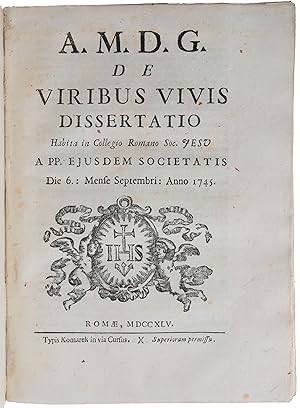 More images
Published by typis Komarek in via Cursis, Rome, 1745
- First Edition
Seller: SOPHIA RARE BOOKS, Koebenhavn V, DenmarkSOPHIA RARE BOOKS
Contact seller5-star sellerCondition: Used
US$ 12,500.00
Free ShippingShips from Denmark to Hong KongQuantity: 1 available
Add to basketFirst edition. FIRST STATEMENT OF BOSCOVICH'S ATOMIC THEORY OF MATTER. First edition, very rare, of the first published statement of Boscovich's universal force law, the basis of his atomic theory of matter, which prefigures much of his masterpiece Philosophiae Naturalis Theoria Redacta ad Unicam Legem Virium in Natura Existenti…um (1758) - at the beginning of part I of the Philosophiae, Boscovich states that he had first developed his theory in 1745 (. Theoria, in quam incidi jam ab Anno 1745). "The 'Theory of Natural Philosophy' is now recognized as having exerted a fundamental influence on modern mathematical physics . As the title of his book implies, he considered that a single law was the basis of all natural phenomena and of the properties of matter; that the multiplicity of physical forces was only apparent and due to inadequate mathematical knowledge" (PMM). "In spite of his important contributions to mathematics, astronomy, and optics, today Boscovich is best known for a unified theory of matter based on the hypothesis of point atoms governed by a universal law of force. The basic features of this remarkable theory go back to a treatise of 1745, De viribus vivis" (Kragh, p. 19). This universal force law was inspired partly by Boscovich's refusal to accept Descartes' assertion that the velocities of colliding bodies changed discontinuously, and partly by the 31st query with which Newton concluded the fourth edition of Opticks, which proposed that attractive and repulsive forces operate alternately between the particles of matter. Boscovich's force law is repulsive and tends to infinity at short distances, rendering direct contact between particles impossible, while at longer distances it is alternately attractive and repulsive; this enabled Boscovich to interpret cohesion, impenetrability, extension, and many physical and chemical properties of matter, including its emission of light. Boscovich's theory "was not only the first general mathematical theory of atomism, but more specifically it was the first scientific theory to treat all the ultimate constituents of matter as identical; to employ finite numbers of point particles; to eliminate Newtonian mass as a primary quantity, substituting a kinematic basis; to postulate a relational basis for the mathematical treatment of inertia and of all space and time observations; to propose to derive all physical effects from a single law; to eliminate the scale-free similarity property of the Newtonian law, introducing natural lengths into continuous laws so as to determine unique equilibrium positions and other scale-fixed properties; to employ a power series to represent an observable" (Whyte). "A natural philosopher, mathematician, physicist, astronomer, geodesist, engineer, and poet, Boscovich was, in the words of the physicist John Henry Poynting, 'amongst the boldest minds humanity has produced.' Boscovich published about one hundred books and papers, most of them in Latin . The French astronomer Joseph Jérôme Le Français de Lalande said that in each of these works there are ideas worthy of a man of genius" (Whyte in Encyclopedia of Philosophy). In 1958, Werner Heisenberg wrote: "Boscovich's work contains numerous ideas that have found their deserved place only in the modern physics of the past 50 years." ABPC/RBH list only one copy. OCLC records Huntington, Smithsonian, American Philosophical Society, Harvard, Princeton, and Brown (not on COPAC). "The occasion that led Boscovich to the formulation of his dynamic theory of forces was Father Carolus Scherffer's suggestion of studying the center of oscillation (or center of percussion) of solid bodies. This research led Boscovich to the investigation of the phenomenon of impact or collision of two bodies, a subject dealt with in his De viribus vivis. In sections 16 and 17 of his magnum opus, A theory of natural philosophy, Boscovich writes: 'In the year 1745, I was putting together my dissertation 'De Viribus vivis,' and had derived everything that they who adhere to the idea of Leibniz, and the greater number of those who measure "living forces" by means of velocity only, derive from these "living forces" . I then began to investigate somewhat more carefully that production of velocity which is thought to arise through impulsive action, in which the whole of the velocity is credited with being produced in an instant of time by those who think, because of that, that the force of percussion is infinitely greater than all forces which merely exercise pressure for single instants. It immediately forced itself upon me that, for percussions of this kind, which really induce a finite velocity in an instant of time, laws of their actions must be obtained differently from the rest. "However, when I considered the matter more thoroughly, it struck me that, if we employ a straightforward method of argument, such a mode of action must be withdrawn from Nature, which in every case adheres to one and the same law of forces, and the same mode of action. I came to the conclusion that really immediate impulsive action of one body on another, and immediate percussion, could not be obtained, without the production of a finite velocity taking place in an indivisible instant of time, and this would have to be accomplished without any sudden change or violation of what is called the Law of Continuity; this law indeed I considered as existing in Nature, and this could be shown to be so by a sufficiently valid argument'" (Jammer, p. 171). "In a nutshell, [Boscovich's] theory prescribes that every process in the world, beginning with those regarding the farthest stars down to those of the smallest particles, is an effect of a unique force that is repulsive at minute distances, attractive at large distances, and alternatively attractive and repulsive at intermediate scales. More exactly, bodies tend to move away from one another (repulsion) at very short distances, with a repulsive force that grows to infinity when the gap.
Also in these catalogs: Atomic Physics, Quantum Theory, Classical Physics, Mechanics, Optics, Printing and the Mind of Man
Seller Inventory # 5520
 More images
Published by for the author, Paris, 1588
- First Edition
- Signed
Seller: SOPHIA RARE BOOKS, Koebenhavn V, DenmarkSOPHIA RARE BOOKS
Contact seller5-star sellerCondition: Used
US$ 65,000.00
Free ShippingShips from Denmark to Hong KongQuantity: 1 available
Add to basketFirst edition. DIBNER 173: RENAISSANCE MECHANICAL ENGINEERING A LANDMARK IN BOOK DESIGN. First edition, in a beautiful contemporary binding, of one of the most famous illustrated books of the sixteenth century and a landmark in book design. "The military engineer Agostino Ramelli produced a remarkable illustrated book in 1588 de…scribing a large number of machines that he devised. Called Le diverse et artificiose machine del Capitano Agostino Ramelli (The various and ingenious machines of Captain Agostino Ramelli); this work had a great impact in the field of mechanical engineering. The book contains 195 superb engravings of various machines along with detailed descriptions of each one in both French and Italian" (Brashear). About half of the engravings depict hydraulic devices, the rest showing military machines as well as fountains, bridges, cranes, foundry equipment, etc., and a smattering of innovative devices such as the famous 'reading wheel' or the bouquet with artificial singing birds. In addition to weapons, 13 chapters are devoted to machines for breaking and entering - forcing doors, lifting doors off their hinges, cutting through metal fences - and all of which Ramelli insists can be accomplished without the perpetrator being discovered! "The plates in Ramelli's treatise are artistically as well as technologically superb, the bilingual text beautifully printed, and both plates and text surrounded by handsome borders of typographic ornaments. The reasons for this sumptuousness were twofold: first Ramelli had dedicated the book to his patron Henri III; and second, he had previously had several designs stolen from him by a trusted associate (probably Ambroise Bachot, later engineer to Henri IV), who published them in corrupt and mutilated form and claimed them as his own. As a result of this experience Ramelli planned his treatise as a particularly lavish work that would be difficult to counterfeit, and produced and published it from his own house where he could maintain absolute control over the project" (Norman). Together with Agricola's De Re Metallica (1556), Ramelli's work was the most influential and copied of all the early illustrated manuals of inventions and machines. Its influence was felt in such later works as Böckler's Theatrum machinarum (1662), and it was even copied in China, where it had been taken by Jesuit missionaries. Provenance: Girolamo Cosmi Rovereto (Ownership signature on the title); Roger Paultre (small label on fly leaf - see his Catalogue, Grands siècles et grandes images, 1993, no. 247). "Ramelli was born in northern Italy, probably in 1531. As a young man he served under the famous Italian warlord, Gian Giacomo de' Medici, Marquis of Marignano, and became trained in mathematics and military engineering. His reputation grew and he eventually left for France to serve under the Duke of Anjou, later King Henry III. His year of death is unknown and usually given as 'circa 1600,' but since documents exist to show that he was still alive in 1608, circa 1610 is a more realistic approximation. "Ramelli was greatly influenced by the increasing importance placed on mathematics and geometry as an important tool for engineers and artists, and particularly by the writings of Guidobaldo del Monte (1545-1607) and Petrus Ramus (1515-1572). Ramelli's interest in mathematics is demonstrated in the preface to his book, 'On the excellence of mathematics in which is shown how necessary mathematics are for learning all the liberal arts.' Ramelli also wanted to make his book accessible to many engineers so, as an Italian living in France, he produced both Italian and French descriptions of the machines. "The book itself is a fine example of the exquisite work of late sixteenth-century French printers and artists. It is a large book in folio format thus allowing great detail to be placed in the numerous engraved plates which total 195 in all (although plates 148 and 149 are combined into one image). Twenty of the plates are two-page spreads. Ramelli's bilingual descriptions are much more detailed than those found in previous illustrated books of machines (popularly called 'theaters of machines') by Jacques Besson (Theatrum instrumentorum et machinarum, 1569) and Jean Errard de Bar-le-Duc (Le premier livre des instruments mathématiques mechaniques, 1584). "Ramelli's book had a great influence on future mechanical engineering as can be see in Georg Andreas Böckler's work, Theatrum machinarum novum, 1662, where he copied eighteen of Ramelli's plates. Ramelli's influence can also be seen in the well-known works of Grollier de Servière (Recueil d'ouvrages curieux de mathematique et de mecanique, 1719) and Jacob Leupold (the multi-volume set Theatrum machinarum, 1724-1739). Leupold's work helped pass along Ramelli's ideas to a large population of eighteenth-century engineers. "Of the 195 machines pictured in the book, the majority are of devices designed to raise water. The breakdown is as follows: 110 Water-raising machines 21 Grain mills 4 Other mills 10 Cranes 7 Machines for dragging large objects 2 Machines to raise excavated earth 2 Cofferdams 4 Fountains and artificial bird-calls 1 Book wheel 15 Military bridges 14 Screw jacks and other breaking devices 4 Hurling engines 1 Gunner's quadrant "Bachot was an apprentice and assistant to Ramelli, eventually becoming an architect and engineer to King Henry IV. As described in Gnudi's introduction to her translation of Ramelli, during the sixteen years he spent with Ramelli, Bachot learned a great deal about engineering but had a falling out with the elder engineer and attempted to pass off some of Ramelli's machine designs as his own in an attempt to gain patronage. These designs were published in 1587 in a book by Bachot, Le Timon, and the similarity in style between Bachot's engravings and Ramelli's is impressive. After intense research, Gnudi concluded that Bachot engraved the plates for his own work and most of those produced for Ramelli's. Signed.
Also in these catalogs: Classical Physics, Mechanics, Optics, Printing and the Mind of Man
Seller Inventory # 5502
 More images
Published by G. Hamilton & J. Balfour, Edinburgh, 1754
- First Edition
Seller: SOPHIA RARE BOOKS, Koebenhavn V, DenmarkSOPHIA RARE BOOKS
Contact seller5-star sellerCondition: Used
US$ 185,000.00
Free ShippingShips from Denmark to Hong KongQuantity: 1 available
Add to basketFirst edition. EVANS (49) - THE DISCOVERY OF CARBON DIOXIDE. First edition of one of the greatest rarities in the history of science, the discovery of carbon dioxide and the foundation work of quantitative chemical analysis. "There is perhaps no other instance of a graduation thesis so weighted with significant novelty as Black'…s 'De humore acido a cibis orto, et magnesia alba' presented to the Faculty, 11 June, 1754" (William Osler in DNB). It "was soon recognised for what it is: a brilliant model, perhaps the first successful model, of quantitative chemical investigation, as well as a classic exemplar of experimental science worthy of comparison with Newton's Opticks . The Dissertatio in its original form is virtually unprocurable" (Guerlac, p. 124). Black's biographer Sir William Ramsay, who was awarded the 1904 Nobel Prize in chemistry "in recognition of his services in the discovery of the inert gaseous elements in air," wrote of "Black's celebrated thesis, which gained for him not merely the degree of Doctor of Medicine, but also brought his name before every 'philosopher' in Europe and America as that of a man who had made a discovery of more fundamental influence on the progress of Chemistry than any which had previously been described" (Ramsay, p. 20). "In the late spring of 1754, the famous Scottish chemist and physician Joseph Black (1728-99) put the finishing touches on his thesis for the doctorate of medicine at the University of Edinburgh. Entitled Dissertatio medica inauguralis, de humore acido a cibis orto, et magnesia alba, . it has received unstinted praise as one of the great classics in the history of science . [Black] studied and carefully distinguished the chemical behaviour of the common alkalis (carbonates) and of the two alkaline earths, lime and magnesia. He showed that the changes produced in these substances by roasting and calcining the mother substances (limestone, chalk and magnesia alba) were associated with the loss of an elastic, aeriform constituent, a 'fixed air' [carbon dioxide], and need not be explained by assuming that some hypothetical 'principle' was added during intense heating. Most important of all, Black proved by careful gravimetrical experiments that this elastic fluid was a precise quantitative constituent of these chemical compounds. As is well known, Black's results led directly to the classic studies on gases carried out by Henry Cavendish, Joseph Priestley, and Black's own pupil, Daniel Rutherford" (Guerlac, p. 125). An expanded English translation was published by the Edinburgh Philosophical Society in 1756, and the original thesis was reprinted in 1785 in William Smellie'sThesaurus medicus (Tom. II, pp. 271-304). ESTC lists 11 copies of the Dissertatio worldwide (7 in the UK, 3 in North America, and one in the Netherlands). We have been unable to trace any other copy having appeared in commerce. Joseph Black was born in Bordeaux where his father, who was born in Belfast but was ultimately of Scottish descent, had a wine business. Joseph was sent to school in Belfast in 1740, and around 1745 entered Glasgow University, where he studied languages and natural philosophy, and later, about 1748, anatomy and medicine under William Cullen. After working for three years in Cullen's laboratory, in 1752 Black left Glasgow for the more prestigious University of Edinburgh, where he attended the lectures of the physiologist Robert Whytt, and of Charles Alston, a botanist and chemist who lectured on materia medica. "In 1754 Black received the M.D. with his now historic dissertation De humore acido a cibis orto et magnesia alba" (DSB). Black succeeded Cullen as professor of anatomy and lecturer in chemistry in Glasgow in 1756, but exchanged the chair of anatomy with the professor of medicine. He succeeded Cullen as professor of chemistry in Edinburgh on 1 November 1766, and occupied that position, at the same time practising medicine, until his death in 1799. "Black's investigation of alkaline substances had a medical origin. The presumed efficacy of limewater in dissolving urinary calculi ('the stone') was supported by the researches of two Edinburgh professors, Robert Whytt and Charles Alston. It interested Cullen as well, and Black came to Edinburgh as a medical student with the intention of exploring the subject for his doctoral dissertation. "But at this moment Whytt and Alston were at loggerheads: they disagreed as to the best source, whether cockleshells or limestone, for preparing the quicklime. And they differed as to what occurs when mild limestone is burned to produce quicklime. Whytt accepted the common view that lime becomes caustic by absorbing a fiery matter during calcination, and thought he had proved it by showing that quicklime newly taken from the fire was the most powerful dissolvent of the stone. Alston, in an important experiment on the solubility of quicklime, showed that this was not the case, and that the causticity must be the property of the lime itself. Both men were aware that on exposure to the air quicklime gradually becomes mild, and that a crust appears on the surface of limewater. For Whytt, this resulted from the escape of fiery matter; but Alston, noting that the crust was heavier than the lime in solution, hinted that foreign matter, perhaps the air or something contained in it, produced the crust. Yet he was more disposed to believe that the insoluble precipitate formed when the quicklime combined with impurities in the water. Black, although he had criticized Alston as a chemist, was soon to profit from his findings. "Preoccupied at first with his medical studies, Black did not come to grips with his chosen problem until late in 1753. When he did so, he found it expedient to avoid any conflict between two of his professors; instead of investigating limewater, he would examine other absorbent earths to discover, if possible, a more powerful lithotriptic agent. He chose a white powder, magnesia alba, recently in vogue as a mi.
Also in these catalogs: Chemistry, Medicine, Biology, Natural History, Geology, Printing and the Mind of Man
Seller Inventory # 5461


