
Antiquariaat FORUM BV
Houten, NLD
 More images
Published by [France,, 1634
- Hardcover
Seller: Antiquariaat FORUM BV, Houten, NetherlandsAntiquariaat FORUM BV
Contact seller5-star sellerCondition: Used
US$ 17,577.42
US$ 28.44 shippingShips from Netherlands to Hong KongQuantity: 1 available
Add to basket2 works in 1 volume. Two exceedingly rare pamphlets about the "Loudon possessions", a case of mass hysteria surrounding the supposed demonic possession of Ursuline nuns that took place in the western French town of Loudun in 1634. The affair led to the trial of a local priest, Urbain Grandier, who was accused of witchcraft. Inte…restingly, these two pamphlets are by an anonymous partisan of the accused priest. The possession cases began in 1632 when several nuns at the local Ursuline convent claimed to be possessed by demons. The nuns accused Grandier, a charismatic and controversial figure in Loudun, of casting spells on them and making them his witches. Grandier, who had gained the enmity of the powerful Cardinal Richelieu, was arrested and put on trial, despite a lack of evidence against him. The trial was riddled with corruption and political intrigue, and Grandier was ultimately found guilty and sentenced to death by burning at the stake. His execution took place on 18 August 1634.While 18th century accounts of the famous trial such as those by De La Menardaye were popular, contemporary accounts are almost unobtainable. Neither pamphlet has appeared in auction records, and there are very few institutional holdings.The spine and corners of the boards are rubbed, the title label is slightly chipped. Numbers in the upper corners of the leaves indicate that these two works were likely removed from a sammelband containing multiple works. Internally slightly browned, an older typed description has been mounted with tape to the recto of the first free flyleaf. Otherwise in good condition.l Ad 1: Caillet 4718; Coumont F7.1; WorldCat 467111589, 705771905 (7 copies); Yve-Plessis 1285; Ad 2: Coumont R31.1; WorldCat 1254612433 (2 copies); Yve-Plessis 1286; cf. for more information about Grandier and the Loudun Nuns, see: Robbins, The Encyclopedia of Witchcraft and Demonology, pp. 312-317; Both ads not in Barbier, Dictionnaire des ouvrages anonymes; Rosenthal, Bibliotheca Magica et Pneumatica; Thorndike (Grandier and the Ursulines only mentioned once in general, vol VIII p. 583); Ad 2 not in Caillet. Modern marbled boards with a red morocco title-label lettered in gold on the spine. Pages: 12; 8 pp. With:(2) [WITCHCRAFT]. Remarques et considerations servans a la justification du curé de Loudun, autres que celles contenuës en son factum.[France, ca. 1634].
Also in these catalogs: Alchemy
Seller Inventory # ABC_48501
 More images
Published by Michael Endter,, Nürnberg,, 1661
Seller: Antiquariaat FORUM BV, Houten, NetherlandsAntiquariaat FORUM BV
Contact seller5-star sellerCondition: Used
US$ 7,030.97
US$ 28.44 shippingShips from Netherlands to Hong KongQuantity: 1 available
Add to basket2 parts in 1 volume. First and only edition of an important work of Hermeticism, which analyses the works of Hermes Trismegistus, Zoroaster, and Sanchuniathon, and compares them to the Mosaic scriptures. Caillet calls it an "Ouvrage d'érudition catholique", but the work also discusses magic and the occult, the science of Adam, a…strolatry, the mages from the Gospel, the library of Alexandria, and the Sibylline books. The second part of the work, written by Christophorus Arnoldus (dates unknown) discusses the same subjects.Johannes Heinrich Ursinus (1608-1667) was a humanist and Lutheran theologian from Speyer, Germany. He was a rector in Mainz and the Dean of Regensburg. He authored a large number of works. His most well-known one is Arboretum biblicum (1663), which was the first attempt of note to create an alphabetical list of all the botanical references in the Bible. Likely because of this, the plant genus Ursinia was named after him in the 18th century.With an ownership annotation on the recto of the first free flyleaf ("MWegel(?) by") and another on the verso of the second free flyleaf ("NWuttke 1869"). The vellum is somewhat soiled and the manuscript title on the spine has faded. With a horizontal tear in the front pastedown, the work is browned throughout. Otherwise in good condition.l Brüning 2058; Caillet III, 10946; Rosenthal 867; USTC 2623071; VD17 39:118402K; not in Duveen. Contemporary overlapping vellum, sewn on 5 supports laced through the joints, with the faded manuscript title on the spine. With 6 decorated woodcut initials, 7 headpieces built up from typographical ornaments, and 5 tailpieces (2 built up from typographical ornaments, 3 woodcuts). Pages: [16], 240; 71, [1 blank] pp.
Also in these catalogs: Alchemy
Seller Inventory # ABC_48615
 More images
Published by Benoît Prévost for Jacques Kerver,, Paris,, 1561
- First Edition
Seller: Antiquariaat FORUM BV, Houten, NetherlandsAntiquariaat FORUM BV
Contact seller5-star sellerCondition: Used
US$ 14,647.85
US$ 28.44 shippingShips from Netherlands to Hong KongQuantity: 1 available
Add to basket3 parts in 1 volume. First French edition of the first printed work on cryptography, complete with all the tables and illustrations. This edition is particularly impressive because of the volvelles, which are exclusive to the French edition. The beautifully printed work contains hundreds of codes and ciphers, which could be used… for writing or deciphering coded messages. It also includes many ancient alphabets and is the oldest known source for the Theban or witches' alphabet, which is still used in modern witchcraft today.The Polygraphia is primarily a handbook for cryptography. The work is divided in three parts. The first contains a short history and description of the art of cryptography, and extensive lists of ciphers to use in coded messages. These ciphers are arranged in columns of code words, each corresponding to a letter of the alphabet. The code words are arranged grammatically, so that a grammatically coherent sequence emerges when words from each column are strung together to form a message. The first part also includes several exotic alphabets, including two purporting to have been derived from the works of Bede, and another from the 1546 Hypnerotomachie, presumably added by the translator. The second part of work contains the key, and the third extra information to help use the ciphers, including the volvelles, which are very useful for the swift transcribing from one alphabet to another. This third part was written by the translator, Gabriel de Collange (1524-1572), and is therefore not present in the first Latin edition (1518).With the bookplates of Henry Pannier (1885-1935) and Guy Bechtel (1931) mounted on the front pastedown, later manuscript annotations with information about the work in four different hands on the verso of the second free endleaf, and a small manuscript inscription at the head of the main title page. With a small restored hole in the outer margin of the title page, not affecting the text, some of the leaves are slightly foxed, with brown stain on the verso of leaf 15, somewhat affecting the text, a water stain in the outer margins of leaves 177-186, some of the volvelles are slightly creased, the end papers have a small tear in the gutter, not affecting the structural integrity of the binding. Otherwise in very good condition.l Caillet 10850; Mortimer, Harvard college library: French 16th century books, 528; Pettegree & Walsby 49898; USTC 1225; cf. Glidden, H., Polygraphia and the Renaissance sign: The case of Trithemius. In: Neophilogus 71, 1987, pp. 183-195. 18th-century gold-tooled reddish-brown morocco, with the title and author lettered in gold on the spine, marbled endpapers, gold-tooled board edges, red edges. Printed in red and black, the main title and the titles of parts 2 and 3 set within a woodcut decorated border, 3 woodcut portraits of the translator, 13 large volvelles in part 3, numerous woodcut headpieces, and numerous woodcut decorated initials. Pages: [18], 300 ll. Including: (2) TRITHEMIUS, Johannes and Gabriel de COLLANGE (translator). Clavicule, et interpretation sur le contenués cinq livres de Polygraphie, & universelle escriture Cabalistique.(3) COLLANGE, Gabriel de. Tables et figures planispheriques, extensives & dilatatives des recte & averse, servants à l'universelle intelligence de toutes escritures tant methathesiques, transpositives, mythologiques, numerales, anomales, que orchemales.
Also in these catalogs: Alchemy
Seller Inventory # ABC_48878
 More images
Published by Jan van Hilten (colophon: printed by Pieter Dircksz. Boeteman),, Amsterdam,, 1646
- First Edition
Seller: Antiquariaat FORUM BV, Houten, NetherlandsAntiquariaat FORUM BV
Contact seller5-star sellerCondition: Used
US$ 3,808.44
US$ 28.44 shippingShips from Netherlands to Hong KongQuantity: 1 available
Add to basket4 parts in 1 work. Rare Dutch translation of this popular work on sorcery and witchcraft, magic potions, the power of imagination on (imagined) diseases, and more. The first edition was published in 1638 but this edition includes a treatise on invulnerability in war, a magic salve for the treatment of wounds and a refutation of…Paracelsus. Another issue appeared in the same year, published in Amsterdam by J.F. Stam. The present work is a selection of theories from the works of Daniel Sennertus (1572-1637), taken from several original Latin editions. Sennertus was one of the leading physicians of his day, respected and honoured all over Europe. He was the first to introduce chemistry at the University of Wittenberg (Germany), where he was professor of medicine from 1602 on. The author of a considerable amount of scientific and medical works, the ideas of Sennertus were never thoroughly treated. In his works a valuable survey is given of scientific and medical literature from the 16th and the early 17th century, although his frequent use of quotes from other writers was reason to accuse him of plagiarism. Sennertus can be considered a sceptical believer in occultism. Daniel Jonctys (1600-1654), who was the translator of the present work, touches in the preface on the subject of people's naive belief in occultism. He holds Sennertus's work to be a valuable weapon in the battle against harmful superstitious beliefs. But even a sceptic like Sennertus was convinced of the existence of occult qualities, and stated that it was possible for diseases to be caused by witchcraft. Sennertus even described how soldiers could make themselves invulnerable to weapons by carrying occult signs with (or on) them, and how this was supposedly effective.With manuscript parchment waste used to reinforce the binding at the head and foot of the spine, visible between the paste-downs and the first free flyleaf and leaf Y2 at both ends of the book. With the green and white bookplate of the Buijnsters-Smets collection on the front paste-down. The binding shows slight signs of wear, lacking the final blank flyleaf. The engraved title-page has been reinforced by a thin paper strip mounted on the outer edge of the verso. Occasionally very slightly foxed and slightly browned along the edges. Otherwise in good condition.l Krivatsy 10958; Poggendorff II, pp.907-908; STCN 170560392; cf. Caillet 10145 (latin ed.); Scheepers I, 571 (1638 ed.) Waller 1541 (1638 ed). Contemporary overlapping vellum, sewn on 3 supports laced through the joints, with the manuscript title on the spine, blue sprinkled edges. With an engraved title-page showing a magician laying magic bones at a person's sickbed, a small vignette on the title-page, 3 typographical divisional title-pages, 1 small woodcut illustration in the text (p. 200), 3 decorated initials (3 different series) and 3 ornamental tail-pieces. Pages: [1], [1 blank], [1], [1 blank], [24], 331, [8], [1 blank] pp.
Also in these catalogs: Alchemy
Seller Inventory # ABC_47606
 More images
Published by The Hague,, 1820
- Softcover
Seller: Antiquariaat FORUM BV, Houten, NetherlandsAntiquariaat FORUM BV
Contact seller5-star sellerCondition: Used
US$ 2,167.88
US$ 28.44 shippingShips from Netherlands to Hong KongQuantity: 1 available
Add to basketPrinted open letter of 1820 from Frederik of the Netherlands (1797-1881), Prince of Orange-Nassau, addressed to the Sovereign Princes of the Rose Croix (one of the highest degrees of freemasons) inviting them to join his new order of Freemason, which eliminated the higher degrees. From 1816 to his death Prince Frederik was grand… master of the order of freemasons under the "Grootoosten der Nederlanden", which represented many masonic lodges in the Low Countries.With the wax seal of Prince Frederik and his name (signature?) written in ink next to the seal on p. 97. In very good condition.l WorldCat 707466853 (5 copies); De Raat, Ackermans & Nissen, De verleiding van het vreemde: katholieke eigenzinnigheid in de twintigste eeuw (2002), p. 45. Contemporary stiff marbled paper wrappers. Pages: 97, [3 blank], 6, [1], [1 blank], 17, 23 pp.
Also in these catalogs: Alchemy
Seller Inventory # ABC_45630
 More images
Published by printed in Zagan (now in Poland) by Johann Ockel, Sagan,, Leipzig, Elias Fiebig;, 1677
- Hardcover
Seller: Antiquariaat FORUM BV, Houten, NetherlandsAntiquariaat FORUM BV
Contact seller5-star sellerCondition: Used
US$ 5,273.23
US$ 28.44 shippingShips from Netherlands to Hong KongQuantity: 1 available
Add to basketFirst and only edition of a curious collection of material on the history of superstition by the prolific and versatile, but later unjustly overlooked author, Johann Praetorius, the partly Latinized name of Hans Schultze (1630-1680). "Praetorius had an open eye and a sharp ear for all wonder stories, witch tales, and accounts of… ghosts and sorcery current among the people. He indefatigably collected all information on remarkable subjects and happenings, and was fond of popular gossip, even of the uncouth type . [The Philologemata] deals with the superstitious belief that a finger [thumb] cut off from the hand of a hanged thief serves as a good luck charm, and with vagabonds, diving rods, etc." (Faber du Faur). The thumbs-up woodcut on the title-page therefore has a more sinister meaning than one might first think.Title-page with subtly restored fore-edge margin, some usual minor browning and pages 6-7 printed unsharp, otherwise in very good condition.l ADB XXVI, pp. 520-529, no. 33; Caillet 8951; Faber du Faur 764; VD17 23:741244G. 18th-century vellum, red edges, later green cloth ties. With a woodcut illustration on title-page showing a hand with turned up thumb, and one woodcut in text (p. 195) showing a hand divided into alphabetical compartments. Pages: 216 pp.
Also in these catalogs: Alchemy
Seller Inventory # 18016
 More images
Published by Guilelmus Rovellius,, Lyon,, 1561
- First Edition
Seller: Antiquariaat FORUM BV, Houten, NetherlandsAntiquariaat FORUM BV
Contact seller5-star sellerCondition: Used
US$ 1,464.79
US$ 28.44 shippingShips from Netherlands to Hong KongQuantity: 1 available
Add to basketFourth edition of the translation into Latin of the famous "Secreti" of Alexius Pedemontanus (or Piemontese, ps., Girolamo Ruscelli (1500-1565), as is generally assumed), by Johann Jakob Wecker. The first edition of this translation had appeared in Basel, published by Petrus Perna, in 1559, followed by two editions in 1560 (Base…l and Antwerp); a fifth edition was also published in Lyon in 1565. Pedemontanu 'Secreti', first published in 1555, was an immensely popular book, printed in more than a hundred editions until the end of the 18th century. The Secreti was, apart from this Latin edition, translated into, German (1569; translator also J.J. Wecker, also published by Petrus Perna), English (1558), Spanish, French (1557) and Polish, and unleashed a torrent of 'Books of Secrets' that continued to be published down through the 18th century.Pedemontanus was the prototypical "professor of secrets". His description of his hunt for secrets in the preface to the Secreti helped to give rise to a legend of the wandering empiric who dedicated his life to the search for natural and technological secrets. In a later work, Pedemontanus reported that the Secreti contained the experimental results of an "Academy of Secrets" that he and a group of humanists and noblemen founded in Naples in the 1540s. Pedemontanus' academy is the first recorded example of an experimental scientific society.The translator Johannes Jacob Wecker (1528-1586) was a Swiss physician and philosopher. He worked as a physician in Colmar from 1566 and wrote a number of works about medicine, some of which were in both French and Latin, the most well-known being his Antidotarum generale, a work about alchemy. His work is known for the elaborate bibliography on chemistry-alchemy. Doubtless fleeing accusations of sorcery, Wecker moved to Basel where he was appointed professor of logic.Owner's stamp (with initials A. D. C.?) in the lower margin of the title page. In very good condition.l Adams, A729; Durling, 110; Duveen, p. 15; Ad Stijnman, A short-title bibliography of the Secreti by Alessio Piemontese 044; Wellcome, 178; cf. W. Eamon, Science and the Secrets of Nature: Books of Secrets in Medieval and Early Modern Culture (Princeton 1994); Ferguson, Hist. of Inventions and books of secrets, I/5, pp. 30-31; Thorndike VI, p. 215. Later vellum. Pages: "344" [= 342], [25], [1 blank] pp.
Also in these catalogs: Alchemy
Seller Inventory # ABC_45599
 More images
Published by Hendrick Laurensz.,, Amsterdam,, 1636
- Hardcover
Seller: Antiquariaat FORUM BV, Houten, NetherlandsAntiquariaat FORUM BV
Contact seller5-star sellerCondition: Used
US$ 703.10
US$ 28.44 shippingShips from Netherlands to Hong KongQuantity: 1 available
Add to basket2 parts in 1 volume. Rare sixth edition of the Dutch translation of an immensely popular book of secrets, compiled by Alexis of Piedmont. It is generally supposed that Piedmont is the pseudonym of the Italian humanist Girolamo Ruscelli (1500-1566), since Ruscelli mentions in a later work that he and other humanists had founded a…n "Academy of Secrets" that had published the Secreti. "Books of secrets and experiments had been prominent in medieval manuscripts and were to flare forth again in the second half of the [16th] century in the Secreti of Alessio of Piedmont, of which Ferguson listed 56 edition between its first appearance in 1557 [in Venice] and the end of the century" (Thorndike). It gives numerous "secrets", ranging from how to dye leather, to how to cure sick horses, clean paintings and whiten teeth. Besides these more convenient secrets, there are some occult passages, informing the reader how to dream wildly or how "to write letters on someone's skin that can never be removed". "No treatise better illustrates the popular or household practice of applied chemistry, of the arts, and of medicine." (Ferguson).With a bookseller's ticket on paste-down. Somewhat browned, with a waterstain in lower right corner throughout, not affecting text, and some occasional spots and ink blots. A good copy.l J. Ferguson, "The secrets of Alexis: a sixteenth century collection of medical and technical receipts" in: Proceedings of the Royal Society of Medicine XXIV (1930), pp. 225-246; STCN (2 copies); Thorndike V, p. 147 & VI, pp. 215-216; WorldCat (3 additional copies). Modern sheepskin. With woodcut device on each individual title-page. Pages: 260, [12]; 164, [11], [1 blank] pp.
Also in these catalogs: Alchemy
Seller Inventory # I25D7GU9X1DL
 More images
Published by Liège,, 1789
- First Edition
- Signed
Seller: Antiquariaat FORUM BV, Houten, NetherlandsAntiquariaat FORUM BV
Contact seller5-star sellerCondition: Used
US$ 2,929.57
US$ 28.44 shippingShips from Netherlands to Hong KongQuantity: 1 available
Add to basketRare first edition of a work containing 20 adapted prophecies of the French apothecary and seer Michel de Nostradamus (1503-1566). Nostradamus's predictions, first published in 1555 as Les proheties, are here edited by an anonymous author, giving an explanation of and opinion about each prophecy. Each prophecy is preceded by an…oval emblematic engraving, 6 signed by the Antwerp-based engraver Pieter Balthazar Bouttats (1666-1756). Since the engravings don't relate to the text, they were probably originally made to illustrate an earlier work, and were reused in the present work.With bookplate. Browned, with some occasional small spots or stains, but otherwise in good condition. Binding worn along the extremities, bottom of spine damaged.l Chomarat, M. & J.-P. Laroche, Bibliographie Nostradamus (Baden-Baden 1989) 372; WorldCat (6 copies). Contemporary mottled, tanned sheepskin, gold-tooled spine with red title-label, marbled edges. With a woodcut illustration on title-page, 20 engraved emblems at the beginning of each chapter, several by Pieter Balthazar Bouttats, and some woodcut tailpieces. Pages: VIII, 90, [1], [1 blank] pp.
Also in these catalogs: Alchemy
Seller Inventory # 18819
 More images
Published by Fédéric Morel,, Paris,, 1566
- Hardcover
- First Edition
Seller: Antiquariaat FORUM BV, Houten, NetherlandsAntiquariaat FORUM BV
Contact seller5-star sellerCondition: Used
US$ 2,636.61
US$ 28.44 shippingShips from Netherlands to Hong KongQuantity: 1 available
Add to basketFirst edition, in the original Latin, of what proved an extremely popular work: 900 medical and other "secrets", including information on astrology, gardening, cosmetics and other subjects, arranged in nine numbered chapters, each containing 100 numbered prose "aphorisms". Like most books of secrets it offers a mixture of scienc…e and superstition gathered from a wide variety of ancient and modern sources, many of them named in the aphorisms, and its medicinal recipes served in turn as sources for other authors internationally. It is a beautiful little piece of book production, with finely engraved woodcut decorated initials and headpieces, excellent presswork and the main text set in a lovely Granjon St Augustin (86 mm/20 lines) italic.Mizauld (1510-1578) was a professor of medicine at the University of Paris and astrologer and physician to Margaret of Valois. Mizauld thought the poor often fell prey to greedy apothecaries, so he presented them with remedies they could often grow in their own gardens or gather in the wild. It was an entirely different work from the Memorabilium aliquot . that Mizauld had published in 1554, but succeeded to and expanded on his Arcanorum naturae sylvula (1555). With occasional contemporary and later manuscript notes and an 18th-century(?) library stamp on the title page (partly erased), not affecting the printed image. With 1 leaf nearly detached, a water stain in the last 5 quires, and occasional (mostly marginal) slight browning or minor stains, but still generally in good condition. With the sewing supports broken at the front hinge and minor damage to the headbands, but binding otherwise good.l Brüning, Bibliogr. alchemestischen Lit. 369; Durling 3178 note & 3187 note (to 1572 Cologne & 1599 Frankfurt eds.); Ferguson II, p. 96 note (to 1592 Frankfurt ed.); French books 79994; Rosenthal, Bibliotheca Magica, 2987 (incompl.); Thorndike VI, p. 216; USTC 158149; Wellcome 4362; cf. Duveen, Bibl. alchemica, p. 407 (1574 Cologne ed.). 17th-century(?) limp sheepskin parchment, sewn on 3 tanned leather supports, with remains of 2 pair of alum tawed ties. With Morel's woodcut tree device on the title page, 2 woodcut headpieces and 7 woodcut decorated initials (plus 3 repeats), the headpieces and initials in an unusually delicate design, finely executed, the initial A printed from two different but very similar blocks. Set in italic types with the preliminaries in roman, and incidental Greek. Pages: [16], 136 pp.
Also in these catalogs: Alchemy
Seller Inventory # K15FD0MAD6FO
 More images
Published by Johann Gabriel Hertz,, Venice,, 1707
Seller: Antiquariaat FORUM BV, Houten, NetherlandsAntiquariaat FORUM BV
Contact seller5-star sellerCondition: Used
US$ 878.87
US$ 28.44 shippingShips from Netherlands to Hong KongQuantity: 1 available
Add to basket4 parts in 1 volume. Third Venice edition of a medical work by the German alchemist Adrian von Mynsicht (1603-1638). "One of the most frequently reprinted works of medical pharmacy was the Thesaurus of Adrian Mynsicht (1603-1638), an M.D. of Helmstedt who became physician to the duke of Mecklenburg and others . It purported to r…eveal to the "sons of doctrine and wisdom" a most secret way of compounding drugs based on his own experience and practice" (Thorndike). He was a follower of Paracelsus, opposing the Galenic theory in believing that illnesses were caused by chemical processes instead of fluctuation of the humours. Von Mynsincht was the first to describe emetic tartar. At the end of the text is a small treatise concerning the philosopher's stone. The work is followed by three smaller works by Carolus Musitanus, Andreas Battimelli and Hieronymus Piperus, who wrote additions to Mynsicht's Thesaurus. With a faint stamp on title-page, and a frequently appearing faint library stamp on pages throughout the book. Browned and foxed throughout, with frequent water stains and some occasional spots. Overall a good copy.l Blake, p. 318; Thorndike, pp. 84-86. Contemporary limp sheepskin parchment. With an engraved title page, woodcut head- and tailpieces and woodcut initials. Pages: [8], 446 [=452], [52]; 162 [=168] pp.
Also in these catalogs: Alchemy
Seller Inventory # I21GLAXQTZE0
 More images
Published by Hero Alopecius [Fuchs],, Cologne,, 1539
- Hardcover
- First Edition
Seller: Antiquariaat FORUM BV, Houten, NetherlandsAntiquariaat FORUM BV
Contact seller5-star sellerCondition: Used
US$ 14,647.85
US$ 28.44 shippingShips from Netherlands to Hong KongQuantity: 1 available
Add to basketPerhaps the best of the seven 16th-century editions of an influential treatise in verse on the virtues of precious stones, compiled by Marbode of Rennes (or Marbodius, 1035-1123), archdeacon and schoolmaster at Anjou, later bishop of Rennes. Beside the magical powers of the 60 precious stones treated in this poem, it also lists…medicinal qualities, and is hence often seen as a medical treatise. "There is a new spirit in his [Marbode's] work, not seen in earlier lapidaries, which emphasizes that the knowledge of stones is useful and a means of power for men. Marbode's lapidary then becomes the model for numerous subsequent treatises" (Schuh).The first printed edition of the text appeared in 1511, edited by the German physician Georg Pictorius (ca. 1500-1569). The present edition was edited by the Dutch humanist Alardus Amstelredamus (1491-1544), who "had a much more complete and correct manuscript than Pictorius so that this edition contains 100 more verses of the original poem. He also added the variants of the text, extracts from the works of Plinius, Dioscorides, Galen, Philo, Hegesippus, Origenes, St. Basil, Gregory of Nazianzus, Chrysostomos, Marsilio Ficino, Ermolao Barbaro, as well as Pictorius' annotations and his own scholia, which he titled Praecipuæ gemmarum lapidumque pretiosorm Explicationes." (Schuh). The preliminaries also include two letters from the mysterious Arabian King Evax to Tiberius, annotated by Alardus. The book is dedicated to Georgius of Egmond, bishop of Utrecht.With the bookplate of the Prince of Liechtenstein on the pastedown and the bookplate of Bob Luza on the first flyleaf. Some minor damaged on the title page, some ink underscoring, some minor marginal foxing. Binding only very slightly rubbed. Overall in very good condition.l Adams M519; Caillet 7102; Schuh 3229; Sinkankas 4173; Thorndike I, pp. 775-782; VD16, M 932. 17th-century gold-tooled red morocco, richly gold-tooled spine with green morocco title-label, gold-tooled fillets and small cornerpieces on both boards, gold-tooled board edges and turn-ins, gilt edges, marbled endpapers. With a woodcut illustration on the title page, representing a Jewish priest behind a board with the names of 12 stones which represent the 12 tribes of Israel. Pages: 124, [2] ll.
Also in these catalogs: Alchemy
Seller Inventory # 21777
 More images
Published by Eustache Vignon,, Geneva,, 1575
Seller: Antiquariaat FORUM BV, Houten, NetherlandsAntiquariaat FORUM BV
Contact seller5-star sellerCondition: Used
US$ 2,285.06
US$ 28.44 shippingShips from Netherlands to Hong KongQuantity: 1 available
Add to basketSecond edition of the Latin translation of a work on ghosts, phantoms and apparitions of people who have passed away, written by the Swiss theologian Ludwig Lavater (1527-1586). Besides ghosts, it deals with strange sounds, voices, inexplicable events and peculiar accidents occurring after someones death. Lavater denies that sou…ls or ghosts of the dead could appear. If someone does see these apparitions, he should be aware that they aren't the souls of the deceased, but the work of demons. "As a Protestant, Lavater rejected the idea of Purgatory. as an outdated Catholic concept. This greatly complicated the idea of 'ghosts', often thought to be visitations by human souls that were not at rest, such as those who died unbaptized or in tragic or violent circumstances. Without Purgatory, ghosts could only be visitations from Heaven or Hell. Lavater felt they were more likely to have come from Hell, and this meant that many ghosts were demonic and their requests dangerous: they could be trying to lure humans into damnation, for example by persuading them to commit murder or suicide" (British Library).Minor water stain in the head and foot margins of the last 40 leaves and in the head margins of the first 15 leaves, otherwise a very good copy.l Adams L300; Caillet 6237; Dorbon 2509 ("très rare"); cf. "Of ghosts and spirits walking by night by Ludwig Lavater, 1572" at: British Library online. Early 20th-century vellum, manuscript title on spine. With woodcut printer's device on title-page. Pages: [6], 272 pp.
Also in these catalogs: Alchemy
Seller Inventory # 18813
 More images
Published by printed by Johannes Saur for Peter Kopf,, Frankfurt am Main,, 1606
- Hardcover
- First Edition
Seller: Antiquariaat FORUM BV, Houten, NetherlandsAntiquariaat FORUM BV
Contact seller5-star sellerCondition: Used
US$ 7,616.88
US$ 28.44 shippingShips from Netherlands to Hong KongQuantity: 1 available
Add to basket3 parts in 1 volume. Second enlarged edition of the first systematic chemistry textbook, richly illustrated with nearly 200 woodcut illustrations. It was written by Andreas Libavius (ca. 1555-1616), one of the founders of chemical analysis, and is his chief work. As the first edition was not illustrated, the second edition speci…fically is considered "the greatest and most beautiful of all books on chemistry in the seventeenth century" (DSB). Copies of it rarely appear on the market.In his writings, Libavius sought to separate out the occult and mystical aspects of alchemy and reclaim it as a proper scientific discipline in its own right, but without rejecting alchemical processes such as the transmutation of metals. In the present work, he divides alchemy in two parts: encheria and chymica. The former is the knowledge of chemical procedures, and includes a description of vessels and furnaces, with numerous illustrations. The latter is the description of substances and their properties. Independent of these are two further divisions of alchemy, namely "ars probandi", the analysis of minerals, metals and mineral waters, and "theoretical alchemy", which concerns the philosophers' stone. The work also discusses alloys and transmutation, and includes recipes for remedies, oil, spirits, acids, distilled waters, alkalis, and salts.With the bookplate of the Prince of Liechtenstein mounted on the front pastedown, a contemporary ownership annotation ("Ex bibl Boom") in the head margin of the title page. The edges and corners of the boards are slightly scuffed, the front and back are slightly scratched, with some loss of material on the back board. The work is browned throughout, lacking the final blank leaf. Otherwise in good condition.l Brüning I, 0882; Duveen, p. 357; Ferguson II, p. 31; Schelenz, p. 406; USTC 2040315; VD17 39:125360T; Wellcome I, 3776; cf. DSB 8, pp. 309-312; Partington II, pp. 244-270. Modern blind-tooled speckled brown calf, with the title, author and year of publication lettered in gold on the spine. With an engraved title page, ca. 200 woodcut illustrations (3 full-page, the others in the text), a woodcut printer's device on the divisional title pages of parts 2 and 3, numerous woodcut head- and tailpieces, and woodcut decorated initials. Pages: [20], "196" [= 176], [12]; [10], 402; 192, [8] pp.
Also in these catalogs: Alchemy
Seller Inventory # ABC_48621
 More images
Published by Willem Simon (colophon: Gillis Coppens van Diest),, Antwerp,, 1559
- First Edition
Seller: Antiquariaat FORUM BV, Houten, NetherlandsAntiquariaat FORUM BV
Contact seller5-star sellerCondition: Used
US$ 2,285.06
US$ 28.44 shippingShips from Netherlands to Hong KongQuantity: 1 available
Add to basketFirst edition of a very popular Latin presentation of the secrets of nature, considering physiological, physical, medical, religious and moral topics, by Levinus Lemnius (1505-1568), attempting to explain extraordinary natural phenomena. "Bits of medical and natural lore are thrown together hit-or-miss" in this work, but it was…not without importance "since it was often cited by subsequent learned authors, and since the numerous editions and translation of it show that is was well suited to the taste of the time" (Thorndike). Lemnius clearly intended both to educate and to entertain the reader. Despite his interest in the occult and his astrological beliefs in the influence of the stars and the moon on people, Lemnius always remains pragmatic. Examples are the effects of human saliva, whether it is better to sleep with one's mouth open or closed, whether people should drink white wine before red, the use of vinegar in times of plague, the quarrelsome effect of Poitou-wines and the amorous effect of Rhine-wines, and why not to sleep in the moons rays when you are drunk.With some contemporary(?) manuscript annotations on the first endleaf, which is half cut off. Head and foot of the spine and corners damaged, hinges weak, endleaves damaged, faint marginal water stains in the first quarter of the book (not affecting the text), some wormholes (hardly affecting the text), last leaf half loose, with a large stain affecting the text on 184v. Otherwise in good condition.l Anet 821036; Belg. typog. 1848; Coumont L51b.1; Durling 2770; Thorndike VI, pp. 393-394; USTC 401037; cf. STCV 12917184 (1567 ed.). Contemporary gold- and blind-tooled calf, each board with a blind flower ornament in the centre and four gold corner pieces, the whole in a frame of blind triple fillets, 2 gold flowers on the spine. With Simon's woodcut device (a man in a swarm of bees, with hives in the background and the motto "dulcia mixta malis") on the title-page, woodcut coat of arms on title-page of the second part (a crowned Maltese cross, supported by lions), woodcut decorated initials. Pages: [16], 192 ll.
Also in these catalogs: Alchemy
Seller Inventory # 6879
 More images
Published by Jan Evertsz. Cloppenburgh,, Amsterdam,, 1610
Seller: Antiquariaat FORUM BV, Houten, NetherlandsAntiquariaat FORUM BV
Contact seller5-star sellerCondition: Used
US$ 11,132.37
US$ 28.44 shippingShips from Netherlands to Hong KongQuantity: 1 available
Add to basketThe first Dutch translation of Ludwig Lavater's De Spectris, lemuribus et magnis atque insolitis fragoribus, first published in Geneva in 1570, is an exceptionally rare find with only four other copies known in public libraries and having appeared only three times on the market in the last century. Ludwig Lavater (1527-1586), a…Zurich theologian, achieved great success with his renowned "ghost book," which became a bestseller of its time. Within this book, Lavater succinctly presents the Reformed perspective on the topic of ghosts, offering readers practical guidance on interpreting and managing supernatural phenomena. Drawing from various theological arguments, Lavater asserts that such phenomena do not involve the appearance of deceased individuals but rather the devil's attempts to tempt or punish the living on behalf of God. Consequently, any form of interaction with spirits, including questioning, protective or defensive measures, and exorcisms, is strictly prohibited. Instead, those troubled by ghostly encounters are advised to engage in penance and fervently pray to God. Lavater was a preacher, and later head of the Zwinglian church at Zurich. He denied that souls or ghosts of the death could appear. If such apparitions were seen, it was the works of demons, not of the souls of the death. His work experienced wide circulation, with numerous editions published in the sixteenth and seventeenth centuries, and translations made available in Latin, French, English, and Dutch.With a manuscript note on the back board ("hu 60"?), the green and white bookplate of the collection Buijnsters-Smets, previously attached to the front paste-down (now loose between the front endleaves). The binding shows slight signs of wear, internally very slightly browned and water stained (not affecting the text). Otherwise in very good condition.l STCN 853810273 (3 copies); USTC 1033061 (3 copies, same as STCN); Waller 1012; WorldCat 117168124, 883830908 (4 copies). Contemporary vellum, sewn on three tapes laced through the joints, with the manuscript title and a previous shelfmark(?) in brown ink on the spine, red edges. With an oval woodcut vignette on the title page, a large 8-line woodcut decorated initial at the start of the preface and smaller woodcut decorated initials throughout. Pages: [1], [1 blank], [14], 287, [1 blank], [8] pp.
Also in these catalogs: Alchemy
Seller Inventory # ABC_47609
 More images
Proeve eener voorstelling van het dierlijk magnetismus als geneesmiddel. Uit het Hoogduitsch met eenige bijvoegselen door F. van der Breggen.
KLUGE, Carl Alexander Ferdinant (F. VAN DER BREGGEN, transl.).
Published by Evert Maaskamp,, Amsterdam,, 1812
- First Edition
Seller: Antiquariaat FORUM BV, Houten, NetherlandsAntiquariaat FORUM BV
Contact seller5-star sellerCondition: Used
US$ 1,113.24
US$ 28.44 shippingShips from Netherlands to Hong KongQuantity: 1 available
Add to basketFirst edition of the Dutch translation of Kluge's important work Versuch einer Darstellung des animalischen Magnetismus als Heilmittel (1811), which the Dutch expert in the field, Joost Vijselaar, calls Kluge's magnum opus. It gives a complete and systematic overview of the science at that time. Kluge treats the history of anima…l magnetism and gives a detailed overview of the life of Franz Mesmer, together with descriptions of all aspects of magnetism, ordered in six grades. With a library stamp of P.F. Dubois on the half-title. Index at the end of the book (pp. 1-50) with some bolts unopened. In very good condition.l ADB, 16 (1882), pp. 250-251; BMN, I, p. 153; Bulletin des sciences médicales, 7 (1828), p. 267; DSB, IV, p. 560; Joost Vijselaar, De magnetiche geest. Het dierlijk magnetism 1770-1830 (Nijmegen 2001), pp. 220-221, 359-360. Modern half vellum, marbled sides, new endpapers. With an engraved title-page including an allegorical scene engraved by W. van Senus showing Asklepios and Hypnos chasing Death away from a sick man. Pages: [4], 551, 50 pp.
Also in these catalogs: Alchemy
Seller Inventory # ABC_45723
 More images
Published by Johann Grosse,, Leipzig,, 1689
- First Edition
Seller: Antiquariaat FORUM BV, Houten, NetherlandsAntiquariaat FORUM BV
Contact seller5-star sellerCondition: Used
US$ 6,972.38
US$ 28.44 shippingShips from Netherlands to Hong KongQuantity: 1 available
Add to basket3 works in 1 volume. Ad 1: Enlarged edition of a treatise on metallurgy, especially meant for gold- and silversmiths, written by the master of the Leipzig mint of Modestin Fachs, Prince of Anhalt. He was responsible for assaying metals. The text mainly concerns gold and silver, but the second part covers the managerial aspects o…f the mint. The third part gives lists of alchemical signs, values of several currencies, additional infomation on gold and silver, other metals and alloys. The first edition was published at Leipzig in 1595. Ad 2: First and only edition of an introduction to metallurgy and mining. "Ubersichtliche und selbstständige Anleitung zur Probirkunst, von den alten Probierbüchlein deutlich unterschieden" (Darmstädter).Ad 3: First and only edition of a collection of 153 aphorisms concerning metallurgy and alchemy, also focussing on the medicinal qualities of metals, written by the court physician at Stollberg, David Kellner. He studied medicine at Helmstedt and graduated there in 1670, writing two dissertations on surgical practices. He pursued chemistry and metallurgy, opposing alchemical practices, and wrote a number of books on these subjects.Ad 2 is partly unopened. All three works in very good condition.l Ad 1: Ferchl 149; Ferguson I, p. 261; VD17 12:644313W; not in Hoover. Ad 2: Brüning 2660; Ferchl 249f; Ferguson I, p. 417; Darmstädter, Probirbüchlein, p. 197; VD17 39:117831P; not in Hoover; Schuh. Ad 3: Bolton 572 (only the appendix); Ferguson I, p. 456; cf. DSB VII, 284; Ferchl 269; VD17 3:601877S (1686 ed.); Wellcome II, p. 383; for the author: Schuh, Mineralogy, 1620. Contemporary overlapping vellum, manuscript title on spine. Title-page in red and black, with 1 engraved folding plate with the cross-section of an oven. Pages: [20], 185, [9]; 51, [1]; 173, [1 blank]; 69, [7], [3 blank]; 22, 104, [2]; [22], "389" [= 386]; [30] pp. With:(2) HORN, Johann Bernhard & David KELLNER. Synopsis metallurgica oder kurze jedoch deutliche Anleitung zu der höchts nütz und ergätzlichen edlen Probier-Kunst verfasset in XV. Tabellen. Auf ersuchen des autoris fleissigt durchsehen. zum Druck befordert. Durch D. David Kellnern.[Schneeberg], Johann Christoph Weidner, 1690. Title-page in red and black, with 15 tables (one folding).(3) KELLNER, David. Wohlangerichtetes aerarium chymicum antiquo-novum, oder alter neue und reichlichst vermehrte oder chymische Schatzkammer in welcher nicht allein L. Martini Schmuckens sodern auch vieler andern vornehemen Chymicorum bey 200. herrliche sehr curieuse secreta chymica, meinst[!] auff Verbesserung derer Metallen theils aber zugleich auch auff gute Medicinen gerichtet. Aus vielen Manuscriptis mit sonderbahrem Fleiss zusammen getragen . und zum offentlichen Druck befoerdert durch D. David Kellner. 2 parts.Leipzig, printed by Koberstein for Joh. Herbord Kloss, 1702. Title-page in red and black, woodcut illustrations in text.
Also in these catalogs: Alchemy
Seller Inventory # 9B1A8YX24WTW
 More images
Published by Adriaen Rooman for Daniel de Keyser,, Haarlem,, 1613
Seller: Antiquariaat FORUM BV, Houten, NetherlandsAntiquariaat FORUM BV
Contact seller5-star sellerCondition: Used
US$ 5,859.14
US$ 28.44 shippingShips from Netherlands to Hong KongQuantity: 1 available
Add to basketRare first (and only early) edition of a Dutch Hermetic textbook by the medical doctor Herman Follin, who was born in Friesland at the end of the sixteenth century and died of the plague in Cologne around the middle of the 17th century. Follin had a successful medical practice at 's-Hertogenbosch and became professor of medicine… at Cologne. His present work in Dutch, one of his first publications, presents alchemists' and occult knowledge in clear and easy language for pharmacists and physicians. It is composed like a schoolbook, treating each subject succinctly in short chapters. The first chapter is devoted to alchemists' knowledge of metals, presented in short propositions followed by their proofs. The second chapter, "Die const Hermetis, ofte chymie", treats chemistry. In the third chapter, "Van de eerste materie der philosophen, en van sijn ontallijcke vruchten", Follin gives a survey of the Hermetic-philosophical thought concerning the quintessence of matter. Den Nederlandtsche sleutel is a rare book, not recorded in the standard occult-chemical subject bibliographies, but found in some medical collections. It is a great example of how a medical doctor spread alchemical and occult knowledge among medical practitioners by presenting it in an understandable manner.With an owner's inscription of the Jesuit College at Brussels, dated 1647, at the head of the title-page. In good condition.l BMN, p. 528; Krivatsy 4149; Simoni F47; STCN (4 copies); not in Brüning, Caillet; Duveen; Ferguson; Wellcome. Modern vellum. With 3 half-page woodcuts in the text, one repeated on the title-page, all showing distilling equipment. Pages: 76 ll.
Also in these catalogs: Alchemy
Seller Inventory # 3524
 More images
Published by Pierre Bosc,, Toulouse,, 1646
- Hardcover
Seller: Antiquariaat FORUM BV, Houten, NetherlandsAntiquariaat FORUM BV
Contact seller5-star sellerCondition: Used
US$ 8,788.71
US$ 28.44 shippingShips from Netherlands to Hong KongQuantity: 1 available
Add to basket2 parts in 1 volume. Exceptionally scarce work on spagyric medicine, with the often missing second part included. It is known that Isaac Newton (1642-1726/27) owned a copy of it, as Pierre Jean Fabre (1588-1658) was one of his favourite alchemical authors. The work, and especially the present edition, is very scarce. We have onl…y been able to find one other copy in sales records of the past hundred years. It has also only been recorded in four libraries worldwide, and is not mentioned in most of the relevant reference works.The work is a collection of spagyric remedies and formulas. Spagyric medicine was developed by Paracelsus (1493-1541) and his followers, and flourished until the middle of the 17th century. The method was thought to improve the efficacy of medicine by separating it into its primordial elements and then recombining them. This was done via alchemical processes such as fermentation, distillation and extraction. The present work contains recipes that follow this method. It is divided in two parts. The first contains various remedies. It explains how to create and use the quintessence of human blood to prevent ulcers, leprosy and paralysis; the quintessence of the human skull to cure epilepsy, migraines and vertigo; and the quintessence of urine to protect oneself against contracting the plague. The second part contains case studies of patients Fabre had treated.The corners of the boards are slightly scuffed, the leather on the front and back is slightly scratched, with small wormholes in the front joint. The lower outer corner of the leaves is slightly creased throughout, a small tear in the lower margin of page 157, not affecting the text, the upper and inner margins have been cut somewhat short, with occasional annotations in the margins. Otherwise in very good condition.l Krivatsy 3795; Partington II, p. 181; USTC 6810512 (2 copies); WorldCat 14312222, 1068184285 (4 copies); cf. Caillet II, 3766 (other ed.); Duveen, p. 201, 202 (other eds.); Ferguson I, p. 260 (mentions other ed.); Rosenthal 283 (other ed.); not in Brüning. 20th-century blind-tooled brown morocco, with the title and author lettered in gold on the spine, gilt edges, marbled endpapers. With a woodcut vignette on the title page and the divisional title page of part two, 9 woodcut headpieces, 4 headpieces built up from typographical ornaments, a woodcut tailpiece, and numerous decorated woodcut initials. Pages: 448, [22], [2 blank] pp.
Also in these catalogs: Alchemy
Seller Inventory # ABC_48617
 More images
Published by Helie Josset,, [The Netherlands?, copy imprint:] Paris,, 1682
- First Edition
Seller: Antiquariaat FORUM BV, Houten, NetherlandsAntiquariaat FORUM BV
Contact seller5-star sellerCondition: Used
US$ 2,050.70
US$ 28.44 shippingShips from Netherlands to Hong KongQuantity: 1 available
Add to basketAd 1: A very popular treatise on jealousy and on keeping peace in a marriage, published without the author's name but attributed to Antoine de Courtin (1622-1685), from Riom in Auvergne, who wrote several works on manners and behaviour and became French ambassador to Sweden and private secretary to the Swedish Queen Christine (w…ho knighted him in 1651) and then to King Karel-Gustav. Ad 2: Imitation, adaptation or loose translation, in old French, of the third day, first part, of the Pietro Aretino's Ragionamenti, first published 1534-1536, making fun of prostitution in the Roman nobility. Aretino (1492-1556) a social and religious radical, often satirized leading noblemen and church authorities, including Pope Leo X. Joachim Du Bellay translated some of Aretino's letters, so it's tempting to look for his hand in the present French text, but as far as we know there is no documentation of the translator or adapter. Ad 3: A purely occult work by Kenelm Digby that proved very popular, discussing a "powder of sympathy" that cures wounds and cuts from a distance, first published at Paris in 1658. Digby also presents his belief that under certain conditions people could live forever. A 12-page appendix at the end gives numerous tips to preserve a women's beauty. Kenelm Digby, better known as Chevalier Digby (1603-1665), was a famous English naturalist and physician, who converted to Roman Catholicism and lived mainly in France. Umberto Eco used the idea of the powder of sympathy, though in reverse, in his 1994 novel L'isola del giorno prima.Ad 4: Second edition of a series of 33 letters about happy and unhappy marriage, written by "Sr. de Mainville", letters I-IX & XXXII addressed to "Madame de ****" and X-XXXI & XXXIII to "Mademoiselle de ****". Little is known about the author, though often reported as Jean de Mainville. The widow of Sébastien Huré in Paris published the extremely rare first edition (1 copy in WorldCat) in 1683. It must have proved popular, given the appearance of the present edition a year later and a second Paris edition in 1688.With the circular bookplate of Bob Luza (1893-1980) (showing a book with "BL" in a pseudo-Hebrew style). Ad 1 lacking the final blank leaf; otherwise in good condition. Binding worn and spine damaged.l Ad 1: Gay-Lemonnyer III, col. 1236; WorldCat (2 copies, incl. 1 apparently incomplete); cf. Rahir 3398 (similar 1677 ed.); not in STCN; for Courtin and the text: Kamal Farid, Antoine de Courtin (1969), pp. 19, 29-32 & passim; Svenskt biografiskt lexikon, 9 (1931), p. 14. Ad 2: Brunet 180332? (ed. ambiguous); Gay-Lemonnyer I, cols. 896-897? (ed. ambiguous); WorldCat 1146423505, 52484083 & possibly 475034161 (3 or 4 copies); not in STCN. Ad 3: Brunet II, 708; Ferguson, Bibl. chem. I, p. 213 note; Ferguson, Bibliogr. notes, VI, 22; STCN (2 copies); WorldCat 83109953, 1025579941, 457848494, 633388424 (5 copies); cf. Caillet 3124 (Rouen and Paris eds.); Duveen (French eds.); Thorndike VII, p. 498 ff. & VIII, 295 ff. (on the sympathetic powder). Ad 4: WorldCat 231068513, 29824265, 906635710, 902326400, 939645923, 1181029910, 1190992204, 457902912 (14 copies); STCN (3 copies); cf. Cioranesco 44759-44760 (1683 & 1688 Paris eds.). Sprinkled calf (ca. 1700?), sewn on 4 straight-sewn cords, blind-tooled board edges. With a finely engraved integral frontispiece by Romeyn de Hooghe, 3 "woodcut" decorations (including 1 on the title-page) plus 1 repeat, and 2 "woodcut" decorated initials, mostly cast from woodcut patterns. Pages: [12], 168, [9], [1 blank]; "102" [= 202], [2 blank]; 378, [2 blank]; [8], 274, [6] pp. With: (2) ARETINO, Pietro. Dialogue de l'Aretin, ou Les vies, & faits de Lais, & Lamia courtisanes de Rome sont deduites. Traduict d'Italien en François.[southwest Germany?, ca. 1681/84?]. With 1 woodcut decorated initial.(3) DIGBY, Kenelm. Discours fait en une celebre assemblée touchant la guerison des playes & la composition de la poudre de sympathie. Enrichie avec beaucoup des remedes et rare secrets tirez de memoires du Chevalier Digby. Avec divers secrets pour la conservation de la beauté des dames.Utrecht, Rudolph van Zijll, 1681. With a woodcut decoration on the title-page, a woodcut headpiece (plus 2 repeats) and 2 woodcut acanthus decorated initials.(4) MAINVILLE, Jean(?) de. Du bonheur et du malheur du mariage, et des considerations qu'il faut faire avant que de s'y engager, ouvrage moral & curieux.The Hague, Adriaen Moetjens, 1684. With a woodcut decoration on the title-page, a woodcut headpiece and tailpiece, and 2 woodcut acanthus decorated initials.
Also in these catalogs: Alchemy
Seller Inventory # 1823
 More images
Published by [Germany?],, 1700
Seller: Antiquariaat FORUM BV, Houten, NetherlandsAntiquariaat FORUM BV
Contact seller5-star sellerCondition: Used
US$ 1,757.74
US$ 28.44 shippingShips from Netherlands to Hong KongQuantity: 1 available
Add to basketA German manuscript book of secrets containing medicinal recipes and incantations to protect one from a wide variety of ailments and to execute various magic tricks. The numbered pages contain about 103 entries, nearly all with a heading in brown ink and the text in black ink (a few near the end entirely in black). The 2-leaf qu…ire F that follows, in a different hand, contains an "aria" (F1-1v) with 9 numbered 4-line verses, sung to the tune of "Fleich hin"(?). Verse 4 records a Moorish merchant selling tobacco: "Ey seht den schwarzen Mohr,| er bringt ein Kraut hervor|das heißt Toback in seiner Kraft|erhält den Leibes edlen Saft|ey seht." A Latin verse on p. 25: "Valneribus quiuis [recté Vulneribus quinis], me Christe subtrahe nimis,|Vulnera quinque Dei, sunt medicina DEI" is clearly a variant of one published in Jean Baptiste Thiers, Traité des superstitions selon l'ecriture sainte, les decrets des conciles, ., Paris, Antoine Dezallier, 1679, vol. 1, p. 354 (from chapter VI on phylactères ou préservatifs): "Vulneribus quinis me substrahe Christe ruinis:|Vulnera quinque Dei sunt medicina mei". Besides the usual remedies for toothache, love charms or potions, etc., it includes "Unsichtbar zu machen" (pp. 22-23).Lacking quire A (8 ll. with the last 7 numbered 1-14?) and bifolium B1.8 (pp. 15-16, 29-30). With the first 2 leaves cut 6 mm narrower than the others (occasionally shaving a small bit of the last letter in a line) and some minor browning, but still in good condition. The wrapper is split at the head of the spine and shows a few small chips. A German book of secrets, especially interesting for the aria with a Moorish tobacco merchant. Brown vellum(?) wrapper, sewn without supports at 3 stations. Manuscript in German with occasional Latin phrases, written on laid paper in brown and black ink in at least two German gothic cursive hands (the Latin phrases in Latin hands), a "tetragrammaton" diagram (rectangular with a St Andrew's cross rather than star-shaped) with the name of (the archangel) Uriel and a "sator rotas" square. Lacking quire A and bifolium B1.8 (10 ll.?). Pages: [4], 17-28, 31-78, [8] pp.
Also in these catalogs: Alchemy
Seller Inventory # ABC_45796
 More images
Published by Johannes van Ravesteyn,, Amsterdam,, 1657
- Hardcover
- First Edition
Seller: Antiquariaat FORUM BV, Houten, NetherlandsAntiquariaat FORUM BV
Contact seller5-star sellerCondition: Used
US$ 2,929.57
US$ 28.44 shippingShips from Netherlands to Hong KongQuantity: 1 available
Add to basketRare first known edition of a successful apothecary's manual for students, written in Dutch, mirroring the general knowledge of pharmacology in the middle of the 17th century. The author of this intriguing book long remained unidentified until his initials "I.B.S.I" (fol.*3v of the 1662 "4th" edition, in the Latin note following… the Dutch approbation, both signed from Ghent) identified him as Jan Bisschop S.J. (1590-1664) who worked in Bruges as a pharmacist before he moved to Ghent in 1613 to join the Jesuit order. He trained numerous apprentice pharmacists and later served as official pharmacist at the Vienna court of the Holy Roman Emperor Ferdinand II. His book owed its success above all to its extremely practical approach, including its vast collection of medicinal recipes, many involving distillation.With owner's inscription of Carolina van de Poel on paste-down. Small tear in vellum of back board, bookblock somewhat loose in binding, no endpapers; frontispiece and first leaves a bit thumbed. First known edition of a practical apothecary's manual in Dutch.l Paul Begheyn, Jesuit books in the Dutch Republic 1657.1 (1 copy); BMN, I, p. 372; P. Boeymans, "Broeder Jan Bisschop en zijn 'Pharmacia Galenica'", in: Pharmaceutisch tijdschr. voor België, 33, 9 (1956), pp. 197-201; Hoogendoorn, Bis 01, 1 (3 copies); Jesuit books in the Dutch Republic, p. 52 ; Notaker 409; STCN (1 copy); L.J. Vanderwiele, "Het 'Licht der apotekers'", in: Kring voor de Geschiedenis van de Pharmacie in Benelux, Bulletin, 27 (1960), pp. 1-8; L.J. Vandewiele, "Enige nieuwe gegevens over apotheker Jan Bisschop, Jezuïet", in: Pharmaceutisch tijdschr. voor België, 51, 9 (1974), pp. 443-449; cf. STCV (1667 Antwerp eds. & possibly a 1660/61 Latin translation). Contemporary overlapping vellum over boards. With an engraved frontispiece showing the interior of an apothecary's shop, Van Ravesteyn's woodcut device on title-page (Elijah and the ravens); 3 half-page woodcut illustrations of distilling equipment (pp. 339, 343 and 387); woodcut decorated initials and tailpieces. Pages: [8], 460, [12] pp.
Also in these catalogs: Alchemy
Seller Inventory # ABC_45499
 More images
Published by Emanuel König,, Basel,, 1657
- Hardcover
- First Edition
Seller: Antiquariaat FORUM BV, Houten, NetherlandsAntiquariaat FORUM BV
Contact seller5-star sellerCondition: Used
US$ 8,027.02
US$ 28.44 shippingShips from Netherlands to Hong KongQuantity: 1 available
Add to basketScarce fourth and final Latin edition of a fundamental work on mining and metallurgy by the German scholar Georgius Agricola (or Georg Bauer, 1494-1555), who is generally considered to be the founder of geology as a discipline. He supplied a new scientific classification of minerals based on their physical properties.The De re m…etallica remained the most authoritative textbook on the subject for more than two centuries, paving the way for further systematic study of the earth and its rocks, minerals, fossils, refinery, and oil. It is lavishly illustrated with 290 striking woodcuts, including seven are monogrammed "RMD" in the block, generally attributed to the Swiss artist and printmaker Hans Rudolf Manuel Deutsch (1525-1571). These illustrations form a 16th-century graphic account of industrial activity in South Germany, depicting mining installations, utensils, and the different stages of the extraction and transformation of metals.The first edition was published in 1556 in Basel by Hieronymus Froben (1501-1563) and his brother-in-law Nicolaus Episcopius (1501-1564). Subsequent editions appeared in 1561, 1621, and 1657, together with Agricola's treatise De animantibus subterraneis which was first published in 1549 (Basel, H. Froben and N. Episcopius). The present fourth edition is expanded with five smaller Latin works by Agricola, which were partly published between 1533-1546, forming together the first collective edition of almost all his technological writings on geology, metallurgy, mineralogy, palaeontology, and subterranean life. Our copy includes the often missing two preliminary text leaves comprising the dedication by the German theologian Cornelius Martinus (1568-1621) to the German physician and botanist Johannes Sigfridus (1556-1623), dated Helmstedt, 15 September 1612."The De Re Metallica embraces everything connected with the mining industry and metallurgical processes, including administration, prospecting, the duties of officials and companies and the manufacture of glass, sulphur and alum . Some of the most important sections are those on mechanical engineering and the use of water-power, hauling, pumps, ventilation, blowing of furnaces, transport of ores, etc., showing a very elaborate technique" (PMM).With a small leaf containing a short description of the work mounted at the foot of the front pastedown and traces of a book plate that was previously mounted on the front pastedown. The binding shows slight signs of wear, mainly around the spine with a small tear at its head and the corners of the boards are bumped, somewhat foxed and browned throughout. Otherwise in good condition.l USTC 6139538; VD 17 3:309843V; cf. for the first ed. (1556) Brüning 1345; Caillet 79; Dibner 88; PMM 79; Rosenthal 8589; Sparrow, Milestones of science, no. 4; Wellcome I, 67-69. Contemporary sprinkled calf, sewn on 6 supports with corresponding raised bands on the spine, gold-tooled spine and board edges, with the title lettered in gold on the spine, red sprinkled edges. With a woodcut illustration on the title page (identical to the one printed on p. 176), 2 folding woodcut plates (one depicting a sundial) and 289 woodcut illustrations and diagrams in the text, including 68 almost full-page. Further with woodcut and typographical head- and tailpieces and decorated woodcut initials. Pages: [1], [1 blank], [3], [3 blank], [8], 708, [58], [2 blank], [32] pp.
Also in these catalogs: Alchemy
Seller Inventory # ABC_48618
 More images
Published by heirs of Lazarus Zetzner,, Strasbourg,, 1619
- Hardcover
- First Edition
Seller: Antiquariaat FORUM BV, Houten, NetherlandsAntiquariaat FORUM BV
Contact seller5-star sellerCondition: Used
US$ 8,788.71
US$ 28.44 shippingShips from Netherlands to Hong KongQuantity: 1 available
Add to basket2 works in 1 volume. Ad 1: First edition of an encyclopaedic work by the German theologian Johann Valentin Andreae (1586-1654), who called it a Christian fable book. It is divided into three "books" which are divided into several "manipuli". Each "manipulus" combines longer essays with shorter pieces or sentences on various subj…ects and historical figures, arranged alphabetically. For example, the first manipulus contains brief texts on alchemy, antipathy, the Arabic language, Johann Arndt, astrology, oppression, Tommaso Campanella, cardinals, illiterates, kabbalah, patience, symbols, weeds, etc.Ad 2: First edition of a theological work by the Dutch Remonstrant Timan van Gessel (Timannus Gesselius, ca. 1591-1664). It contains five chapters, the first dealing with the holy scripture, the second with the "modern" church, the third and fourth with the creed, the fifth with peace.Ad 1: the engraved title-page is slightly damaged at the fore-edge margin, slightly browned; ad 2: with the name of the author added in ink on title-page, a small stain at the foot of title-page, a few faint marginal water stains in the last few leaves. Some faint stains on boards. Otherwise in very good condition.l Ad 1: Arnold, Rose-Croix, p. 194; Bibl. der freimaurerischen Literatir II, 42372; Dünnhaupt I, p. 265, 16.II; Gardner, Rosicruciana 37; Hall, Alchemy 9; VD17: 12:105642E; A.E. Waite, Brotherhood of the Rosy Cross, p. 205; Wellcome I, 302; Wolfsteig II, 42372; Yates, The Rosicucian Enlightment, pp. 137, 140-44; ad 2: NNBW VI, col. 580; STCN 089516702 (1 copy). Contemporary vellum with title in ink on spine. Ad 1: with an engraved title-page, a small woodcut device on the two divisional title-pages and some woodcut initials. Ad 2: with the title-page printed in red and black, a woodcut headpiece and initial. Pages: [24], 352, [7], [1 blank]; [38], 197, [1] pp. With: (2) [GESSEL, Timan van]. Synopsis locorum sacrae scripturae patrum, et recentiorum quorundam theologorum, quibus demonstratur, quaenam sint ad salutem creditu necessaria & sufficientia.Amsterdam, [Joan Blaeu?], 1650.
Also in these catalogs: Alchemy
Seller Inventory # A6PAFU01U79O
 More images
Published by Lankischens Buchhandlung,, Leipzig,, 1760
- Hardcover
Seller: Antiquariaat FORUM BV, Houten, NetherlandsAntiquariaat FORUM BV
Contact seller5-star sellerCondition: Used
US$ 4,394.36
US$ 28.44 shippingShips from Netherlands to Hong KongQuantity: 1 available
Add to basket2 parts in 1 volume. Second, enlarged edition of a scarce alchemical work, supposedly copied from the manuscript from which Nicolas Flamel (1340-1418) gained his skill. The beautifully illustrated work discusses the basics of alchemy and the creation of the philosopher's stone. It also contains 156 rules and canons relating to t…he philosopher's stone, which are exclusive to the second edition. The work rarely appears on the market, as we have only been able to find four other copies in sales records of the past hundred years, the last complete copy being offered in 1998.In the preface, editor Julius Gervasius von Schwarzburg (dates unknown) states that the present work was transcribed from a highly sought after manuscript, known as The Book of Abraham the Jew, which was allegedly owned by Flamel. This manuscript was a principal source on alchemy, as Abraham de Jew, or Abraham Eleazar, had copied the notions and illustrations in it directly from the copper tables of Tubal-Cain, the first blacksmith from the Bible. However, this manuscript has never been found, and the current consensus is that the present work was written by Gervasius himself. Both the first (1735) and second edition of his work are relatively scarce, especially complete. The beautiful alchemical plates capture the imagination and are therefore often removed and sold separately. The present copy, however, contains all illustrations.The leather is scratched on the back, with a few green stains. The work is somewhat browned throughout, with annotations in the margins of some of the leaves, lacking the final blank leaf. Otherwise in very good condition.l Brüning 4844; Caillet I, 31 (part 1) and 32 (part 2); Duveen, p. 1; Ferguson I, pp. 2-3; VD18 10213538 (part 1); VD18 1053881X (part 2); WorldCat 493643101, 5043078, 311551310, 1046410976. Modern silver- and blind-tooled greenish-brown leather with a red morocco title label lettered in silver on the spine, red edges. With an engraved frontispiece, 15 numbered full-page engravings, numerous woodcut illustrations in the text, woodcut decorated initials, and woodcut head- and tailpieces at the beginning and end of each part. Pages: [1], [1 blank], [26], 122, [14], [1], [1 blank], [10]; [1], [1 blank], 104, [12] pp. Including: [IDEM]. Donum dei Samuelis Baruch, des Juden Rabbi.
Also in these catalogs: Alchemy
Seller Inventory # ABC_48609
 More images
Published by Christophe Plantin,, Antwerp,, 1585
Seller: Antiquariaat FORUM BV, Houten, NetherlandsAntiquariaat FORUM BV
Contact seller5-star sellerCondition: Used
US$ 2,050.70
US$ 28.44 shippingShips from Netherlands to Hong KongQuantity: 1 available
Add to basketEarly edition of a famous work on natural magic, discussing a wide variety of topics, from invisible writing to alchemy and cosmetics. It became the most popular treatise on the subject in the 16th century and was translated into many European languages. The present Latin edition, however, is one of the first editions with an in…dex. It is also quite rare on the market, as we have only been able to trace one other copy in sales records.The work is divided in four books, which contain instructions for gardening, like tree grafting and the dyeing of flowers; recipes for fireworks, including torches that cannot be extinguished by the wind; hair dyes, make-up, and witches' ointments; alchemy and metallurgy; and optical instruments such as mirrors, lenses, and magic lanterns. The text also includes a number of experiments. Magiae naturalis is a continuation of the books of secrets and experiments from the late Middle Ages, and was written when the author was just fifteen years old. It was first published in Naples in 1558, and republished 15 more times within the next two decades by publisher's across Western Europe. Due to its popularity, the author expanded the work from four to twenty books in 1589. The present edition, however, was published before this, and therefore only includes four books. It is the 6th and final edition by Plantin and is a textual reprint of his 1576 edition, which was the first to include an index. A later shelfmark label ("1115") mounted on the front pastedown, with the bookplates of the Bibliothèque de Mr. E.M. Mangel, and Gordon Willis Jones (1915-1987) mounted below, a later annotation ("1104") on the 4th free flyleaf in the front, and near-contemporary calculations on the first free flyleaf in the back. The vellum is slightly soiled. The work is somewhat browned throughout, a tear in the outer margin of the title page, which has been repaired with tape on the verso, and a tear in the outer margin of page 289 that has been repaired with Japanese paper, slightly affecting a few words. Otherwise in good condition.l Belgica typographica 4045; Machiels P 1131; USTC 406717 (13 copies); Voet 2090; cf. DSB 11, pp. 95-98; Caillet 8854 (edition 1560); Thorndike VI, pp. 418-422; this edition not in Duveen; Ferguson; STCV. Slightly later vellum, dark blue edges. With Plantin's woodcut printer's device on the title page, and 9 decorated woodcut initials. Pages: 296, [7], [1 blank] pp.
Also in these catalogs: Alchemy
Seller Inventory # 824
 More images
Published by Michael and Johann Friderich Endter,, Nürnberg,, 1667
- First Edition
Seller: Antiquariaat FORUM BV, Houten, NetherlandsAntiquariaat FORUM BV
Contact seller5-star sellerCondition: Used
US$ 5,273.23
US$ 28.44 shippingShips from Netherlands to Hong KongQuantity: 1 available
Add to basketFirst edition of a scarce compilation of important alchemical tracts, containing the first known edition of a work attributed to Marsilio Ficino (1433-1499) about the philosopher's stone. The other tracts were written by Samuel Norton (1548-1621) and Clovis Hesteau de Nuisement (also known as Jacques de Nuysement, ca. 1550-1623/…24), and both appear here in German translation for the first time. According to the title page, the present edition and translation of the texts was the work of a certain Vigilantus de Monte Cubiti (dates unknown), presumably an editor and translator operating under a pseudonym. The work rarely appears on the market, as we have only been able to find four other copies in recent sales records.The work starts with a general introduction, which is followed by three parts. Ficino's tract, here titled Büchlein von dem Stein der Weisen, makes up the third part. The present edition of this tract predates the first Latin edition (1702), titled Liber de arte chemica, by more than 30 years. The tract itself was likely transcribed and translated from a short Latin text found in Manuscript Sloane 3638, which now resides in the British library. The text is anonymous, but was ascribed to Ficino in 1518. Although this attribution is currently disputed, the present German translation is the first known printed edition of this tract in any language.The first part of the present compilation is a German translation of Traittez du vray sel secret des philosophes (1621) by De Nuisement. This work discusses salt, one of the four basic elements in alchemy. It was seen as a stable, pure element, which could provide the foundation for alchemical transformations. According to De Nuisement, the "true salt" is a secret fire that comes from the sun, which he explains in more detail in his tract. The second part of the work contains all eight alchemical treatises by Norton. They explain various alchemical processes, including the process of creating the vegetable, mineral, animal, mixed and transparent stones, as well as the elixir of life. This part of the work is illustrated with full page engravings of the alchemical processes, depicted schematically in the shape of trees.The vellum is somewhat soiled, with a brown ink stain on the back board, remnants of a paper label at the head of the spine. The work is lightly browned throughout, pp. 295-298 are detached, but still present. Otherwise in good condition.l Brüning 2158; Caillet 7686; Duveen p. 410; Ferguson II, p. 102; USTC 2584629 (7 copies); VD17 3:304753Z (6 copies); WorldCat 14297390, 69152517, 457937950. Contemporary vellum, sewn on 3 supports laced through the joints, a (faded) manuscript shelf mark ("313") at the foot of the spine. With an engraved title page and 16 full-page engravings. Pages: [1], [1 blank], [1], [1 blank], [15], [1 blank], [4], 448, [32] pp. Including:(1) NUISEMENT, Clovis Hesteau de. Tractat von dem waaren geheimen Saltz der Philosophorum, und von dem allgemeinem Geist der Welt.(2) NORTON, Samuel. Mercurius redivivus .; Catholicon physicorum .; Venus vitriolata, in elixir conversa .; Elixir seu medicina vitae .; Saturnus saturatus dissolutus & coelo restitutus .; Metamorphosis lapidum ignobilium in gemmas quasdam pretiosas .; Alchymiae complementum, et perfectio .; Ein Tractätlein welches von den Philosophischen Schrifften handlet .(3) FICINO, Marsilio. Büchlein vom Stein der Weisen .
Also in these catalogs: Alchemy
Seller Inventory # ABC_48608
 More images
Published by printed by Caspar Rötel for Gottfried Tampach,, Frankfurt am Main,, 1629
- Hardcover
- First Edition
Seller: Antiquariaat FORUM BV, Houten, NetherlandsAntiquariaat FORUM BV
Contact seller5-star sellerCondition: Used
US$ 4,101.40
US$ 28.44 shippingShips from Netherlands to Hong KongQuantity: 1 available
Add to basket2 parts in 1 volume. Rare fourth edition of an anonymous German translation of the most important work by the German chemist, alchemist, and physician Oswald Croll (or Crollius, ca. 1563-1609). The Basilica chymica is considered the standard work on iatrochemistry, a branch of both chemistry and medicine, rooted in alchemy and s…eeking to provide chemical solutions to diseases and medical ailments.According to Brüning the first Latin edition of the Basilica chymica was published in 1608 (Frankfurt am Main, G. Tampach) and re-issued many times between 1609 and 1624. The first French translation appeared in 1624, the first English translation in 1670. The richly decorated title page was engraved by the Flemish printmaker Aegidius Sadeler (1570-1629) and first published in the Latin edition of 1609, but apparently it has been reworked or newly engraved for our edition (with the name of Sadeler erased from the plate and with differences in the scrollwork cartouches and the lettering).The first part contains the privilege (printed in Latin) granted by the Austrian Holy Roman Emperor Ferdinand II (1578-1637). The divisional title page of the second part is titled Tractat von den innerlichen Signaturn, oder Zeichen aller Dinge. Oder von der wahren und lebendigen Anatomia der grossen und kleinen Welt . nunmehr aber auff das fleissigst und trewlichst verteutscht (Frankfurt am Main, printed by Caspar Rötel for Gottfried Tampach, 1629).With an owner's inscription on the recto of the first free flyleaf in black ink and an owner's inscription on the engraved title page in brown ink. The binding is soiled, the boards are slightly warped and show some scratches, with a cut in the vellum along the fore edge of the back board, all without affecting the structural integrity of the binding. Minor wormholes in the first blank leaves and the engraved title page, slightly browned throughout, occasionally lightly foxed. Otherwise in good condition.l Brüning 1495-1496; Duveen, p. 150; Partington II, pp. 174-177; Rosenthal 249; Thorndike V, pp. 649-651; USTC 2169435, 2524534 (5 copies); VD17 23:290265D (3 copies); WorldCat 26026464, 1426901737, 813721806, 633203525 (14 copies); cf. Caillet 2702 (1622 Latin ed.); for the title-page: Hollstein XXI, Aegidius Sadeler, no. 391. Contemporary blind-tooled vellum, sewn on 4 vellum tapes laced through the joints, sprinkled edges. With a richly engraved title page designed by Aegidius Sadeler, with circular alchemical diagrams at the top and below (the one below surrounded by alchemical equipment) and portraits of 6 famous alchemists in oval scrollwork cartouches (3 on either side): Hermes Trismegistus, Geber, Roger Bacon, Paracelsus, Ramon Llull, and Morienus Romanus; a divisional title page for part 2 with a woodcut vignette. Further with 5 small woodcut illustrations in the text (depicting alchemical instruments), several woodcut head- and tailpieces and decorated woodcut initials, numerous alchemical symbols at the end of part 2. All text is set within a printed single or double fillet frame. Pages: [8], 248, [15], [1 blank]; 72, [7], [1 blank] pp.
Also in these catalogs: Alchemy
Seller Inventory # ABC_48606
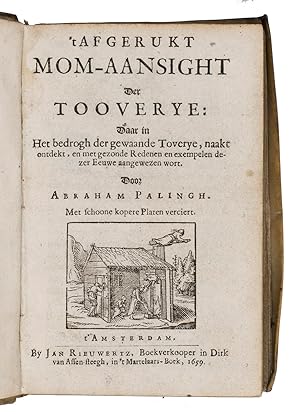 More images
Published by J. Rieuwertz,, Amsterdam,, 1659
- First Edition
Seller: Antiquariaat FORUM BV, Houten, NetherlandsAntiquariaat FORUM BV
Contact seller5-star sellerCondition: Used
US$ 8,788.71
US$ 28.44 shippingShips from Netherlands to Hong KongQuantity: 1 available
Add to basketAn exceptionally rare first edition of a book focusing on the subjects of witchcraft, sorcery, demonology, and black magic. The author passionately expresses his dissatisfaction with the brutalities inflicted upon individuals accused of being witches, using vivid and disturbing illustrations as evidence. Notably, the book featur…es a captivating woodcut title vignette, depicting a witch's daring escape through a chimney. In the image, her legs hang from the opening inside the house, while she simultaneously rises on her broom outside the chimney, creating a striking visual effect. Abraham Palingh is a somewhat elusive figure in Early Modern Dutch literature and his book provides a fascinating insight into the attitudes of an educated man toward witchcraft. He claims that his 't Afgerukt Mom-aansight Der Tooverye is based on firsthand accounts. Information regarding the occurrence of harmful sorcery and attitudes towards sorcery in Amsterdam and Haarlem has been documented from the initial witchcraft trials to the point where such crimes were no longer a concern for the judiciary. Between 1542 and 1566, trials for harmful sorcery took place in Amsterdam, while Haarlem witnessed similar trials in 1549. Historical accounts of both cities, as well as Jacobus Scheltema's History of Witch Trials (published in Haarlem in 1828), make mention of sorcery trials in Amsterdam. However, these references often provide only superficial details, despite the potential for valuable insights found in the actual procedural documents. Conversely, little information about witchcraft in Haarlem can be gleaned from existing literature. Abraham Palingh, author of 't Afrukt Mom-aansight der Tooverye (published in Haarlem in 1659), briefly mentions a few cases of sorcery accusations that he claims to have personally known, yet his accounts remain vague.The fine and copperplate illustrations were made by Salomon Savry (1594-1683). He was a recognised engraver of his time, highly involved with the Amsterdam book industry of the seventeenth century. Some wear to binding. Ex libris from the library of Leontine Buijnsters-Smets. Light browning and foxing. Otherwise in very good condition.l Bibl. Med. Neerl. I, p.150; Muller 539 (1725 edition); Scheepers I, 552; STCN 841091951 (12 copies); Waller 1315 (1725 edition); WorldCat 56854247 (3 copies). Contemporary overlapping vellum. With a woodcut title-vignette showing a witch on a broomstick leaving a house through the chimney (4.3 x 5.2 cm), 13 etched full-page illustrations on 8 plates by Salomon Savry. Pages: [16], 429, [19] pp.
Also in these catalogs: Alchemy
Seller Inventory # ABC_47611


