
Ulysses by Joyce: First Edition (21 results)

Published by Sylvia Beach, [1922, Book Date], Paris, 1922
- Hardcover
- First Edition
Seller: TBCL The Book Collector's Library, Montreal, QC, CanadaTBCL The Book Collector's Library
Contact seller5-star sellerAssociation member: IOBA
Condition: Used
US$ 375.00
US$ 50.00 shippingShips from Canada to Hong KongQuantity: 2 available
Add to basketNo Binding. Condition: Not A Book. Dust Jacket Condition: Clamshell As New. Custom Clamshell Case. Custom Clamshell Case. No Binding. First Edition Clamshell Case. Beautiful clamshell first edition leather bookcase. [Not with Book].Superbly HAND-CRAFTED by our conservation team, the First Edition box is gilt-lettered & dated on…the spine & features an embossed [sculpted] upper cover 'ULYSSES' typographical design. The case's exterior is finished in a fine black calf & the inside in a fine Ulysses Blue cloth. The box is perfectly sized to accommodate the true first edition. A Terrific Collector's Custom Case for an important Book. TBCL Web Site photo/link available for more than 100 of generally in-stock titles. Custom Craft available.
 More images
Published by Egoist Press, London, 1922
- Hardcover
- First Edition
Seller: Quill & Brush, member ABAA, Middletown, MD, U.S.A.Quill & Brush, member ABAA
Contact seller5-star sellerCondition: Used
US$ 6,000.00
US$ 35.00 shippingShips from U.S.A. to Hong KongQuantity: 1 available
Add to basketFirst Edition. First UK edition. Printed in France from the plates of the original Shakespeare and Company edition (just nine months after the first). Number 1299 of 2,000 numbered copies. Finely re-bound in large 8vo gilt-stamped full blue leather with edges slightly trimmed (by approximately 5 mm) and the original paper covers… bound in. The separately published 7-page errata that would have originally been laid in is not present here but facsimile copy is provided. Very good to near fine with original paper covers showing small amount of edge wear, minor damp staining to bottom tips of several leaves, and covers toned to light brown on spine and along edges. [Slocum & Cahoon A18].
 More images
- Softcover
- First Edition
Seller: Jim Crotts Rare Books, LLC, Clemmons, NC, U.S.A.Jim Crotts Rare Books, LLC
Contact seller2-star sellerCondition: Used
US$ 6,950.00
US$ 29.50 shippingShips from U.S.A. to Hong KongQuantity: 1 available
Add to basketLimited edition #1532 of 2000. First UK edition (printed in France). 732 pp. Hardcover in plain paper wrapped boards and blue cloth spine with gilt title. Inner hinges loosening, but binding still solid. Previous owner's bookplate on front pastedown. Handmade paper. Though this is the first edition of Joyce's masterpiece by an E…nglish publisher, it was published in Paris by John Rodker for the Egoist Press, as the book was still outlawed in the UK and US. Rodker used the original plates from the Shakespeare & Company first edition of February of the same year. This copy includes the eight pages of errata laid-in. This copy also carries the provenance of Claudius Edmund Delbos, M.A., LL.D. (June 28, 1878 - January 27, 1949), AKA "C. Edmund Delbos" Delbos was a renowned landscape painter and etcher. Born in London, England, to Clara Ann Ralph (b. 1854) and Leon Edmond Delbos (1850 - November 13, 1915). His given name was "Claudius," later shortened to "Claude," and later dropped completely when he became known as "C. Edmund Delbos." His father, Leon, was a professor of languages at King's College, London, England, and was a noted author and editor as well as having served as an officer-instructor in the British Navy and as the general editor and examiner for the University of Oxford. He was the author of over a dozen books on a variety of topics. Claudius Edmund Delbos was educated both in England and France. Though born in London, part of his youth was spent in Dartmouth Harbor, Devon, where his father worked for the Royal Navy. His cousin was the painter Henri Regnault and Delbos himself was a student in Paris, France of the artist Adolphe Dechenaud (June 28, 1868 -1929) with whom he shared a birthday. He was the elder brother of American painter Julius Maximilian Delbos (1879-1970) who also like his brother worked for a time as a teacher of art, music and French at schools in Connecticut, New Hampshire, and New York City. Their nephew, Claude Meyer Delbos, was also an artist who lived and worked in France. An academic like his father, Claudius Delbos first taught at Downside Abbey in Bath, England and in 1904 he arrived at Montreal to teach at the prestigious Upper Canada College Preparatory School, located in Toronto, Canada. Delbos served at the school from 1904 through 1908. He came to the United States permanently around 1910 to take up his longest appointment, from 1910 through 1925, as the headmaster of the Newman School (closed 1942), which was located first in Hackensack, New Jersey and later moved to Lakewood (where his brother Julius also resided between 1920 and 1927). Delbos was a respected bibliophile and editor, and among works he edited were: España and Émaux et Camées by Théophile Gautier (1907), and Poésies choisies de Alfred de Musset (1925). A portion of his extensive rare book holdings were sold through Parke-Bernet Galleries in New York City in 1943. He is also known to have been a friend and mentor of F. Scott Fitzgerald (1896-1940), who attended the Newman School, where he served as one of the associate editors of the school paper, the Newman News. Letters between Fitzgerald and Delbos are included in Andrew Turnbull's book The Letters of F. Scott Fitzgerald (1963). Though Delbos depicted many European scenes during his career, including those at Pont Aven, Brittany, San Gimignano, Italy, and in Devonshire, England, he became known in America for his scenes of Massachusetts, in particularly of the villages and towns of Gloucester, Lanesville, and Rockport. In fact, he was part of a group of "artist activists" in Gloucester, where he had a summer home and studio during the 1930s named "Tighnamara," which was located at Bass Rocks. The group included Delbos himself and fellow artists John Barry, Theresa Bernstein, Frederick L. Stoddard, and William Meyerowitz. They were influential in helping to establish, in 1933, an art exhibition that featured the work of Cape Ann artists which were featured at local businesses in the center of Gloucester. The Michigan History Magazine noted during his lifetime that Delbos was " . . . well-known for his landscape paintings and etchings." After decades as a bachelor, on November 15, 1924 Delbos married Marie Hall Fuger (September 7, 1872 - November 30, 1961), widow of Lieutenant William Frederick Fuger (February 21, 1869 - November 26, 1915). Her family had owned the famous estate "Tonnancour," located on the shores of Lake St. Clair in Michigan. How they met in unknown, as Delbos is not known to have settled in the Detroit area until after his marriage. However, it is likely that they met during his last years as headmaster at the Newman School, perhaps while she was visiting with friends in New York City. They eventually settled just outside Detroit, where they resided at 333 Lincoln Road, Grosse Pointe, Michigan. In December of 1938 he petitioned the Michigan courts for United States citizenship. He and his wife were very active in several art groups. Delbos himself was a member of the Artists Market; the Detroit Society of Arts and Crafts; The Detroit Symphony Society; the Fine Arts Society; the Gloucester Society of Artists; the Grosse Pointe Artists Association; and the Detroit Museum of Arts Founders Society. He was a donor of money and objects to multiple museums, including the Detroit Institute of Arts (where he gave a Rohlfs tempera and Guercino drawing), and the Toledo Museum of Art (where he donated an oil by William Frederick Mayor). Delbos was also was a benefactor who helped to mount a major exhibition of paintings by Polish artists at the end of World War II (Polish Paintings: a Loan Exhibition, June 1st to July 1st 1945, at the Detroit Institute of Arts in association with the Friends of Polish Art). Delbos exhibited widely, and there are doubtless more exhibitions yet unknown that could be added to the following list of known exhibitions in which he participated during his lifetime: Detroit Society of Arts and Cr.
 More images
- Softcover
- First Edition
Seller: John Windle Antiquarian Bookseller, ABAA, San Francisco, CA, U.S.A.John Windle Antiquarian Bookseller, ABAA
Contact seller4-star sellerCondition: Used
US$ 7,950.00
US$ 35.00 shippingShips from U.S.A. to Hong KongQuantity: 1 available
Add to basketParis: John Rodker for the Egoist Press, 1922. 4to, [15], 732, (1)pp. Later half black morocco, gilt top, backstrip richly gilt, original Aegean blue printed wrappers bound in. A very good copy tastefully bound and preserving the iconic wrappers. § First UK edition, number 715 of 2,000 copies printed (500 were seized and burned…by the U.S. customs upon arrival); with half-title and 7 pages of errata at the front. Long bookseller's note in pencil at back (by John Howell-Books), priced $75. Joyce's ground-breaking modernist novel was first serialized in the American journal The Little Review and was the target of the first of many censorship attempts soon after the publication of the Nausicaa episode. Despite being banned in the UK and suppressed in the US well into the 1930s the novel was recognized as a landmark in literature from its earliest reviews. "I hold this book to be the most important expression which the present age has found; it is a book to which we are all indebted, and from which none of us can escape." - T.S. Eliot. Slocum & Cahoon A18.
 More images
Published by Egoist Press, London, 1922
- Softcover
- First Edition
Seller: Passages Bookshop, Portland, OR, U.S.A.Passages Bookshop
Contact seller5-star sellerAssociation member: CBA
Condition: Used
US$ 11,500.00
US$ 42.00 shippingShips from U.S.A. to Hong KongQuantity: 1 available
Add to basketFirst UK edition. 732 pp., 7.25 x 9 inches. Sewn signatures glued into printed paper covers. One of two thousand numbered copies on handmade paper. Accompanied by separate errata sheet, folded twice to make eight pages. Printed by Maurice Darantiere in October, 1922. Light soiling to covers, and wear and chipping to edges, with…some creasing to spine and normal toning to pages, otherwise a very good and unaltered copy, and very uncommon thus. The uncut errata sheet has a light stain along the leading edge, not affecting the text. Housed in a quarter-leather and cloth clamshell case, with color cover label reproducing the front cover of the book; the case is clean and tight, attractive despite a very faint stain on the top edge and a few stray marks on the back. The second printing (and first British edition) of Joyce's landmark novel, printed for John Rodker in London, eight months after the first printing for Shakespeare and Company in Paris, by the same printer in Dijon, France. With a new title page and front matter, and the first appearance of the errata. A nice, sound copy in the original and now iconic blue printed wrappers, almost always found rebound and/or repaired, and rarely with the scarce errata sheet.
 More images
Published by EGOIST, 1922
- Softcover
- First Edition
Seller: Vagabond Books, A.B.A.A., PASADENA, CA, U.S.A.Vagabond Books, A.B.A.A.
Contact seller3-star sellerCondition: Used - Near fine
US$ 12,500.00
US$ 60.00 shippingShips from U.S.A. to Hong KongQuantity: 1 available
Add to basketSoft cover. Condition: Near Fine. First Edition. A very good plus first edition. London: Published for the Egoist Press, 1922. First English edition, printed in France. Limited to 2,000 copies on handmade paper, of which this is number 1,591. Large octavo. [xii], 732 pages. Publisher's original paper wrappers, Untrimmed. With er…rata laid in. Housed in a matching green cloth chemise and slipcase, chemise with brown leather label lettered in gilt.the spline is almost near fine. A few spots not affecting text.
 More images
Published by Shakespeare and Company, Paris, 1922
- First Edition
Seller: Whitmore Rare Books, Inc. -- ABAA, ILAB, Pasadena, CA, U.S.A.Whitmore Rare Books, Inc. -- ABAA, ILAB
Contact seller5-star sellerCondition: Used - Very good
US$ 17,500.00
US$ 35.00 shippingShips from U.S.A. to Hong KongQuantity: 1 available
Add to basketCondition: Very Good +. First edition. One of 750 copies on handmade paper, from the wider first edition limitation of 1,000 copies. Based on Sylvia Beach's records, it has been asserted that, out of the three issues of the first edition, this one was sent out first. This copy marked as number 482. Modern blue half morocco gilt…over marbled boards, bookplate of Giles Alexander Esme Gordon to front pastedown. Front free endpaper with some marginal restoration, a few small unrestored closed tears to preliminary leaves, a little occasional foxing, a few gatherings a little roughly opened. Housed in a custom morocco-backed clamshell case. A Very Good+ copy. Arguably the key text of the Modernist movement. "Joyce, not to mince words, is Ireland's Shakespeare, its Goethe, its Racine, its Tolstoy" (John Sutherland). The book also proved to be a major test case for laws of freedom of expression. "Forced underground by censors, this was a cryptoclassic already before it was read, a subversive colossus" (Sherry). Provenance: Giles Gordon was a literary agent and writer, working for publishers Secker & Warburg and Gollancz (the latter as Editorial Director) before representing writers such as Peter Ackroyd and Vikram Seth. Slocum and Cahoon A17. (7586). Very Good +.
 More images
Language: English
Published by Shakespeare and Company, Paris, 1922
- Hardcover
- First Edition
Seller: Westsider Rare & Used Books Inc., New York, NY, U.S.A.Westsider Rare & Used Books Inc.
Contact seller4-star sellerCondition: Used - Near fine
US$ 20,000.00
US$ 126.00 shippingShips from U.S.A. to Hong KongQuantity: 1 available
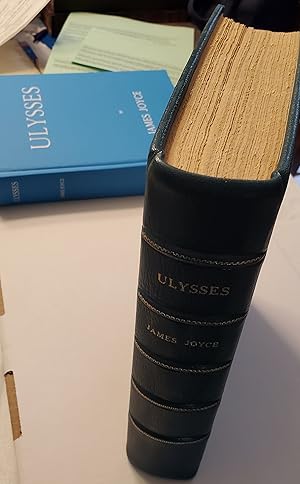
Add to basketHardcover in slipcase. Condition: Near Fine. No Jacket. Limited Edition. First Edition, One of 750 numbered copies on handmade paper from a total edition of 1000 copies, this being No. 310. Quarto, bound in full blue morocco. The original wraps are bound in. Near Fine in bespoke slipcase with blue morocco spine, five raised band…s and gilt lettering.
 More images
Published by Shakespeare and Company, Paris, 1922
- Hardcover
- First Edition
Seller: Virginia Books & More, Spotsylvania, VA, U.S.A.Virginia Books & More
Contact seller5-star sellerCondition: Used - Near fine
US$ 22,202.40
US$ 60.00 shippingShips from U.S.A. to Hong KongQuantity: 1 available
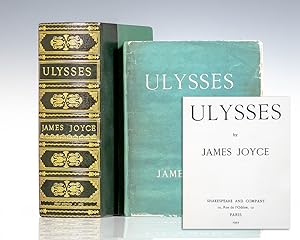
Add to basketHardcover. Condition: Near Fine. 1st Edition. This is the original 1922 text, limited to 1000 copies published by Shakespeare and Company, this being # 784 (used for the Orchises Press facsimile). Rebound in teal green, the color to which most of the 1922 covers have oxidized. The front cover is bound into the text. Clean throug…hout, deckle edges. Please see my attached photos. More photos and information available on request.
Published by Shakespeare and Company, Paris, 1922
- Softcover
- First Edition
Seller: Raptis Rare Books, Palm Beach, FL, U.S.A.Raptis Rare Books
Contact seller5-star sellerCondition: Used
US$ 25,000.00
US$ 55.00 shippingShips from U.S.A. to Hong KongQuantity: 1 available
Add to basketFirst edition of Joyce's masterpiece, one of 750 numbered copies printed on handmade paper from a total edition of 1000 copies, this is number number 817. Thick quarto, original blue and white wrappers. In very good condition with some expert restoration to the spine and a crease to the front wrapper which has been coloured. Hou…sed in a custom half morocco chemise and clamshell box. Ulysses was published in Paris by Shakespeare & Company, 1922. It was a struggle for the author to find a publisher, a comic irony considering that Ulysses is "[u]niversally hailed as the most influential work of modern times" (Grolier Joyce 69). Ulysses was an immediate success. The first printing sold out, and "within a year Joyce had become a well-known literary figure. Ulysses was explosive in its impact on the literary world of 1922" (de Grazia, 27). Even so, the book faced difficulties in global reception. It was banned in the U.K. and was prosecuted for the obscenity in the Nausicaa episode (Ellmann, 1982). Joyce's inspiration for the novel began as a young boy reading Charles Lamb's Adventures of Ulysses and writing an essay entitled "My Favorite Hero" after being impressed by the wholeness of the character (Goreman, 1939). The idea for the novel grew from a story in Dubliners in 1906, which Joyce expanded into a short book in 1907, before reconceptualizing it as the heady novel in 1914 (Ellmann, 1982). The book can initially seem unstructured and chaotic, and Joyce admitted that he "put in so many enigmas and puzzles that it will keep the professors busy for centuries arguing over what I meant" (The Observer, 2000). The French translator Stuart Gilbert published a defense of Ulysses shortly after its publication in which he supported the novel's use of obscenity and explained its internal structure and links to the Odyssey against accusations of ambiguity. Every episode, Gilbert explained, is connected to the Odyssey by theme, technique, and correspondence between characters. Another instance of Ulysses' literary contribution is his use of stream-of-consciousness, a technique employing carefully structured prose, both humorous and charactering, and involving puns and parodies. Joyce was a precursor to the use of stream of consciousness in the later decades. Similar narrative techniques were used by his contemporaries Virginia Wolfe, William Faulkner, and Italo Svevo. Their style can be better characterized as an "interior monologue, rather than stream of consciousness, is the appropriate term for the style in which [subjective experience] is recorded, both in The Waves and in Woolf's writing generally" (Stevenson, 1992).

Published by Shakespeare and Company, Paris, 1922
- Hardcover
- First Edition
Seller: Raptis Rare Books, Palm Beach, FL, U.S.A.Raptis Rare Books
Contact seller5-star sellerCondition: Used
US$ 25,000.00
US$ 55.00 shippingShips from U.S.A. to Hong KongQuantity: 1 available
Add to basketFirst edition, first printing of Joyce's masterpiece, one of 750 numbered copies printed on handmade paper from a total edition of 1000 copies, this is number 909. Thick quarto, bound in full morocco by Baker Bindery with gilt titles and tooling to the spine in six compartments within raised gilt bands, triple gilt ruling to the… front and rear panels, gilt turn-ins and wide gilt scrolled inner dentelles, marbled endpapers, top edge gilt. In near fine condition. An exceptional example. Ulysses was published in Paris by Shakespeare & Company, 1922. It was a struggle for the author to find a publisher, a comic irony considering that Ulysses is "[u]niversally hailed as the most influential work of modern times" (Grolier Joyce 69). Ulysses was an immediate success. The first printing sold out, and "within a year Joyce had become a well-known literary figure. Ulysses was explosive in its impact on the literary world of 1922" (de Grazia, 27). Even so, the book faced difficulties in global reception. It was banned in the U.K. and was prosecuted for the obscenity in the Nausicaa episode (Ellmann, 1982). Joyce's inspiration for the novel began as a young boy reading Charles Lamb's Adventures of Ulysses and writing an essay entitled "My Favorite Hero" after being impressed by the wholeness of the character (Goreman, 1939). The idea for the novel grew from a story in Dubliners in 1906, which Joyce expanded into a short book in 1907, before reconceptualizing it as the heady novel in 1914 (Ellmann, 1982). The book can initially seem unstructured and chaotic, and Joyce admitted that he "put in so many enigmas and puzzles that it will keep the professors busy for centuries arguing over what I meant" (The Observer, 2000). The French translator Stuart Gilbert published a defense of Ulysses shortly after its publication in which he supported the novel's use of obscenity and explained its internal structure and links to the Odyssey against accusations of ambiguity. Every episode, Gilbert explained, is connected to the Odyssey by theme, technique, and correspondence between characters. Another instance of Ulysses' literary contribution is his use of stream-of-consciousness, a technique employing carefully structured prose, both humorous and charactering, and involving puns and parodies. Joyce was a precursor to the use of stream of consciousness in the later decades. Similar narrative techniques were used by his contemporaries Virginia Wolfe, William Faulkner, and Italo Svevo. Their style can be better characterized as an "interior monologue, rather than stream of consciousness, is the appropriate term for the style in which [subjective experience] is recorded, both in The Waves and in Woolf's writing generally" (Stevenson, 1992).
 More images
Published by 1922, 1922
- Hardcover
- First Edition
Seller: Ulysses Rare Books Ltd. ABA, ILAB, Dublin , IrelandUlysses Rare Books Ltd. ABA, ILAB
Contact seller4-star sellerCondition: Used - Very good
US$ 26,366.13
US$ 22.75 shippingShips from Ireland to Hong KongQuantity: 1 available
Add to basketHardcover. Condition: Very Good. 1st Edition. According to Sylvia Beach's Ulysses Notebook this copy was sold to a George Wythe, in March 25, 1922. [Slocum & Cahoon A17].
 More images
Published by Paris: Shakespeare and Company,, 1922
- Hardcover
- First Edition
Seller: Yves G. Rittener - YGRbookS, Zürich, SwitzerlandYves G. Rittener - YGRbookS
Contact seller5-star sellerCondition: Used - As new
US$ 28,999.18
US$ 43.23 shippingShips from Switzerland to Hong KongQuantity: 1 available
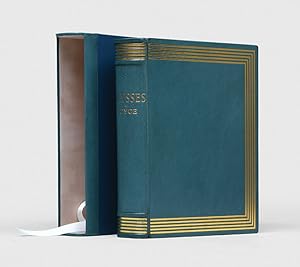
Add to basketHardcover. Condition: Wie neu. Dust Jacket Condition: Wie neu. 1. Auflage. First Edition, First Printing. This is number 959 of the edition of 750 numbered copies (of a total edition of 1000 copies). Original blue wrappers - front and back - bound in. A tall copy (leaf size 183 by 235mm) in near fine state: the wrappers very fre…sh, the pages clean, only the edges slightly browning. Most beautifully bound in different dark blue leathers by renowned Swiss bookbinder Jean Luc Honegger (and signed by him). While we always prefer unbound books in their original condition, Ulysses is such a fragile book that we have come to love bound issues: you can take the book into your hands ("yes"), read it ("yes") and appreciate it much more ("Yes.").
 More images
Published by Paris: Shakespeare and Company, 1922, 1922
- First Edition
Seller: Peter Harrington. ABA/ ILAB., London, United KingdomPeter Harrington. ABA/ ILAB.
Contact seller5-star sellerCondition: Used
US$ 34,280.54
US$ 29.29 shippingShips from United Kingdom to Hong KongQuantity: 1 available
Add to basketFirst edition, number 418 of 750 copies on handmade paper numbered 251 to 1,000. This attractive copy is finely bound, retaining the distinctive original blue wrappers at the front and rear. The edition was published on 2 February 1922 in imitation of the traditional three-tiered French format, which was aimed at both connoisseu…rs and general readers. It consisted of 100 signed copies on Dutch handmade paper, 150 large-paper copies printed on heavier vergé d'Arches, and 750 copies on vergé à barbes, which formed the trade issue. One of the key texts of 20th-century modernist literature, Ulysses also proved a major test case for laws of freedom of expression. "Forced underground by censors, this was a cryptoclassic already before it was read, a subversive colossus" (Sherry, p. 1). Its creator is considered one of the great geniuses of modern literature: "Joyce, not to mince words, is Ireland's Shakespeare, its Goethe, its Racine, its Tolstoy" (Sutherland). Horowitz, Census, p. 121; Slocum & Cahoon A17. Brian Patrick Duggan, Saluki: The Desert Hound and the English Travelers Who Brought It to the West, 2014; Vincent Sherry, Joyce: Ulysses, 2004; John Sutherland, "Ireland's Shakespeare", The Guardian, 10 Feb. 2004. Small quarto (234 x 184 mm). Finely bound by the Chelsea Bindery in greenish blue morocco, spine lettered in gilt, quintuple gilt ruled border to spines and covers, turn-ins ruled in gilt, cream endpapers, top edge gilt, others untrimmed, original wrappers bound in. Housed in a matching leather entry slipcase by the Chelsea Bindery. A fine copy.
 More images
Published by Shakespeare and Company, Paris, 1922
- Hardcover
- First Edition
Seller: Baughman's Modern Firsts, Toledo, OH, U.S.A.Baughman's Modern Firsts
Contact seller4-star sellerCondition: Used
US$ 37,800.00
US$ 9.00 shippingShips from U.S.A. to Hong KongQuantity: 1 available
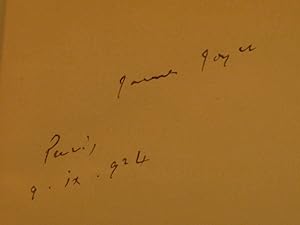
Add to basketSlocum Bibliography #17. Joints are cracked. Otherwise fine condition. Beautiful leather binding decorative stamped gold inner dentelles. Marbled paper endpapers. Two blank flyleaves. Original blue paper covers with fold over edges trimmed off. Top edge gilt Limited edition, #448 of 1000 copies. One of 750 copies printed on hand…made paper.
 More images
Published by Shakespeare and Company, Paris, 1922
- Hardcover
- First Edition
- Signed
Seller: Brainerd Phillipson Rare Books, Holliston, MA, U.S.A.Brainerd Phillipson Rare Books
Contact seller5-star sellerAssociation member: SNEAB
Condition: Used - Very good
US$ 40,000.00
US$ 60.00 shippingShips from U.S.A. to Hong KongQuantity: 1 available
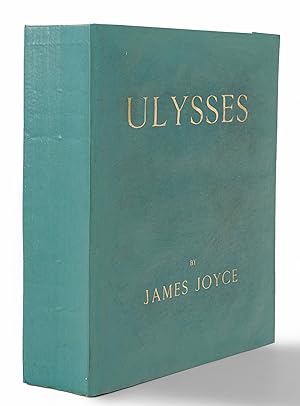
Add to basketHardcover. Condition: Very Good. No Jacket. Specially bound in full leather in 2 volumes. This is number 389 of a the special 750 copies printed on handmade, laid paper. Signed and dated in ink by James Joyce: "James Joyce, Paris, 9. ix. 1924" on the front endpaper following the front blue wrapper. Joyce's Signature has been aut…henticated by Glenn Horowitz of NYC. Volume I contains 370 pages. Volume II begins on page 371 and and ends on p. 732 with the "Trieste-Zurich-Paris, 1914-1921" dateline. The next page is printed in capital letters: "Printed for Sylvia Beach by Maurice Darantiere at Dijon, France." The rear wrapper is not present at the end of volume two. Both volumes have been specially bound in full leather with 4 gilt rectangular rules and a delicate inner rectangle of hand-tooled chain patterns culminating in larger floral designs at the inside corners of the front and rear boards. Handsomely rebacked in leather spines with gold rules and title. Both front boards bear the name of "JOAN" in vertical gilt capital letters. Possibly a reference to Joan Bridges Baez, the mother of Joah Baez.The front blue wrapper printed in white with "Ulysses" by James Joyce is clean and crisp, as is the text throughout volumes one and two. Apparently, the pages have been trimmed. The front blue wrapper measures: 9 x 7 All pages of text measure 9 x nearly 7 . The right side margins measure 1.25 ; top margins measure 1 from the text to the top edge. The bottom margins measure a tad under 1.5 . The left, inside margins measure .75 . The top edges are gilded. And there are predominantly orange and grey marbled endpapers. There is hand-tooled dentelle gilding along the front and rear inside edges of the boards as well. Despite the unusual two-volume format and the missing rear wrapper, modern first edition authority Allen Ahearn opined that this signed and dated copy in Joyce's hand of one of the 750 specially printed first editions is perhaps as scarce as one of the 100 signed copies, given that none of the 750 copies was issued with Joyce's signature. This copy was signed and dated two years after publication in 1924. This edition is limited to 1000 copies: 100 copies (signed) on Dutch handmade paper numbered from 1 to 100; 150 copies on vergé d'Arches numbered from 101 to 250; 750 copies on handmade paper numbered from 251 to 1000. This is copy No. 389. "The publisher asks the reader s indulgence for typographical errors unavoidable in the exceptional circumstances. S.B." In a review in The Dial, T.S. Eliot said of Ulysses: "I hold this book to be the most important expression which the present age has found; it is a book to which we are all indebted, and from which none of us can escape." He went on to claim that Joyce was not at fault if people after him did not understand it: "The next generation is responsible for its own soul; a man of genius is responsible to his peers, not to a studio full of uneducated and undisciplined coxcombs." The book has its critics; Virginia Woolf stated that "Ulysses was a memorable catastrophe immense in daring, terrific in disaster." Ulysses has been called "The most prominent landmark in modernist literature", a work where life's complexities are depicted with "unprecedented, and unequalled, linguistic and stylistic virtuosity." That style has been stated to be the finest example of the use of stream-of-consciousness in modern fiction, with the author going deeper and farther than any other novelist in handling interior monologue. This technique has been praised for its faithful representation of the flow of thought, feeling, mental reflection, and shifts of mood. (Wikipedia) First Edition, One of 750 numbered copies. Seller Inventory # 310. First and special edition: This is number 389 of a the special 750 copies printed on handmade, laid paper. Signed and dated in ink by James Joyce: "James Joyce, Paris, 9. ix. 1924" on the front endpaper following the front blue wrapper. Signed and dated by Author.
 More images
Published by James Joyce, 1922
- Softcover
- First Edition
Seller: Barry Lawrence Ruderman, La Jolla, CA, U.S.A.Barry Lawrence Ruderman
Contact seller5-star sellerCondition: Used - Very good
US$ 45,000.00
US$ 1.00 shippingShips from U.S.A. to Hong KongQuantity: 1 available
Add to basketSoft cover. Condition: VG. 1st Edition. First Edition: Number 775 of 1000 copies, on handmade paper Paris: Shakespeare and Company, 1922. The New York periodical The Little Review started publishing Ulysses serially, with 23 installments appearing fr. Quarter. Original light blue paper wrappers (expertly restored) with white let…tering on recto. Printed on handmade white laid paper. Uncut (deckled edges). First and terminal blanks inserted under folding flaps of outer front and back covers. Housed in custom green half-morocco clamshell case. [3], 732 First Edition: Number 775 of 1000 copies, on handmade paper Paris: Shakespeare and Company, 1922. The New York periodical The Little Review started publishing Ulysses serially, with 23 installments appearing from 1918 to 1920, until the "Nausicaa" episode resulted in a 1921 obscenity trial, forcing the editors Margaret Anderson and Jane Heap to cease publication. London's The Egoist also started serial publication, with five episodes appearing in 1919, until editor Harriet Shaw Weaver ran into trouble finding printers and some subscribers lodged complaints and canceled subscriptions (Arnold). Following these roadblocks, Sylvia Beach, of Shakespeare and Company, offered to publish the condemned novel. The collaboration allowed Joyce to deeply involve himself with the printing; he became set on having the covers the blue of the Greek flag at the time, reflecting the Hellenic origins of Ulysses. This proved an arduous task, necessitating several visits to Paris for the Dijon-based printer Maurice Darenti re to match the color. Not finding the right color on the right paper, Darenti re had white cardboard lithographed to the blue. Published in February 1922, Ulysses was quickly banned by the United States, England, Canada, and Australia. Copies sold swiftly in Paris, many of those smuggled and subsequently confiscated and destroyed by customs officials (Vanderham). Book.
 More images
- Softcover
- First Edition
Seller: Henry Sotheran Ltd, London, United KingdomHenry Sotheran Ltd
Contact seller5-star sellerCondition: Used
US$ 54,848.87
US$ 53.25 shippingShips from United Kingdom to Hong KongQuantity: 1 available
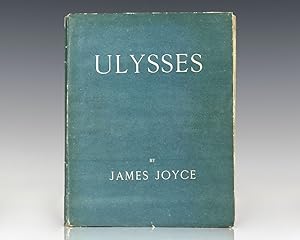
Add to basketParis: Shakespeare and Company. 1922. 4to. Original blue wrappers, titles to cover in white; pp. 732, uncut; spine, hinges and extremities expertly repaired; a very good copy, housed in a custom quarter brown calf over blue cloth book form box, lettered in gilt to the spine; early bookplate 'Ex Libris Yester House' to front free… endpaper (see below).First edition, number 442 of 750 copies on handmade paper numbered 251 to 1,000; the copy sold to the poet E. E. Cummings according to Sylvia Beach's records.'Ulysses is not a great novel in the sense of A la recherche du temps perdu. The characters do not develop. It has no consistent tragic grandeur and bogs down in several stylistic exercises which have nothing to do with the novel proper; yet the early Dedalus section, the middle parts of Bloom and the Nightown orgy and Molly's final reverie stand out like Gaudi's unfinished cathedral. The whole plan fails through Joyce's intellectual preference for language rather than people - yet somehow it does achieve greatness like a ruined temple soaring from a jungle - and should be judged perhaps as a poem, a festival of the imagination' (Connolly, 100 Key Books of the Modern Movement).Cyril Connolly's judgement stands as a fair summation of this astonishing novel - discursive, baffling, funny, moving, a unique mingling of highbrow allusion and quotidian detail. It is as dazzling a display of stylistic virtuosity as has ever been attempted in prose, to the extent that it might not even be prose any more, and it is all in the service of a narrative that does nothing more than illuminate one day in the life of an ordinary man. It is a celebration of the individual that expresses the deep richness of human existence by drawing the parallels between the feats of classical heroes and the deeds of everyday life.It was also, famously, judged to be so obscene after excerpts of the work in progress were published in the American journal The Little Review between 1918 and 1920 that no mainstream publisher would touch it. Indeed, British printers were forbidden from printing it. It would take Sylvia Beach, the visionary owner of Shakespeare and Company in Paris, to publish this, the first edition in book form, in a strictly limited run on Joyee's fortieth birthday on 2 February 1922. The first UK edition, published by The Egoist Press in the October of the same year, had to use Beach's printer in Dijon, Darantiere, and her plates to obviate the legal restrictions. The very existence of this work in print, then, is due to the perseverance and commitment of Sylvia Beach. Beach met Joyce at a tea party in 1920 and got to know him and his work after he joined her lending library; from such low-key beginnings quickly grew a creative partnership that would shape literary history. Shakespeare and Company gained considerable fame from the publication of Ulysses but actually lost financially after Joyce signed with another publisher and left Beach in debt caused by bankrolling the printing and distribution of his masterpiece, the first book she had ever published. Nevertheless, she seems never to have seriously regretted her part in the production of this cultural behemoth, a book for which T. S. Eliot wrote in awestruck tones: 'I hold Ulysses to be the most important expression which the present age has found; it is a book to which we are all indebted, and from which none of us can escape'.Provenance: According to Sylvia Beach's records, copy number 442 was sold to the poet E. E. Cummings in February 1922. The copy has an alternative provenance: Mary Mowbray-Clarke, proprietor of The Sunwise Turn bookshop in New York City, records copy no. 442 arriving at her shop in January 1923. The Yester House of the elegant bookplate is located in Mobile, Alabama and is now called Carolina Hall. It is listed on the National Register of Historic Places. We are not sure who was living there in 1922 but in 1955 a William Clay Perdue and his wife Martha took over the property.Slocum & Cahoon A17.
Published by Shakespeare and Company, Paris, 1922
- Softcover
- First Edition
Seller: Raptis Rare Books, Palm Beach, FL, U.S.A.Raptis Rare Books
Contact seller5-star sellerCondition: Used
US$ 75,000.00
US$ 55.00 shippingShips from U.S.A. to Hong KongQuantity: 1 available
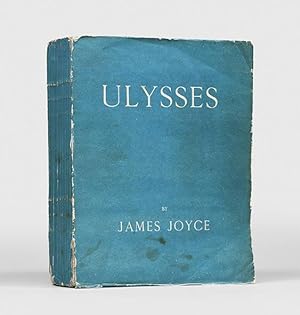
Add to basketFirst edition of Joyce's masterpiece, one of 750 numbered copies printed on handmade paper from a total edition of 1000 copies, this is number 276. Thick quarto, original blue and white wrappers. In near fine condition, square and tight with a touch of rubbing to the crown and foot of the spine. Housed in a custom slipcase. An e…xceptional example. Ulysses was published in Paris by Shakespeare & Company, 1922. It was a struggle for the author to find a publisher, a comic irony considering that Ulysses is "[u]niversally hailed as the most influential work of modern times" (Grolier Joyce 69). Ulysses was an immediate success. The first printing sold out, and "within a year Joyce had become a well-known literary figure. Ulysses was explosive in its impact on the literary world of 1922" (de Grazia, 27). Even so, the book faced difficulties in global reception. It was banned in the U.K. and was prosecuted for the obscenity in the Nausicaa episode (Ellmann, 1982). Joyce's inspiration for the novel began as a young boy reading Charles Lamb's Adventures of Ulysses and writing an essay entitled "My Favorite Hero" after being impressed by the wholeness of the character (Goreman, 1939). The idea for the novel grew from a story in Dubliners in 1906, which Joyce expanded into a short book in 1907, before reconceptualizing it as the heady novel in 1914 (Ellmann, 1982). The book can initially seem unstructured and chaotic, and Joyce admitted that he "put in so many enigmas and puzzles that it will keep the professors busy for centuries arguing over what I meant" (The Observer, 2000). The French translator Stuart Gilbert published a defense of Ulysses shortly after its publication in which he supported the novel's use of obscenity and explained its internal structure and links to the Odyssey against accusations of ambiguity. Every episode, Gilbert explained, is connected to the Odyssey by theme, technique, and correspondence between characters. Another instance of Ulysses' literary contribution is his use of stream-of-consciousness, a technique employing carefully structured prose, both humorous and charactering, and involving puns and parodies. Joyce was a precursor to the use of stream of consciousness in the later decades. Similar narrative techniques were used by his contemporaries Virginia Wolfe, William Faulkner, and Italo Svevo. Their style can be better characterized as an "interior monologue, rather than stream of consciousness, is the appropriate term for the style in which [subjective experience] is recorded, both in The Waves and in Woolf's writing generally" (Stevenson, 1992).
 More images
Published by Paris: Shakespeare and Company, 1922, 1922
- First Edition
Seller: Peter Harrington. ABA/ ILAB., London, United KingdomPeter Harrington. ABA/ ILAB.
Contact seller5-star sellerCondition: Used
US$ 75,417.19
US$ 29.29 shippingShips from United Kingdom to Hong KongQuantity: 1 available
Add to basketFirst edition, number 825 of 750 copies on handmade paper numbered 251 to 1,000. Sylvia Beach's notebook records that this copy was one of two dozen sold to "Miss Weaver (on sale)". Harriet Shaw Weaver was Joyce's indispensable patron, without whose munificent backing Portrait of the Artist as a Young Man, Ulysses, and Finnegans… Wake might never have been published. As a measure of Weaver's paramount importance to Joyce, he inscribed copy number 1 of Ulysses to her. Ulysses was published in imitation of the traditional three-tiered French format aimed at both connoisseurs and readers: 100 signed copies on Dutch handmade paper; 150 large-paper copies printed on heavier vergé d'Arches, and 750 copies on vergé à barbes forming the trade issue. The novel was published on 2 February 1922. Widely recognized as the key book of 20th-century English literature, Ulysses is among the major works in the modernist canon, and its creator one of the great geniuses of all literature: "Joyce, not to mince words, is Ireland's Shakespeare, its Goethe, its Racine, its Tolstoy" (John Sutherland). The book also proved to be a major test case for laws of freedom of expression. "Forced underground by censors. this was a cryptoclassic already before it was read, a subversive colossus" (Norman Sherry, James Joyce, Ulysses, 2nd edition). Slocum & Cahoon A17. Horowitz, Census, p. 131. Small quarto. Original blue wrappers, titles to cover in white. Housed in a dark blue leather backed book-form box. Pencil ownership inscription of veterinarian and Joyce collector, Alfred T. Cowie (1916-2003), dated 1954, to first blank. Mild rubbing to extremities with some loss to spine ends, wrappers lightly soiled but entirely unrestored, very few trivial spots within, a very good copy.
 More images
Published by Paris: Shakespeare & Co, 1922
- Softcover
- First Edition
- Signed
Seller: Jonkers Rare Books, Henley on Thames, OXON, United KingdomJonkers Rare Books
Contact seller5-star sellerCondition: Used
US$ 102,841.63
US$ 42.60 shippingShips from United Kingdom to Hong KongQuantity: 1 available
Add to basketFirst edition, number 760 of 750 copies on handmade paper, from a total edition of 1000 copies. Original 'Greek flag' blue-green wrappers, lettered in white to upper cover. A near fine copy, with a short tear to the front joint at the base of the spine and trivial wear to the corners with "Ulysses" added in manuscript to the spi…ne, but fresh and crisp, with notably vivid colouring. Internally fine and tight. A superb example of a fragile production and rare in this condition. Housed in chemise and quarter morocco slipcase. The author's most famous work and tour de force of modern literature. The first printing of Ulysses consisted of 1000 numbered copies to be sold by subscription. Copies number 1-100 were printed on Holland handmade paper and each signed by Joyce; copies 101-250 were printed on vergé d'Arches and the remaining 750 copies on linen paper, the least expensive stock. Following a disastrous serialisation in the Little Review, it was to Sylvia Beach and her small Parisian bookshop, Shakespeare and Company, that Joyce turned. Beach, like Andersen before her, had immediately seen the genius in Ulysses, and wrote to her mother that she might be soon to publish "the most important book of the age". A printer was found in Maurice Darantière of Dijon and publication was planned for October. The printing process was not nearly as straightforward as anticipated, due in part to Joyce's continual rewriting of the text and his and Beach's perfectionism in the printing process. The publication date was continually moved back and eventually 2 February 1922, Joyce's birthday, was settled upon. Copies were delivered in tranches and all 1000 of the first edition were sold within a month. It is now recognised as one of the key works of the twentieth century and the defining work of the modernist movement. Slocum A17; Connolly 42.


